


Insider Brief
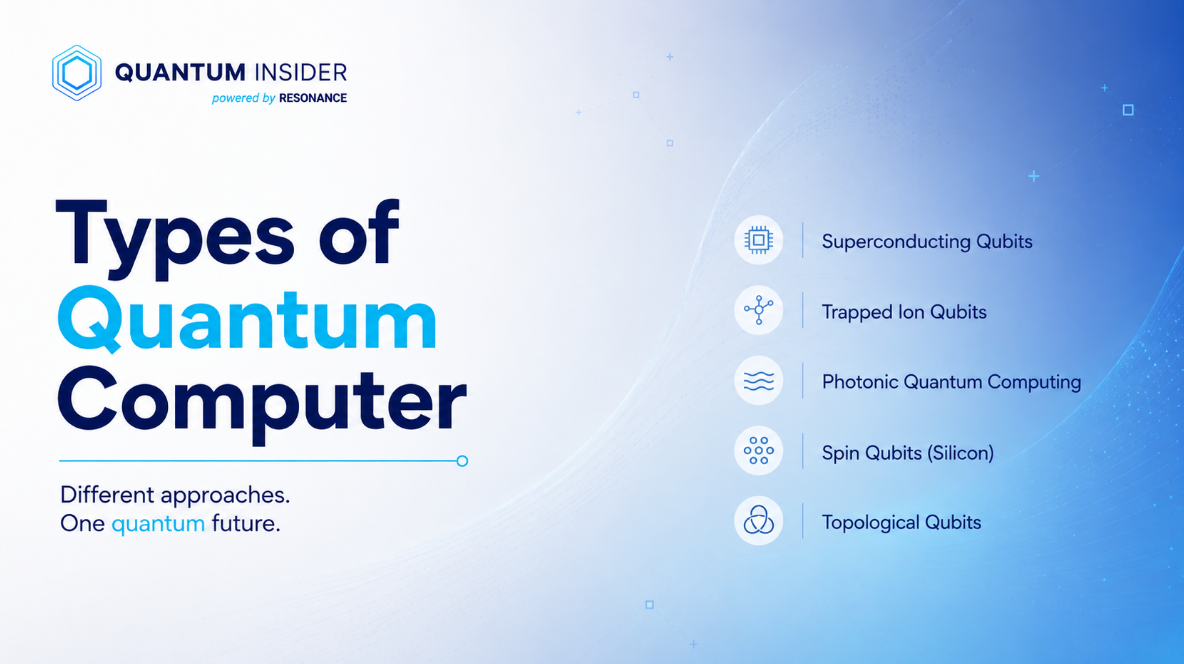
- Quantum computing hardware approaches vary widely, with superconducting, trapped-ion, photonic, neutral-atom, topological and annealing systems making different engineering trade-offs.
- Superconducting and trapped-ion systems are among the most commercially developed approaches, while neutral atoms and photonics are advancing toward larger-scale applications.
- Topological quantum computing remains experimental and contested, while quantum annealers target optimization problems rather than general-purpose quantum algorithms.
IBM and IonQ use very different physical systems to build quantum computers. IBM uses superconducting circuits that must be cooled to extremely low temperatures, while IonQ traps charged atoms using electromagnetic fields. Both approaches can create and control quantum states, but they come with different engineering challenges.
Building a useful qubit is difficult because it needs to maintain its quantum state, be controlled and measured accurately, and interact with other qubits. Different hardware approaches make different trade-offs to achieve these requirements.
That is why qubit count alone does not tell the full story. A system with 1,000 noisy qubits may be less useful for some tasks than a system with 50 more reliable qubits. Factors such as error rates, gate speed, coherence time, connectivity, and how easily the hardware can be manufactured also matter.

This article examines the major types of quantum computers, the trade-offs between their hardware approaches, and where each could be most useful.
And before we move on. It’s worth noting that the companies named throughout this article are included as illustrative examples of each hardware approach, not as an exhaustive list or a ranking. Omission of a company does not reflect its progress or standing in the field.
Superconducting Qubits
Superconducting qubits are built from electrical circuits cooled to approximately 15 millikelvin, colder than deep space. At these temperatures, certain materials conduct electricity with zero resistance, and the circuit exhibits quantum behavior. The qubit’s two states correspond to different quantum configurations of electrical current or charge in that circuit.
IBM, Google, and Rigetti all use this approach. D-Wave also builds superconducting qubits, running both an annealing platform and, since its 2026 acquisition of Quantum Circuits, a separate gate-model program based on a dual-rail architecture.The fabrication process is compatible with existing semiconductor manufacturing techniques, meaning superconducting qubits can be patterned onto silicon wafers using established chip processes. This gives the approach a potential manufacturing advantage as systems scale.
The trade-off is a short coherence time, typically measured in microseconds. Adding more qubits also increases the engineering challenges around control electronics, wiring, and heat management.
In December 2024, Google’s Willow chip demonstrated below-threshold error correction, confirming on real hardware that adding physical qubits to an error correction code reduces logical error rates. IBM’s roadmap targets its Starling system in 2029, designed to demonstrate 200 logical qubits and 100 million quantum gate operations, a threshold IBM describes as the entry point for early fault-tolerant quantum advantage on specific problems.
TQI’s overview of quantum chip companies maps the full landscape of superconducting and other hardware builders.
Trapped Ion Quantum Computers
Trapped ion quantum computers remove an electron from individual atoms to give them a net electrical charge, then hold those ions suspended in vacuum chambers using electromagnetic fields. Laser beams manipulate the ions’ internal energy states to encode and process quantum information.
IonQ and Quantinuum both use trapped ions. Because the qubits are individual atoms of the same element, they are naturally identical, avoiding some of the manufacturing variation found in solid-state qubits. This helps trapped-ion systems achieve high gate fidelity.
Trapped-ion gates typically operate in microseconds rather than the nanoseconds common in superconducting systems, but the qubits can maintain coherence for much longer and have low error rates. In October 2025, IonQ reported 99.99% two-qubit gate fidelity in a prototype. Similarly, in March 2026, Quantinuum reported computations using 94 error-protected logical qubits, with the work achieving beyond-break-even performance.
Scaling is the main challenge. Adding more ions to a single trap makes the system harder to control. Connecting multiple traps to build larger systems adds communication overhead between modules. TQI’s guide to trapped-ion quantum computing companies covers the current hardware landscape in detail.
Photonic Quantum Computers
Photonic quantum computers encode quantum information in properties of individual photons, such as polarization, path, or arrival time. Optical components including beam splitters and phase shifters route and transform photon states to perform operations.
Photons interact weakly with their environment. This is both the approach’s main advantage and its central challenge. Weak interaction means photons resist decoherence and can travel through standard optical fiber with low loss, making photonic systems a natural fit for quantum networking. It also means photons are difficult to entangle with each other, which complicates two-qubit gate operations essential for general computation.
Many photonic components can operate at room temperature, although single-photon detectors typically still require cooling. Xanadu and PsiQuantum are two of the leading companies developing photonic quantum computers. In June 2025, Xanadu demonstrated on-chip generation of GKP states, an error-correctable approach to encoding photonic qubits, on a silicon nitride chip. The company listed on Nasdaq in March 2026. PsiQuantum closed a $1 billion Series E in September 2025 and is targeting a fault-tolerant system by 2029 using silicon photonic chips manufactured at GlobalFoundries.
TQI’s guide to photonic quantum technology companies in 2026 covers the full landscape of companies and approaches within this category.
Neutral Atom Quantum Computers
Neutral atom quantum computers trap uncharged atoms using focused laser beams called optical tweezers and encode qubits in the atoms’ energy states. Because neutral atoms carry no electrical charge, the electromagnetic trapping methods used for ions do not apply. The atoms can also be rearranged during computation, allowing different connectivity patterns for different algorithms.
When excited to high-energy configurations called Rydberg states, neutral atoms interact with nearby atoms over short distances, enabling two-qubit operations. QuEra and Atom Computing are the leading commercial companies in this space. In September 2025, a Caltech team demonstrated a 6,100-qubit neutral atom array using cesium atoms, with 13-second coherence times and 99.98% control fidelity. The demonstration was conducted in a research setting, but it showed how neutral atom systems could scale to large arrays.
The approach is less mature than superconducting and trapped-ion systems. Controlling individual atoms precisely while scaling to large arrays is difficult. Atoms that escape their optical traps must be replenished during computation, adding operational complexity.
Topological Quantum Computers
Topological quantum computers encode information in global properties of a quantum system. Because local disturbances cannot easily change this information, the approach could provide greater protection against some types of errors and reduce the need for active error correction.
The approach relies on exotic quasiparticles called Majorana zero modes, whose existence in usable form has been the subject of sustained scientific debate. In February 2025, Microsoft announced its Majorana 1 chip, claiming eight topological qubits on a chip designed to scale to one million. The announcement faced significant community scrutiny, with physicists questioning the verification methods used to identify the relevant quasiparticles.
Similarly, in June 2026, Microsoft reported results from its Majorana 2 processor, replacing aluminum with lead in its superconducting material stack. The change more than doubled the topological gap protecting quantum states and improved parity lifetimes from milliseconds to over 20 seconds. The results were presented amid continued debate within the physics community.
The potential benefit is substantial if topological qubits can be demonstrated and controlled at scale. Their built-in resistance to certain errors could reduce the number of physical qubits needed to create logical qubits, potentially by a large margin. Whether this advantage can be achieved in practical systems remains an open question.
Quantum Annealers
Quantum annealers work differently from gate-based quantum computers. Gate-based systems run algorithms through sequences of quantum operations, while annealers encode optimization problems into the energy landscape of a quantum system and allow it to evolve toward a low-energy state. Quantum tunneling can help the system move away from local energy minima that may trap classical optimization methods.
D-Wave is the primary commercial quantum annealing company. Its Advantage2 system has more than 4,400 qubits, but these qubits cannot run general-purpose algorithms such as Shor’s or Grover’s. Instead, they are designed for optimization problems. D-Wave has applied its systems to areas including logistics scheduling, financial portfolio optimization, and materials discovery. In March 2025, D-Wave claimed quantum supremacy on a real-world simulation problem, a result the company says has gone unchallenged, though demonstrating consistent quantum speedup over the best classical methods remains an open challenge across practical use cases. D-Wave also runs a separate gate-model program, discussed in the superconducting section above.
It’s worth noting that, Quantum annealers serve a different role from gate-based systems. They may be relevant for organizations exploring specific optimization problems, while gate-based quantum computers are the focus for general quantum algorithms.
Key Differences Between Quantum Computer Types
| Approach | Gate Speed | Coherence Time | Maturity | Key Advantage | Key Challenge |
| Superconducting | Fast (nanoseconds) | Microseconds | High | Speed, manufacturing | Decoherence, cooling |
| Trapped Ion | Slow (microseconds) | Seconds | High | High fidelity, connectivity | Scaling, speed |
| Photonic | Fast | Long (low decoherence) | Medium | Networking, room temperature | Photon interactions, loss |
| Neutral Atom | Medium | Reasonable | Medium | Scalability potential | Control at scale |
| Topological | Unknown | Potentially very long | Low (experimental, contested) | Error resistance | Unproven at scale |
| Quantum Annealer | N/A (different model) | Short | High (for optimization) | Qubit count | Limited to optimization |
Which Approach Will Win?
One of the most heated debates in quantum computing is over which hardware approach will ultimately win. Superconducting qubits, trapped ions, neutral atoms, photonics, topological qubits, and quantum annealers all take different routes to the same broad goal, but each comes with its own strengths and limitations.
There may not be a single winner. Different approaches could prove better suited to different applications, with some focused on general-purpose computation, others on networking or specialized optimization problems.
Superconducting and trapped-ion systems are among the most commercially developed today. Neutral atoms are being explored for larger systems, photonics has strong ties to quantum networking, quantum annealers target specific optimization problems, and topological qubits remain at an earlier stage. The more likely outcome may be a quantum computing industry with several hardware approaches serving different use cases rather than one technology replacing all the others.
For readers looking to go deeper, TQI’s overview of trapped-ion quantum computing companies covers the modality currently holding the gate fidelity lead; photonic quantum technology companies in 2026 maps the full photonics landscape; and the companies building quantum computing chips in 2026 covers the hardware manufacturing ecosystem across all modalities.
Frequently Asked Questions
What are the main types of quantum computers?
The main types are superconducting qubits, trapped ions, photonic systems, neutral atoms, and topological qubits, each using a different physical system to represent quantum information. Quantum annealers are a separate category designed specifically for optimization rather than general computation. Each approach involves different trade-offs in speed, error rates, coherence time, and scalability.
Which type of quantum computer is best?
No single type is best across all dimensions. Superconducting qubits offer fast operations and manufacturing advantages. Trapped ions provide higher fidelity and longer coherence. Photonic systems suit quantum networking. Neutral atoms have demonstrated scaling potential. The best choice depends on the application and which technical challenges prove easiest to solve for that specific use case.
What is the difference between quantum annealers and gate-based quantum computers?
Gate-based quantum computers run algorithms through sequences of quantum gates and can perform general-purpose computation, including algorithms like Shor’s and Grover’s. Quantum annealers encode optimization problems into energy states and let the system evolve toward the lowest-energy solution, exploiting quantum tunneling to search for optimal configurations. Annealers cannot run general quantum algorithms. They are specialized tools for optimization.
Why are there so many types of quantum computers?
Building a qubit requires competing properties: isolation from the environment to prevent decoherence, but accessibility for control and measurement; long coherence times, but fast operations; uniformity at manufacturing scale, but precision in individual qubit control. No physical system satisfies all of these requirements optimally. Each approach trades one property for another, and the field has not yet identified which trade-off will prove most tractable for large-scale quantum computing.
What are topological qubits?
Topological qubits encode information in global properties of a quantum system rather than local particle states. Local disturbances that cause errors in conventional qubits cannot change globally encoded information, which could provide inherent error protection. Microsoft has pursued this approach for over a decade using Majorana zero modes. In February 2025, the company announced its Majorana 1 chip, followed by Majorana 2 results in June 2026 showing a more than 1,000-fold improvement in topological qubit parity lifetimes. The claims have faced significant community scrutiny, and the approach remains earlier stage than superconducting or trapped-ion systems.
Do different quantum computers require extreme cooling?
Superconducting qubits require cooling to approximately 15 millikelvin using dilution refrigerators. Trapped ions operate in vacuum chambers but the qubits themselves do not require millikelvin temperatures. Neutral atoms also operate in vacuum at temperatures well above millikelvin. Photonic processors operate at room temperature for many components, though single-photon detectors typically still require cooling. Quantum annealers also require cooling to near absolute zero using dilution refrigerators, operating at temperatures comparable to superconducting qubit systems.







![Quantum Circuits [acquired by D-Wave]](https://s3.us-east-2.amazonaws.com/tqd.s3.bucket/logos_medium/Quantum-Circuits.jpg)