


Insider Brief
- Microsoft reported that its Majorana 2 processor achieved topological qubit lifetimes exceeding 20 seconds, more than 1,000 times longer than earlier devices, supporting its goal of building a scalable quantum computer by 2029.
- The company improved performance by replacing aluminum with lead in its superconducting material stack and redesigning the semiconductor structure, more than doubling the topological gap that helps protect qubits from errors.
- The results, published amid continued scrutiny of Microsoft’s topological quantum computing approach, were presented as evidence that larger topological gaps can significantly improve qubit stability and support future fault-tolerant quantum systems.
Microsoft is reporting that it has achieved a more than 1,000-fold improvement in the stability of its topological qubits, a result the company argues brings its long-debated quantum computing approach significantly closer to practical machines and supports a roadmap targeting a scalable quantum computer by 2029.
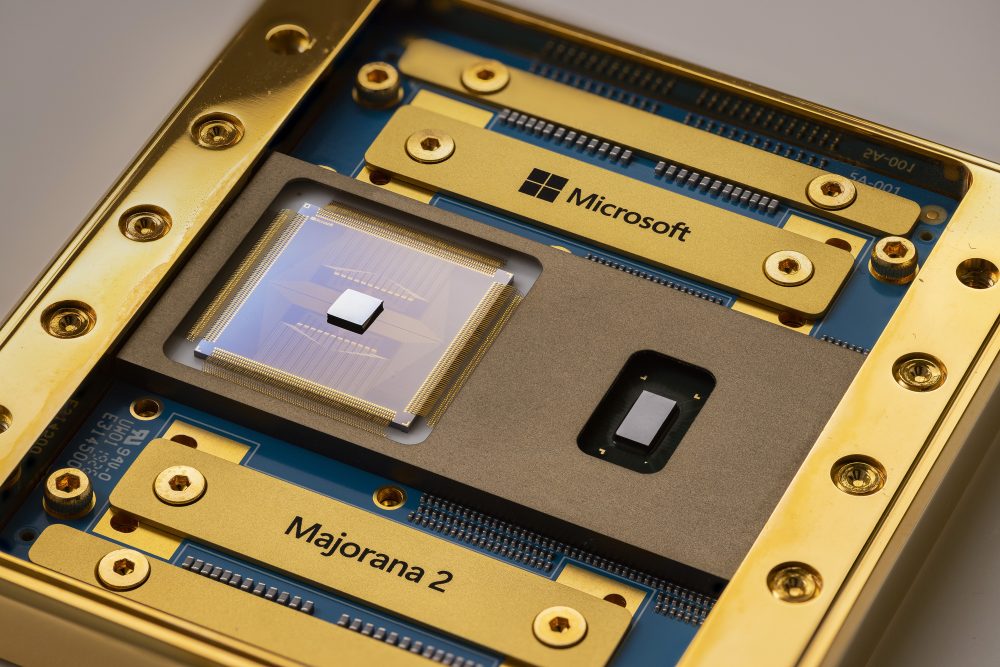
The announcement, detailed in a Microsoft technical paper and accompanying blog post, centers on a new quantum processor called Majorana 2. The device replaces key materials used in the company’s earlier Majorana 1 processor and demonstrates quantum-state lifetimes exceeding 20 seconds, with some measurements surpassing one minute. Those figures are dramatically longer than the microsecond-scale operations needed to perform quantum computations.
The quantum community will likely scrutinize these results because Microsoft’s topological quantum computing strategy has met with considerable criticism. The company has spent nearly two decades pursuing Majorana-based qubits, a path that differs fundamentally from the superconducting, trapped-ion and photonic architectures pursued by most competitors. The approach has attracted both interest and skepticism from physicists because it depends on creating and controlling exotic quantum states known as Majorana zero modes.

Last year, Microsoft’s Majorana 1 announcement prompted extensive discussion within the physics community over the evidence supporting the existence and behavior of those states. The latest paper focuses less on proving the existence of Majorana modes and more on demonstrating engineering progress in devices designed to exploit them.
“We took a step back and said ‘OK, let’s invent the transistor for the quantum age. What properties does it need to have?’” said Chetan Nayak, Microsoft technical fellow. “And that’s really how we got here – it’s the particular combination, the quality and the important details in our new materials stack that have enabled a new kind of qubit and ultimately our entire architecture.”
The company reports that increasing the energy gap protecting a quantum state can sharply reduce errors and improve performance. If it holds, the results would validate a central premise of topological quantum computing: .
A Shift From Aluminum to Lead
The most significant change in Majorana 2 is the replacement of aluminum with lead as the superconducting material in the processor’s hybrid semiconductor-superconductor structure.
According to the paper, lead provides a substantially larger superconducting gap than aluminum. That larger gap makes it more difficult for environmental disturbances to generate unwanted excitations that can disrupt quantum information.
Microsoft also redesigned the semiconductor portion of the device, using a combination of indium arsenide and indium arsenide antimonide grown on a gallium antimonide substrate. Researchers said the revised material stack increases spin-orbit coupling and reduces disorder within the device, both important factors for maintaining topological quantum states.
The paper reports that the topological gap protecting the quantum states more than doubled compared with earlier devices. Researchers measured topological gaps of approximately 70 microelectronvolts in the new platform, compared with roughly 30 microelectronvolts in previous aluminum-based devices.
While those numbers sound small in the classical world, in the quantum world, those material improvements can translate into dramatic gains in qubit stability.
In earlier Majorana-based devices, parity lifetimes — a key measure of how long quantum information remains intact — ranged from roughly one to 12 milliseconds. In Majorana 2, parity lifetimes exceeded 20 seconds and occasionally reached minute-long durations. The researchers reported a characteristic parity lifetime of about 22 seconds.
That figure is particularly important because parity flips represent one of the primary error mechanisms in Microsoft’s architecture. A longer parity lifetime means quantum information remains protected for much longer periods before an error occurs.
Building Qubits Around Measurements
Unlike many quantum computing systems that manipulate qubits through sequences of analog control operations, Microsoft’s architecture relies heavily on measurements.
The company’s topological qubits are built from structures known as tetrons. Each tetron consists of two superconducting nanowires designed to host Majorana zero modes at their ends.
Information is stored in the parity of electrons within these structures, meaning whether they contain an even or odd number of electrons. Instead of directly manipulating the quantum state, operations are performed by measuring that parity.
Those measurements produce digital outputs of 0 or 1 and can be combined to perform quantum computations and error-correction procedures.
Microsoft reports that this measurement-based design offers advantages for scaling because it naturally supports digital control and quantum error correction. Because quantum information is so fragile, many experts view error correction as one of the most important requirements for building useful quantum computers.
The new processor also introduces an rf-based tuning technique that allows researchers to characterize low-energy states using radio-frequency measurements rather than traditional transport experiments.
According to the paper, the method provides measurement precision down to roughly one microelectronvolt and is intended to support automated tuning of larger arrays of qubits.
That capability could become increasingly important as systems grow from a handful of devices to processors containing many qubits.
Implications for Fault-Tolerant Quantum Computing
Fault-tolerant quantum computers use error correction to continuously detect and fix mistakes while calculations are running.
While holy grail is used too much in all scientific fields, most experts would lean on that term to express their views that fault tolerance is the threshold separating experimental quantum devices from systems capable of solving commercially valuable problems.
Microsoft reports in their communications about Majorana 2 that the combination of longer parity lifetimes, larger topological gaps and reduced energy splitting between Majorana states substantially suppresses the dominant error mechanisms affecting its architecture.
The paper reports that parity switching times are now more than seven orders of magnitude longer than typical qubit operation times. In practical terms, that means millions of operations could occur before a parity error is expected.
“Whatever you’re doing in the quantum space needs to have a path to a million qubits. If it doesn’t, you’re going to hit a wall before you get to the scale at which you can solve the really important problems that motivate us,” Nayak said. “We have actually worked out a path to a million.”
Researchers also reported that low-energy states remained stable across extended operating regions, suggesting the devices may be easier to tune and operate than earlier generations.
The architecture described in the paper is based on a scalable “unit cell” design that can be replicated into larger arrays without fundamentally changing control or readout methods.
Important to note that the current device still remains far from a commercially useful quantum computer. The paper describes a prototype multi-tetron structure rather than a large-scale processor. Researchers acknowledge that significant work remains to preserve device performance while scaling to larger systems.
Future efforts will focus on increasing array size, further reducing residual error mechanisms and demonstrating increasingly sophisticated error-correction operations.
DARPA Evaluation Adds External Scrutiny
Microsoft reports that its progress is also being evaluated through the Defense Advanced Research Projects Agency’s Quantum Benchmarking Initiative.
The company is one of only two organizations advanced to the final phase of DARPA’s Underexplored Systems for Utility-Scale Quantum Computing program, which evaluates whether emerging quantum architectures can plausibly achieve utility-scale performance.
The program includes participation from organizations such as the Air Force Research Laboratory, Los Alamos National Laboratory, Lawrence Livermore National Laboratory, Oak Ridge National Laboratory and Johns Hopkins Applied Physics Laboratory.
Microsoft said DARPA previously assessed the company’s architectural designs and engineering plans before advancing it to the final stage of evaluation.
That external review process provides an additional layer of scrutiny at a time when claims across the quantum computing industry are increasingly being measured against concrete milestones rather than theoretical roadmaps.
A Faster Timeline Than Much of the Industry
Based on the Majorana 2 results, Microsoft said it has cut its projected development timeline in half and now aims to deliver a scalable quantum computer by 2029.
If achieved, that target would place Microsoft among the most aggressive timelines in the industry.
Many quantum hardware companies continue to frame fault-tolerant quantum computing as a goal that could take well into the next decade, with timelines often stretching into the 2030s. Microsoft now indicates that recent progress in materials engineering, device fabrication and AI-assisted design has accelerated development enough to compress that schedule significantly.
The paper is quite technical — and I put this together quickly. For a deeper, more technical dive, please review the company’s paper. It’s important to note that this technical paper allows the Microsoft researchers to receive quick feedback on their work. However, it is not — nor is this article, itself — official peer-review publications. Peer-review is an important step in the scientific process to verify results.