Caltech Team Sets Record with 6,100-Qubit Array


Insider Brief
- Caltech researchers have built the largest neutral-atom qubit array to date, assembling 6,100 cesium qubits with lasers and maintaining long coherence times and high control accuracy.
- The team demonstrated that scaling up to thousands of qubits did not compromise quality, achieving superposition lifetimes of 13 seconds and 99.98 percent control fidelity.
- The results show neutral-atom systems as a strong candidate for large-scale, error-corrected quantum computers, with next steps focused on entanglement and full quantum computations.
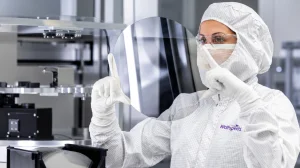
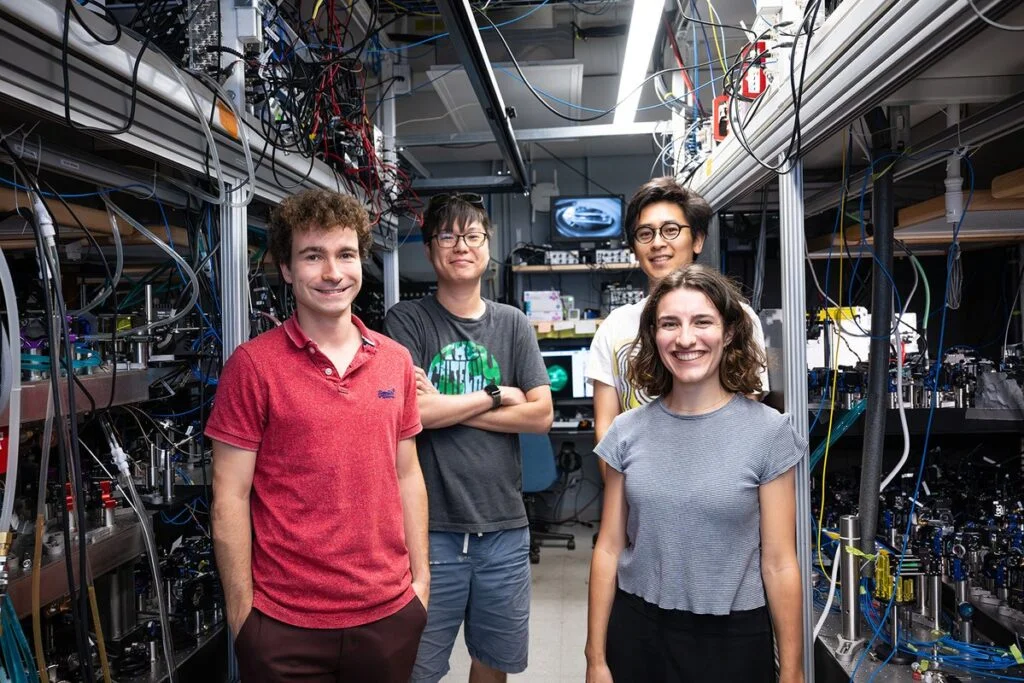
- Image: Elie Bataille, Kon H. Leung, Gyohei Nomura, and Hannah Manetsch in a lab at Caltech. (Caltech/Lance Hayashida)
PRESS RELEASE — Quantum computers will need large numbers of qubits to tackle challenging problems in physics, chemistry, and beyond. Unlike classical bits, qubits can exist in two states at once—a phenomenon called superposition. This quirk of quantum physics gives quantum computers the potential to perform certain complex calculations better than their classical counterparts, but it also means the qubits are fragile. To compensate, researchers are building quantum computers with extra, redundant qubits to correct any errors. That is why robust quantum computers will require hundreds of thousands of qubits.
Now, in a step toward this vision, Caltech physicists have created the largest qubit array ever assembled: 6,100 neutral-atom qubits trapped in a grid by lasers. Previous arrays of this kind contained only hundreds of qubits.
This milestone comes amid a rapidly growing race to scale up quantum computers. There are several approaches in development, including those based on superconducting circuits, trapped ions, and neutral atoms, as used in the new study.

“This is an exciting moment for neutral-atom quantum computing,” says Manuel Endres, professor of physics at Caltech. “We can now see a pathway to large error-corrected quantum computers. The building blocks are in place.” Endres is the principal investigator of the research published today in Nature. Three Caltech graduate students led the study: Hannah Manetsch, Gyohei Nomura, and Elie Bataille.
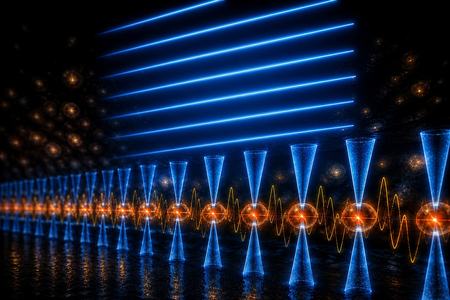
The team used optical tweezers—highly focused laser beams—to trap thousands of individual cesium atoms in a grid. To build the array of atoms, the researchers split a laser beam into 12,000 tweezers, which together held 6,100 atoms in a vacuum chamber. “On the screen, we can actually see each qubit as a pinpoint of light,” Manetsch says. “It’s a striking image of quantum hardware at a large scale.”
A key achievement was showing that this larger scale did not come at the expense of quality. Even with more than 6,000 qubits in a single array, the team kept them in superposition for about 13 seconds—nearly 10 times longer than what was possible in previous similar arrays—while manipulating individual qubits with 99.98 percent accuracy. “Large scale, with more atoms, is often thought to come at the expense of accuracy, but our results show that we can do both,” Nomura says. “Qubits aren’t useful without quality. Now we have quantity and quality.”
The team also demonstrated that they could move the atoms hundreds of micrometers across the array while maintaining superposition. The ability to shuttle qubits is a key feature of neutral-atom quantum computers that enables more efficient error correction compared with traditional, hard-wired platforms like superconducting qubits.
Manetsch compares the task of moving the individual atoms while keeping them in a state of superposition to balancing a glass of water while running. “Trying to hold an atom while moving is like trying to not let the glass of water tip over. Trying to also keep the atom in a state of superposition is like being careful to not run so fast that water splashes over,” she says.
The next big milestone for the field is implementing quantum error correction at the scale of thousands of physical qubits, and this work shows that neutral atoms are a strong candidate to get there. “Quantum computers will have to encode information in a way that’s tolerant to errors, so we can actually do calculations of value,” Bataille says. “Unlike in classical computers, qubits can’t simply be copied due to the so-called no-cloning theorem, so error correction has to rely on more subtle strategies.”
Looking ahead, the researchers plan to link the qubits in their array together in a state of entanglement, where particles become correlated and behave as one. Entanglement is a necessary step for quantum computers to move beyond simply storing information in superposition; entanglement will allow them to begin carrying out full quantum computations. It is also what gives quantum computers their ultimate power—the ability to simulate nature itself, where entanglement shapes the behavior of matter at every scale. The goal is clear: to harness entanglement to unlock new scientific discoveries, from revealing new phases of matter to guiding the design of novel materials and modeling the quantum fields that govern space-time.
“It’s exciting that we are creating machines to help us learn about the universe in ways that only quantum mechanics can teach us,” Manetsch says.
The new study, “A tweezer array with 6100 highly coherent atomic qubits,” was funded by the Gordon and Betty Moore Foundation, the Weston Havens Foundation, the National Science Foundation via its Graduate Research Fellowship Program and the Institute for Quantum Information and Matter (IQIM) at Caltech, the Army Research Office, the U.S. Department of Energy including its Quantum Systems Accelerator, the Defense Advanced Research Projects Agency, the Air Force Office for Scientific Research, the Heising-Simons Foundation, and the AWS Quantum Postdoctoral Fellowship. Other authors include Caltech’s Kon H. Leung, the AWS Quantum senior postdoctoral scholar research associate in physics, as well as former Caltech postdoctoral scholar Xudong Lv, now at the Chinese Academy of Sciences.

Keep track of everything going on in the Quantum Technology Market. In one place.
Topics

Matt Swayne
With a several-decades long background in journalism and communications, Matt Swayne has worked as a science communicator for an R1 university for more than 12 years, specializing in translating high tech and deep tech for the general audience. He has served as a writer, editor and analyst at The Quantum Insider since its inception. In addition to his service as a science communicator, Matt also develops courses to improve the media and communications skills of scientists and has taught courses.
[email protected]

Stay Ahead of Quantum
Get the latest research, company news, and market intelligence every week.
MENTIONED IN THE ARTICLE

California Institute of Technology
The California Institute of Technology, situated in Pasadena, California, is a private research university. It has played a crucial role in numerous contemporary scientific breakthroughs and stands alongside a select few technology institutes in the United States that prioritize teaching in pure and applied sciences.
→

U.S. Department of Energy (DOE)
The mission of the Department of Energy is to ensure America's security and prosperity by addressing its energy, environmental, and nuclear challenges through transformative science and technology solutions. In September, 2022, Research supported by ASCR demonstrated that classical machine learning algorithms can accurately predict ground state properties and classify quantum phases of matter using data generated from quantum experiments. In November, 2022, Research supported by Q-NEXT revealed that the performance of a sensor network is constrained by the intrinsic noise associated with the quantum states used in the network. In March, 2023, Research funded by DOE SC NP achieved the first experimental observation of entanglement between dissimilar particles, specifically positive and negative pions. In August, 2023, Research funded by DOE SC BER demonstrated strong preservation of entanglement in a two-photon absorption process involving organic molecules, offering a new approach for developing quantum light-based spectroscopy and microscopy.
→

Defense Advanced Research Projects Agency (DARPA)
The Defense Advanced Research Projects Agency (DARPA) is an independent research and development agency within the U.S. Department of Defense (DoD) established in 1958 to prevent and create strategic technological surprises for national security. Operating with a relatively small staff of program managers who are empowered to take high-risk, high-reward approaches, DARPA functions by funding cutting-edge research in academia, industry, and government laboratories rather than conducting research in-house. Its mission focuses on creating revolutionary technologies—such as the Internet (ARPANET), stealth technology, GPS, and mRNA vaccine platforms—that transition into practical military and civilian applications. DARPA programs are typically finite in duration and demand transformational breakthroughs rather than incremental improvements, positioning the U.S. at the forefront of technological innovation.
→

Chinese Academy of Sciences
The Chinese Academy of Sciences (CAS) is China's academic institution and research organization in natural sciences, technological innovation, and high-tech development. Established in 1949, CAS operates under the State Council and plays a crucial role in national strategic research and policy advising. It oversees a vast network of research institutes, universities, and enterprises that contribute to China's scientific and technological advancements, particularly in aerospace, quantum technology, artificial intelligence, and biotechnology. CAS is responsible for significant breakthroughs in quantum communication, space science, and high-performance computing, including the launch of the Micius (Mozi) satellite, the world’s first quantum communication satellite. It also leads China’s participation in global scientific collaborations and fosters innovation through partnerships with universities and industries.
→