


Insider Brief
- Researchers experimentally demonstrated a new superconducting circuit architecture that reproduces a key gauge symmetry proposed for future topological quantum computing systems.
- The device validated the fundamental building block of a theoretical architecture that could eventually support topologically protected quantum states when assembled into larger lattices.
- The research team included scientists from the University of Chicago, Purdue University, Boston University and AppliedTQC.
Researchers have experimentally demonstrated a new type of superconducting quantum circuit that reproduces a long-predicted gauge symmetry believed to be a key ingredient for future topological quantum computers, according to a recent study.
The researchers report this marks an early but significant step toward hardware designed to protect quantum information through its underlying physics rather than error correction alone.
The study, posted as a preprint on arXiv by researchers led by University of Chicago scientists, presents what the team calls a “non-planar qubit” built from a crossbar array of Josephson junctions. While the device is not itself a topological qubit, the researchers say it experimentally validates the fundamental building block of a broader architecture that could eventually support topologically ordered quantum states and new forms of quantum simulation.

Topological quantum computing has long attracted interest because it promises qubits that are naturally resistant to certain types of noise. Rather than encoding information in a single physical device, topological approaches store quantum information in collective states spread across many interacting elements, making them inherently more difficult to disturb. However, realizing such systems experimentally has proven challenging.
The new work addresses one of those foundational challenges by showing that an engineered superconducting circuit can realize an exact mathematical symmetry that theorists have long argued is necessary for constructing more complex topological phases.
“This work initiates a general program exploring lattice gauge theories using the toolbox of circuit quantum electrodynamics,” the researchers write in the study. “More broadly, introducing non-planar Josephson connectivities opens a vast space for experimental and theoretical exploration of structures in almost any imaginable dimensionality and geometry.”
Moving Beyond Planar Superconducting Circuits
Currently, leading superconducting quantum computers from companies including IBM and Google are built from planar circuits in which Josephson junctions connect neighboring superconducting elements on a flat chip.
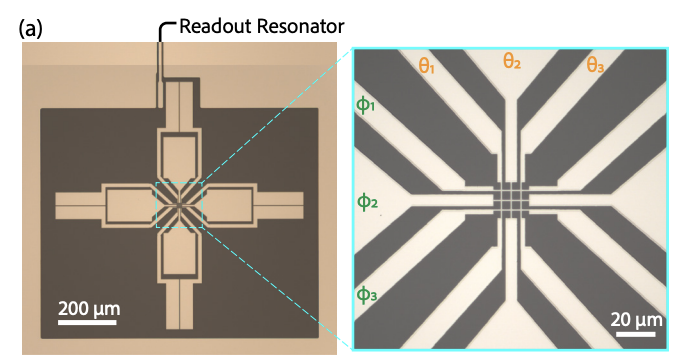
The new design departs from that convention by constructing a three-by-three “crossbar” array in which three horizontal superconducting wires intersect three vertical wires, instead of limiting each superconducting node to nearby connections. The arrangement creates nine Josephson junctions and allows interactions that conventional planar layouts cannot achieve.
The resulting device the researchers dubbed a waffle grid.
According to the researchers, this geometry enables a mathematical property known as “Z₃ combinatorial gauge symmetry” when the circuit is exposed to a carefully tuned magnetic field. To break this down, gauge symmetry refers to transformations that leave the underlying physics unchanged, while the Z₃ designation reflects a three-state symmetry rather than the two-state symmetries more commonly encountered in superconducting circuits.
Although highly mathematical, the concept may have practical significance, the researchers indicate. Previous theoretical work predicted that if many of these “waffle” circuits were connected into a larger honeycomb lattice, the resulting system could exhibit a quantum spin liquid—a highly entangled state of matter that has been proposed as a platform for topological quantum computing.
Until now, however, the basic building block had never been experimentally demonstrated.
Testing the Building Block
The researchers fabricated the device using aluminum Josephson junctions on a silicon substrate and embedded it inside a microwave resonator similar to those widely used to read out superconducting qubits.
By applying an external magnetic field and measuring how the circuit absorbed microwave signals, the team mapped its quantum energy spectrum across a range of operating conditions.
In particular, the circuit behaved exactly as theory predicted at a specific magnetic field, settling into six equivalent low-energy states instead of one. The researchers also observed the expected changes in the circuit’s energy levels as it moved between those states, providing additional evidence that the device was behaving as designed.
To interpret the measurements, the team combined the experiments with numerical simulations based on neural-network variational Monte Carlo methods. Unlike traditional numerical approaches, these machine-learning techniques can efficiently describe complicated quantum systems with many interacting degrees of freedom.
The researchers reported that the experimentally measured spectra closely agreed with the neural-network calculations, giving them confidence that the circuit behaved as the theoretical model predicted.
The agreement also allowed the team to distinguish which features arose from ordinary oscillations within individual energy wells and which reflected quantum tunneling between different states of the system.
A Foundation Rather Than a Finished Qubit
Rather than demonstrating a practical topological qubit, the work validates one component that could eventually become part of a much larger architecture.
The experiment examines only a single “waffle” operating in what physicists describe as the semiclassical regime, where quantum tunneling between energy minima remains relatively weak.
A practical topological quantum computer would require many such building blocks connected into an extended lattice capable of supporting collective quantum states across the entire system.
The researchers report that will make an ideal next stage of development.
“The natural next step is to build devices deep in the quantum regime and tile many such waffles into a honeycomb lattice, where the interplay of inter-vertex couplings and charge fluctuations should give rise to the fully interacting Z₃ quantum double with its topologically ordered ground state,” they write in the paper.
Only after demonstrating that larger lattice could researchers begin investigating whether it supports protected quantum states suitable for computation.
To offer an analogy, this work might be similar to demonstrating the operation of a new type of transistor before building an integrated circuit from millions of them.
Implications Beyond Quantum Computing
Although topological quantum computing may offer obvious motivation, the researchers report that the architecture could find broader uses.
Because the crossbar geometry allows interactions that are difficult or impossible to realize in conventional superconducting circuits, it could become a platform for studying a variety of complex quantum systems.
Among the potential applications are quantum simulations of lattice gauge theories, frustrated magnetic materials and exotic topological phases that are otherwise difficult to investigate experimentally.
The work also illustrates an emerging trend in superconducting quantum hardware.
Rather than focusing solely on incremental improvements to existing transmon qubits, some researchers are exploring fundamentally different circuit geometries that embed desirable physical properties directly into the hardware. If successful, such approaches could reduce the burden on quantum error correction by making quantum states inherently more robust.
For a deeper, more technical dive, please review the paper on arXiv. It’s important to note that arXiv is a pre-print server, which allows researchers to receive quick feedback on their work. However, it is not — nor is this article, itself — official peer-review publications. Peer-review is an important step in the scientific process to verify results.
The research team included Muqing Yu, Hengli Lo, Vishvesha Sridhar, Nadya Mason and Andrew P. Higginbotham, of the University of Chicago; Han Bi, Guilherme Delfino and Claudio Chamon, of Purdue University; and Dmitry Green, of Boston University and AppliedTQC, a New York-based quantum computing company.