Quantinuum and GE Vernova Collaborate to Advance High-Temperature Superconductivity Research


Insider Brief
- Quantinuum and GE Vernova’s Advanced Research Center are collaborating to use quantum computing to study electron behavior associated with high-temperature superconductivity and explore potential energy applications.
- The research will combine Quantinuum’s Helios quantum computer and software tools with GE Vernova’s materials expertise to investigate interacting electrons using the simplified Fermi–Hubbard model.
- Better understanding of superconductivity could inform the development of smaller electrical equipment and higher-capacity power infrastructure, though cooling, manufacturing, material performance and cost remain barriers.
PRESS RELEASE — Quantinuum and GE Vernova’s Advanced Research Center are launching a collaboration to apply quantum computing to one of the research community’s most consequential challenges: understanding the behavior behind high-temperature superconductivity. Advances in this field could, over the long term, transform the energy sector by enabling lighter generators, more compact and powerful motors, and electricity infrastructure that carries more power and better withstands faults.
The research will focus on Fermi–Hubbard modeling, a framework for studying how interacting electrons give rise to complex material properties. By combining Quantinuum’s full-stack quantum computing capabilities—including access to the company’s Helios computer—with GE Vernova’s expertise in material science and engineering simulation applied to industrial applications, the collaboration will bring an industry perspective to a promising area of quantum research.
Why superconductors matter for energy

As energy systems grow, the size, weight, and performance of electrical equipment become increasingly important constraints. High-temperature superconductors offer potential ways to address those limits through their ability to carry large electrical currents without resistance under suitable operating conditions.
Potential applications span power generation, electricity grids, and industrial electrification. Superconducting generators could reduce the weight and footprint of industrial equipment. Superconducting windings could also help make utility generators and industrial or marine propulsion motors more compact and efficient. In electricity networks, superconducting cables could carry more power through constrained spaces, while fault current limiters could help protect equipment during short circuits.
Realizing those benefits more widely depends on overcoming challenges in cooling, material performance, manufacturing, and cost. Better understanding of the physics behind high-temperature superconductivity could help inform the search for materials with more practical operating characteristics.
Why quantum computing may offer new tools for understanding high-temperature superconductivity
High-temperature superconductivity involves the collective behavior of strongly interacting electrons. Accurately modeling these systems is exceptionally difficult: the interactions that make them scientifically interesting also make important aspects of their behavior computationally challenging.
The Fermi–Hubbard model captures essential features of those interactions in a simplified mathematical framework. Although it is not a complete description of a material used in industrial applications, it provides a foundation for investigating mechanisms associated with high-temperature superconductivity.
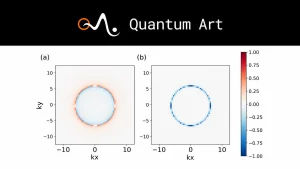
Quantum computing offers a promising way to explore the physics. Quantinuum researchers have already measured superconducting pairing correlations—including s-wave and d-wave pairing—in Fermi–Hubbard models simulated on the Helios quantum computer. These results demonstrate the ability to prepare and probe quantum states relevant to superconductivity research, establishing a foundation for further investigation.
The collaboration with GE Vernova will build on that foundation, bringing industrial expertise to the selection and interpretation of research questions.
Connecting quantum capabilities with industrial expertise
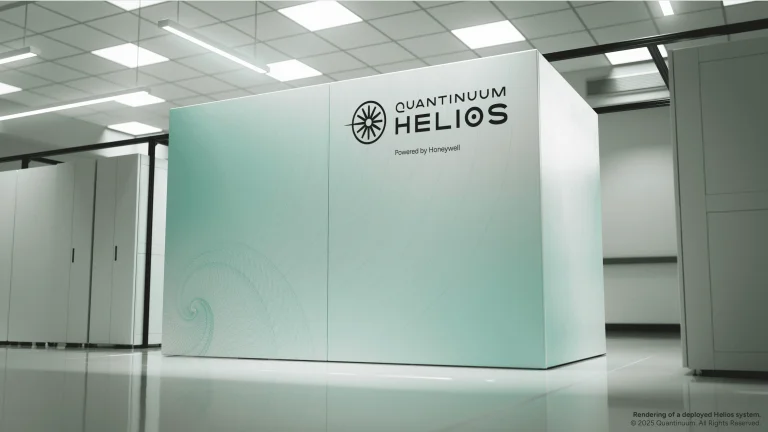
The research will be enabled through access to Quantinuum’s full-stack capabilities, including cloud-based access to Helios, the world’s most accurate quantum computer[1], and Nexus, Quantinuum’s developer platform. Nexus connects quantum hardware with the software tools researchers need to develop and run applications in a unified environment.
GE Vernova’s Advanced Research Center brings the expertise in material science, engineering, and industrial applications to the research and development activity.
“High-temperature superconductors could help us overcome important limits on the size, weight, and efficiency of electrical equipment, but understanding and improving these materials remains a significant scientific challenge,” said Jonathan Owens, PhD, Senior Scientist, Computational Materials Physics at GE Vernova. “By combining our materials simulation and industrial expertise with Quantinuum’s quantum computing capabilities, we can explore new approaches to these difficult problems while building the expertise to assess where quantum computing can make a meaningful contribution.”
The collaboration also extends GE Vernova’s exploration of quantum computing into a new area of materials research while supporting the development of its internal quantum talent. Its previous published work includes investigations of quantum algorithms for carbon-capture materials using simulated quantum processors.
Building toward industrial value
Translating insights from simplified models into practical materials requires sustained scientific and engineering work. Industrial expertise helps connect that effort to the properties, operating conditions, and manufacturing considerations that ultimately determine a material’s usefulness.
For Quantinuum, this collaboration is an opportunity to advance quantum simulation with an industrial collaborator that understands both the potential applications and the barriers to adoption. It brings together demonstrated computing capabilities, a challenging materials problem, and the expertise needed to connect scientific progress with industrial requirements.
The research collaboration aims to deepen understanding of this field and explore how quantum computing may contribute to future energy technologies.
[1] Based on two-qubit gate fidelity as of December 31, 2025.

Keep track of everything going on in the Quantum Technology Market. In one place.
Topics

Matt Swayne
With a several-decades long background in journalism and communications, Matt Swayne has worked as a science communicator for an R1 university for more than 12 years, specializing in translating high tech and deep tech for the general audience. He has served as a writer, editor and analyst at The Quantum Insider since its inception. In addition to his service as a science communicator, Matt also develops courses to improve the media and communications skills of scientists and has taught courses.
[email protected]

Stay Ahead of Quantum
Get the latest research, company news, and market intelligence every week.
MENTIONED IN THE ARTICLE

Quantinuum
Quantinuum builds full-stack quantum computing solutions for practical deployment. Leveraging proprietary enhancements to trapped-ion QCCD architecture, the company has launched multiple commercial hardware generations that deliver leading two-qubit gate fidelity and industry-topping accuracy.
→

GE
General Electric Company is an American multinational conglomerate. The company's innovation arm, GE Global Research, is responsible for creating, developing, and transforming new ideas into products that contribute to a better world. The products developed by GE Global Research cover a broad range of industries, including aviation, power, transportation, and healthcare, and are part of GE's extensive industrial portfolio.
→