QuEra, Harvard and Anthropic Use AI to Reduce Quantum Circuit Resource Requirements


Insider Brief
- Researchers from QuEra Computing, Harvard University and Anthropic used Claude to design quantum circuits that reduce gate counts and qubit requirements across seven of eight computational building blocks.
- The research reported a 12-fold reduction in Toffoli gates for a Reed-Solomon decoder, a 9.9-fold reduction in combined resources for a Coulomb potential calculation, and a 39-fold reduction for a fixed-point Gaussian function.
- The team also developed a new reversible modular inversion approach that offers additional trade-offs between gate counts and qubit requirements.
PRESS RELEASE — QuEra Computing, the leader in fault-tolerant quantum computing, today highlighted research with Harvard University and Anthropic showing that AI can design quantum circuits that require fewer computational resources. The findings show how advances in algorithm design could expand what future fault-tolerant quantum computers can accomplish with a given hardware capacity.
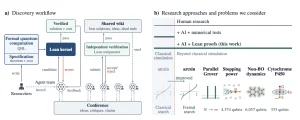
The research preprint, “Discovering state-of-the-art quantum circuits with large language models” (arXiv:2610.22367), examines eight computational building blocks used in larger quantum algorithms. In seven, AI-designed circuits reduced both gate counts and qubit requirements relative to the corresponding baseline designs. In the eighth, the search found a new approach that offers additional choices between qubit requirements and gate counts. The research, reflecting an industry-first collaboration of AI and Quantum market leaders, was led by Andi Gu as part of Anthropic‘s STEM Fellows Program, with Alek Kemeny of Anthropic, Susanne Yelin of Harvard, and Mikhail Lukin of Harvard and QuEra.
Useful quantum computing arrives where two curves meet. One is hardware capability, which rises as machines gain more qubits and more reliable operations. The other is the resources useful algorithms require, which fall as those algorithms are made more efficient. Progress on either curve moves the meeting point earlier; progress on both can bring valuable applications within reach sooner. This research addresses the second curve.

What the Paper Shows
The researchers paired Anthropic‘s Claude with an independent automated evaluator that checked each proposed circuit design for correctness and scored its resource use. Claude used that feedback to explore and improve its designs. The evaluator scored each design on two numbers: its Toffoli-gate count and its qubit count. Both numbers matter. Toffoli gates can account for a substantial share of the overhead in fault-tolerant computations, while logical qubits occupy valuable hardware capacity. Reducing both can lower the resources needed to execute a circuit, although the resulting runtime and physical hardware requirements depend on the system’s architecture. Selected results include:
- Optimization: The Reed-Solomon decoder, the most expensive step in decoded quantum interferometry (DQI), a promising quantum optimization algorithm, was significantly improved. AI achieved 12x fewer Toffoli gates, from 5.1 million to about 440,000, while also using fewer qubits.
- Chemistry: The Coulomb potential, the term that describes how charged particles interact when simulating molecules, was also optimized. AI achieved a 9.9x reduction in the combined resource metric, with Toffoli gates down from 6,355 to 1,140 and qubits from 252 to 142.
- Numerical computation: A fixed-point Gaussian function was also substantially changed. AI achieved a 39x reduction in the combined resource metric, the largest in the paper, with Toffoli gates down from about 24,000 to 1,583 and qubits from 362 to 139.
The combined metric multiplies the Toffoli-gate count by the peak number of logical qubits, so a 39x improvement in that metric is not a 39x speedup. These results are resource estimates for individual building blocks rather than runs on hardware, and their effect on complete applications will depend on how those components are used. Reducing what key components require can expand the problems a given system could tackle.
A New Subroutine Discovered by AI
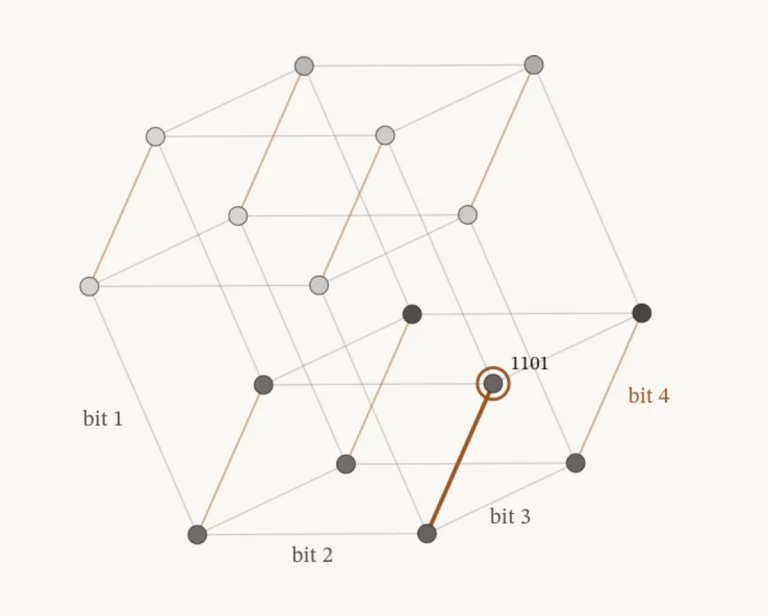
Beyond improving existing designs, Claude helped discover a new reversible approach to modular inversion, an arithmetic operation central to elliptic-curve calculations. The approach reconstructs much of the information normally stored during intermediate steps, creating new options for balancing gates against qubits. In the complete point-addition benchmark, one design required about 17x fewer gates than the prior design using the fewest qubits, while using about 12% more qubits.
“Reversibility makes many efficient classical methods costly to implement on quantum computers. What is exciting here is that AI, guided by a rigorous evaluator, found new circuit structures that work more efficiently within that constraint. This opens a promising path for discovering algorithms for large-scale, useful quantum computers, which QuEra, Anthropic, and Harvard will continue to uniquely collaborate on,” said Mikhail Lukin, Co-Founder and Chief Science Officer at QuEra and Joshua and Beth Friedman University Professor at Harvard University.
From Algorithm Discovery to Reliable Operation
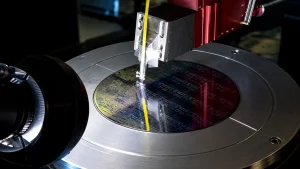
The findings build on QuEra‘s earlier pilot with Anthropic on laser control. Laser stability is a key requirement for reliable operation of QuEra’s quantum computers. In that pilot, Claude developed and validated control software that recovered the correct laser lock in 695 of 700 trials, in seconds rather than the 5 to 10 minutes a human expert needs; the resulting controller is conventional software that runs without the AI. Together, the projects show three roles for AI in quantum computing:
- Improving algorithms: the new circuit designs reduce resource requirements for computational building blocks used in quantum applications.
- Supporting reliable operation: automated relocking and AI-assisted tuning could reduce specialist intervention and simplify support for deployed systems.
- Developing control software: Claude wrote and validated laser-recovery software, demonstrating how AI can assist with demanding engineering tasks.
“The evaluator is what made this work. Because every design was independently checked and scored, Claude could pursue unconventional ideas and we could trust the ones that held up. That pairing of open-ended search with rigorous verification is a promising model for AI-assisted discovery well beyond quantum computing,” said Alek Kemeny, Member of Technical Staff, at Anthropic.
What It Means for the Industry and for Users
QuEra is building fault-tolerant quantum computers for real work, with Libra targeted for availability on Amazon Braket in 2028. Research like this is part of why QuEra pursues hardware and algorithms together.
Algorithm improvements can profoundly change the hardware needed for useful quantum computing. Successive advances reduced the estimated Toffoli-gate count for one widely studied FeMoco simulation by roughly 150,000 times over eight years. This study suggests AI could accelerate parts of that research process: a 53-hour search, guided by researcher-defined requirements and an automated evaluator, produced the new elliptic-curve circuit approach. The results point toward faster exploration of designs that could make future quantum applications less demanding.
“Customers need both capable hardware and algorithms that make the effective use of it. Just as large language models transformed language, where meaning depends on context, AI is now transforming quantum circuit design, where an improvement in one place often pays off only when the rest of the design is rethought along with it. Combined with advances in hardware, AI-driven reductions in the resources required for the most important computations expand what future fault-tolerant systems can deliver,” said Takuya Kitagawa, President of QuEra Computing.
Learn More
- Explore QuEra‘s roadmap: quera.com/our-quantum-roadmap
- Read the preprint: arxiv.org/abs/2610.22367
- Read Anthropic‘s account of the research: anthropic.com/research/designing-efficient-quantum-circuits
- Read QuEra‘s blog post, AI Is Cutting the Cost of Quantum Algorithms: quera.com/blog-posts/ai-is-cutting-the-cost-of-quantum-algorithms
- Read the earlier collaboration, Holding the Light: quera.com/blog-posts/holding-the-light-teaching-an-ai-to-lock-and-tune-our-quantum-computers-lasers

Keep track of everything going on in the Quantum Technology Market. In one place.
Topics

Mohib Ur Rehman
Covering quantum and emerging technologies, Mohib explores the intersection of technology, security, and society. His work also frequently examines surveillance infrastructure and the institutions shaping the digital world. In addition to his work at The Quantum Insider, he co-runs SK NEXUS, an independent technology publication that helps readers understand the technologies shaping their lives.

Stay Ahead of Quantum
Get the latest research, company news, and market intelligence every week.
MENTIONED IN THE ARTICLE

QuEra Computing
QuEra Computing uses research on neutral atoms, developed at Harvard University and the Massachusetts Institute of Technology, as the basis for a scalable, programmable quantum computer solution. QuEra’s quantum processing technology is based on trapping, energizing, and shuttling atoms with laser beams.
→

Harvard University
Harvard University, located in Cambridge, Massachusetts, is a private Ivy League research institution. Established in 1636 under the name Harvard College and in honor of its initial supporter, clergyman John Harvard, it holds the distinction of being the oldest higher education institution in the United States. Its global reputation, financial resources, and rankings have positioned it as one of the world's most esteemed universities.
→

Anthropic
Anthropic is an American artificial intelligence (AI) safety and research company known for developing the Claude family of large language models (LLMs). Founded in 2021 by former OpenAI executives, the company focuses on creating reliable, interpretable, and steerable AI systems, often utilizing a "Constitutional AI" training approach to prioritize safety and ethical guidelines.
→