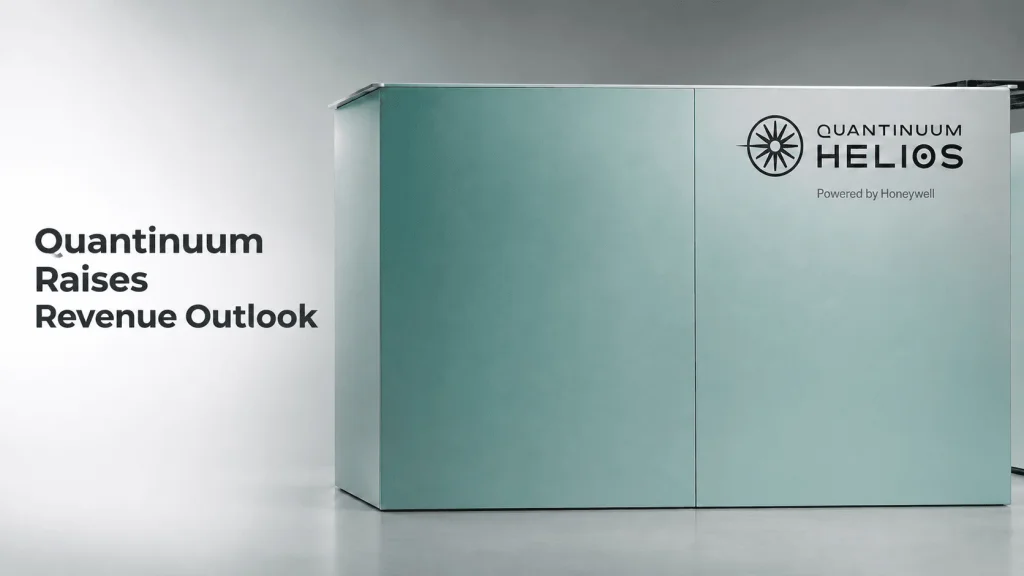
Quantinuum Raises Revenue Outlook After Landing Its Largest Cloud Agreement


Insider Brief
- Quantinuum reported third-quarter revenue of $9.1 million, up 233% from a year earlier, and raised its full-year revenue forecast to between $31 million and $34 million.
- The company secured its largest cloud agreement, including access through its planned Apollo system, while Nexus adoption reached 215 organizations.
- Quantinuum reported improved quantum error-correction accuracy and maintained its 2029 Apollo target, while its quarterly net loss widened to $118 million from $52 million.
PRESS RELEASE — Quantinuum secured its largest cloud agreement and raised its annual revenue forecast as customers committed to using future generations of its quantum computers, according to a statement from the company.
The multiyear extension with a leading global financial institution includes committed access through Apollo, the system Quantinuum plans to introduce in 2029, and Nexus, its software platform for developing and running quantum applications.
The deal accompanied broader commercial growth, according to the statement with third-quarter revenue reaching $9.1 million, up 233% from $2.7 million a year earlier. Quantinuum increased its full-year revenue outlook to between $31 million and $34 million, from its previous range of $28 million to $32 million.

The company also reported growing software use and new agreements in pharmaceuticals, energy and logistics, alongside technical results it said support its plan to deliver universal, fault-tolerant quantum computing in 2029. Such computers would correct errors during calculations, allowing them to run longer and tackle a wider range of problems reliably.
“In the third-quarter, we extended our technology leadership in the critical area of fault-tolerance, added to our customer base, and expanded our routes to market,” said Rajeeb Hazra, President and Chief Executive Officer of Quantinuum, in a statement. “This accelerated momentum is supporting our raised revenue outlook for 2026 and giving us more confidence than ever in the opportunity in front of us.”
As business expanded, Quantinuum also reported a quarterly net loss of $118 million, compared with $52 million a year earlier, and ended September with $1.94 billion in cash and cash equivalents.
Customers Commit to Future Systems
The financial institution’s cloud agreement mentioned above extends across Quantinuum’s hardware and software offerings, securing access through its planned Apollo generation.
Other commercial developments covered several industries. Quantinuum signed an agreement with another company it described as one of the world’s five largest pharmaceutical businesses to apply quantum computing and AI to materials used in cancer therapies. The work aims to support drug development and potentially more effective treatments, the company said.
An agreement with GE Vernova will focus on developing applications involving superconducting materials. Quantinuum also signed a deal with Abu Dhabi Maritime Academy and Quincus for research and applications in maritime logistics.
The company expanded its distribution through an agreement with an unnamed major cloud provider serving millions of developers. Separately, it launched a joint beta program with Oracle for applications combining quantum computing and AI.
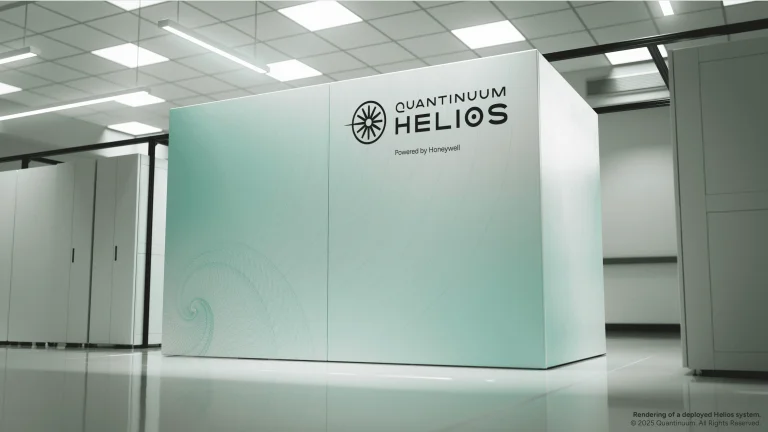
International installations also advanced. Assembly of a Helios system is underway in Singapore ahead of planned commissioning in spring 2027. An upgrade to the Reimei system at Japan’s RIKEN research institution is scheduled for completion in November, according to the company.
In the United States, Quantinuum said it continued work under its Stage B contract in the Defense Advanced Research Projects Agency’s Quantum Benchmarking Initiative and was discussing the scope of potential Stage C work. It also participated in four winning proposals in the first phase of the Department of Energy’s Genesis Mission.
Error-Correction Results Support Hardware Plans
Quantinuum reported successive results on its Helios computer in September and October set accuracy records and strengthened its plans for larger, more reliable systems.
The October result reached 99.9995% logical fidelity, a measure of how accurately protected quantum information performs in the reported test. Logical qubits combine physical quantum bits with error-correction methods to reduce mistakes.
According to Quantinuum, the October error rate was 10 times lower than its September record and 100 times lower than the best published result using other types of quantum hardware.
The company said the results used two error-correction codes within the same overall system design and reached accuracy within Apollo’s target range. They also supported its approach to limiting the additional hardware needed for error correction, Quantinuum said.
Those results are milestones toward its planned systems rather than delivery of the complete Apollo computer.
Sol, Quantinuum’s next planned system, remains on schedule for the second half of 2027. The company said it has completed full-scale validation of Sol’s control system and is targeting integration and assembly in the first quarter of 2027.
Further testing and tuning will aim for 100 logical qubits at a target logical error rate of one in 100,000.
Apollo remains scheduled for 2029. Quantinuum said it has validated that the system’s cooling equipment can operate at the required scale and strengthened its manufacturing plans through partnerships with GlobalFoundries, Infineon, Honeywell Aerospace and Monarch Quantum.
The company also finalized a CHIPS research and development award, saying it was the only trapped-ion company selected.
Software Use Rises Ahead of New Hardware
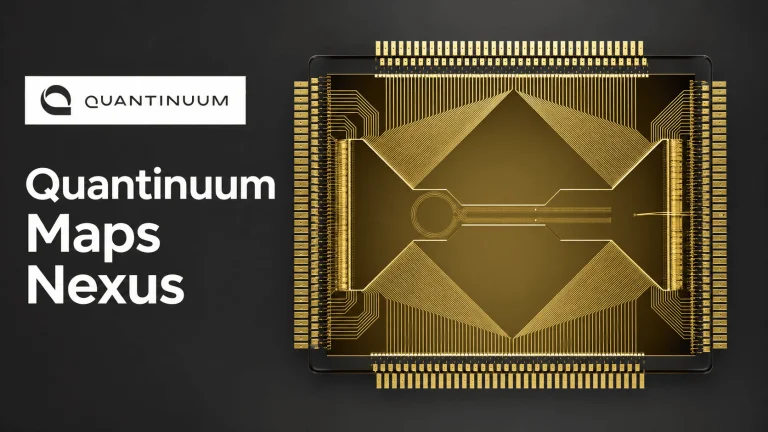
Quantinuum’s Nexus roadmap is intended to let customers develop applications that advance alongside successive hardware generations through Apollo.
Adoption grew nearly 20% from the preceding quarter to 215 organizations. Job submissions increased tenfold in the 12 months through August 2026 compared with the preceding 12-month period, the company said.
A September software release expanded Guppy programming tools for logical qubits and supported additional error-correction capabilities. Quantinuum said the changes reduce the need to rewrite applications for particular error-correction codes.
A planned December release will expand workflows that move work between quantum and conventional computers, add support for more error-correction codes and provide more information to help developers improve application performance.
Quantinuum also introduced QUOPS with Sandia National Laboratories and NVIDIA to assess useful computational scale and speed. The company said it is seeking broader agreement on a common benchmark that could help customers compare systems and make purchasing decisions.
Its Q-Net community grew to more than 800 members, while a global quantum challenge organized with Singapore’s National Quantum Office attracted more than 200 submissions.
Margins Improve While Losses Widen
Quantinuum’s gross margin, the share of revenue remaining after direct costs, improved to 33.3% from negative 43.5% a year earlier.
Adjusted gross margin was 74.6%, an increase of about 8.5 percentage points. That measure excludes certain costs included under generally accepted accounting principles.
The company’s adjusted loss before interest, taxes, depreciation and amortization widened to $80 million from $45 million a year earlier.
Net loss per share attributable to Class A common stockholders was 46 cents, while adjusted net loss per share was 29 cents.

Keep track of everything going on in the Quantum Technology Market. In one place.
Topics

Matt Swayne
With a several-decades long background in journalism and communications, Matt Swayne has worked as a science communicator for an R1 university for more than 12 years, specializing in translating high tech and deep tech for the general audience. He has served as a writer, editor and analyst at The Quantum Insider since its inception. In addition to his service as a science communicator, Matt also develops courses to improve the media and communications skills of scientists and has taught courses.
[email protected]

Stay Ahead of Quantum
Get the latest research, company news, and market intelligence every week.