How the Department of Commerce’s Quantum Awards Work and What Companies Give in Return


Insider Brief
- The U.S. Department of Commerce’s $2.013 billion CHIPS initiative proposed funding for nine companies to advance quantum computing research and expand domestic manufacturing, with minority government stakes planned as a condition of funding.
- The proposed awards ranged from up to $38 million for Diraq to up to $1 billion for IBM’s quantum foundry subsidiary, Anderon, with up to $375 million for GlobalFoundries and up to $100 million each for six other companies.
- SEC filings from Rigetti, D-Wave and Quantinuum show how three of the deals work, with shares issued upfront, later payments tied to milestones and provisions allowing Commerce to recover funding under specified conditions.
The U.S. Department of Commerce’s quantum computing awards combine research funding with government ownership, giving companies access to capital for specific engineering projects in exchange for shares and commitments governing how the work is completed.
Agreements disclosed in SEC filings by Rigetti Computing, D-Wave Quantum and Quantinuum show how the arrangement works. Each company secured an award of up to $100 million, with some funding available initially and the rest dependent on milestones. Each also issued the Commerce Department‘s shares calculated against the full potential award.
The funding and ownership follow different schedules. The Commerce Department received its shares when the transactions closed, while the companies must meet conditions to gain access to later payments. The agreements also give the department rights to recover money under specified circumstances and restrict the use and transfer of technology developed with federal support.

All of these deals put together offer a glimpse of how the Commerce Commerce is relying on research spending to pursue several objectives, including advancing quantum hardware, strengthening domestic manufacturing and giving taxpayers a financial interest in the companies receiving support.
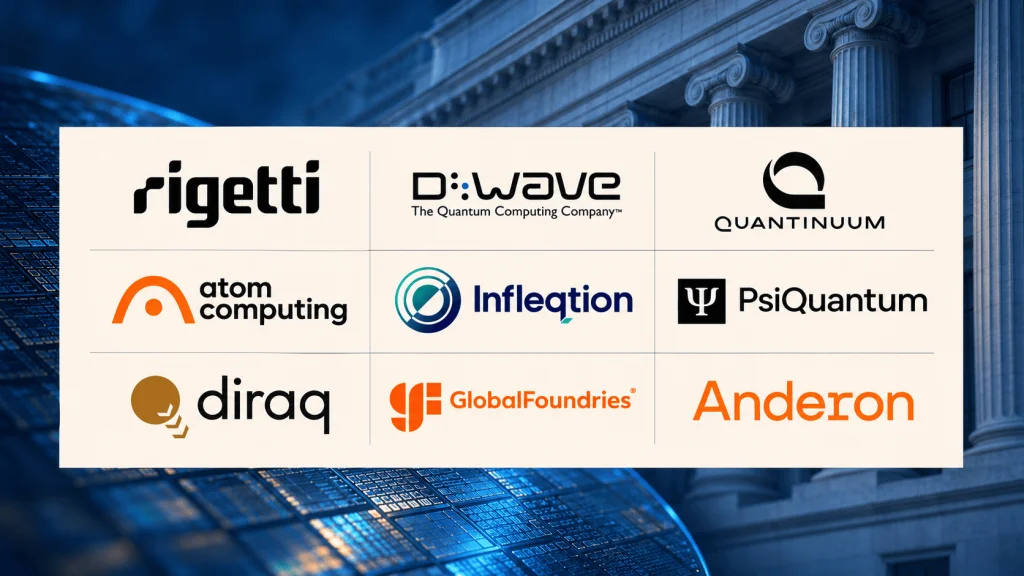
The three agreements represent part of a broader initiative announced May 21, when the department disclosed nine letters of intent covering $2.013 billion in proposed CHIPS and Science Act incentives.
The proposed funding included $1 billion for IBM’s quantum foundry subsidiary, Anderon, and $375 million for GlobalFoundries. Atom Computing, D-Wave, Infleqtion, PsiQuantum, Quantinuum and Rigetti were each allocated up to $100 million, while Diraq was allocated up to $38 million.
The Commerce Department reports that the portfolio spans several approaches to quantum computing, including superconducting circuits, trapped ions, neutral atoms, photonics and silicon spin qubits. The department said it would receive a minority, noncontrolling equity stake in each company as a condition of the funding.
A letter of intent establishes proposed terms. Final agreements set out the obligations governing the award.
Several recipients have since reached that stage. GlobalFoundries announced its final agreement Sept. 8, and Anderon announced its agreement Sept. 16. The department finalized PsiQuantum’s award Sept. 8 and Atom Computing’s on Nov. 13.
Rigetti, D-Wave and Quantinuum each disclosed their agreements in SEC filings, offering a detailed look at three deals in the broader CHIPS initiative. Each company secured up to $100 million, with some funding available initially and later payments tied to milestones. All three issued Commerce shares calculated against the full potential award.
It’s important to note, however, that the provisions of those agreements may not automatically apply to every recipient.
What the money supports
According to the Commerce Department, these projects target aspects of quantum computing such as control electronics, cooling capacity, chip fabrication and optical components — which are considered specific obstacles to building larger quantum computers.
Rigetti’s award supports three areas — namely, integrating and miniaturizing readout electronics — which measure qubit states, developing a new cryostat architecture to expand cooling capacity, and improving fabrication capabilities for chips with greater connectivity, according to its SEC filing.
Both readout electronics and cryostat systems — which maintain the extremely low temperatures required by superconducting processors — become more demanding as systems grow, making the surrounding equipment an important part of the scaling problem.
D-Wave’s project covers components, subsystems and prototypes for both annealing and gate-model superconducting quantum computers. Its agreement includes installing tools, fabricating prototype quantum processing units, integrating manufacturing processes, and calibrating and benchmarking larger processors.
This projects show that the work reaches beyond individual chip designs to the equipment and processes needed to build and evaluate them.
Quantinuum’s award addresses hardware for trapped-ion systems. Its projects include low-loss integrated photonics operating at 422 nanometers, specialized control chips designed for cryogenic operation, and reliable optical components at wavelengths needed by its trapped-ion technology, according to its filing.
In practical terms, the work concerns delivering light, controlling hardware and packaging components so they can operate reliably in larger systems.
Across the three awards, the emphasis seems to focus on engineering and manufacturing capabilities that support the processors.
How the funding is released
All research agreements were awarded as of Sept. 4 and the securities issuance agreements appear to follow Sept. 8.
Rigetti’s agreement made $43.9 million available initially, with two subsequent funding tranches of $29.9 million and $26.2 million tied to milestones, according to its SEC filing.
D-Wave’s agreement made about $53.6 million available initially. Later payments total approximately $9.1 million, $16.7 million and $20.4 million, with another $287,380 available in connection with the expected completion of all milestones.
Quantinuum’s initial funding availability was $56 million, followed by potential payments of $32 million and $12 million.
Those figures describe funding availability under the agreements, but they don’t necessarily establish whether the companies immediately withdrew or spent the money.
For example, in its third-quarter SEC filing, Quantinuum reported that it had drawn no award funding as of Sept. 30, even though its initial $56 million tranche had become available.
The agreements give The Commerce Department discretion to determine whether the required work meets the applicable criteria, so later funding may depend on project milestones and related conditions..
The project periods generally end when all milestones are completed or five years after the award date, whichever comes first, unless extended or terminated earlier. Parts of the technical milestones and schedules are redacted in the public agreements, limiting outside assessment of the precise requirements.
The funds are also restricted to eligible project costs consistent with approved budgets. Rigetti’s research agreement, for example, requires money withdrawn through the federal payment system to be spent or applied to eligible costs within 30 days. Unused amounts must be returned.
The headline award amount is therefore a ceiling on conditional project support.
What The Commerce Department receives
The companies issued the full blocks of shares associated with their potential $100 million awards when the equity transactions closed.
Rigetti issued 7,739,938 shares at an implied price of $12.92 per share, according to its quarterly SEC filing. D-Wave issued 7,095,721 shares at $14.093 per share, according to its amended SEC filing. Quantinuum issued 2,369,528 Class A shares at a contractual price of $42.20 per share, according to its quarterly report.
Those prices determine how many shares the Commerce Department receives. They do not guarantee the shares’ subsequent market value.
The pricing formulas also incorporated discounts. Under the terms disclosed in Rigetti’s May SEC filing, the company used the lowest closing price across three specified dates connected with the negotiations and award, discounted by 15%.
Quantinuum’s formula used the lower of its IPO price discounted by 20% or its award-date closing price discounted by 15%, according to its September filing.
Issuing shares to the Commerce Department can reduce existing investors’ percentage ownership. Quantinuum reported that Commerce acquired its shares on Sept. 9, but the company excluded them from its third-quarter earnings-per-share calculation because it had drawn no award funds as of Sept. 30.
For taxpayers, there’s a risk-reward tradeoff. The shares provide potential exposure to growth in the companies’ value, but they also expose the government’s holdings to falling stock prices. The eventual financial return depends on the value the Commerce Department can realize from the shares and the funding ultimately disbursed.
Ownership restrictions?
Share ownership isn’t without restrictions and the Commerce Department’s stakes carry limits on both voting and sales.
Under Rigetti’s securities issuance agreement, the government generally cannot vote its shares on routine shareholder matters. Exceptions include specified changes to the stock’s capital structure or rights, and mergers, consolidations or similar transactions.
Transfer restrictions connect the Commerce Department‘s ability to sell shares with funding actually withdrawn and retained, according to the agreements. What that means is that, without the company’s consent, the department can sell only the portion of its stake corresponding to award funding the company has received and not returned. The department also cannot sell shares to a competitor in a privately negotiated transaction.
The companies granted registration rights intended to facilitate resale through securities filings and related procedures. Those rights operate alongside the contractual transfer limits, the SEC documents show.
The Commerce Department consequently has several roles in these transactions: shareholder, research funder and enforcer of the award conditions. Its financial interest does not give it unrestricted control over the companies.
What happens if a company misses its obligations
The agreements distinguish between conditions for receiving more money and obligations that can expose money already received to recovery.
D-Wave’s research agreement allows the DOC to demand repayment of all payments made if a required project activity is not completed by its deadline. Rigetti’s agreement contains a similar recovery provision, subject to applicable cure periods and forbearance provisions.
Quantinuum’s agreement permits recovery of disbursed funding for specified failures involving required project activities, research security, domestic control of intellectual property or domestic production. Other remedies can include withholding or suspending payments and imposing additional conditions, according to its SEC filing.
Repayment is therefore a possible contractual remedy, rather than an automatic consequence of every delay.
The equity treatment is particularly consequential. Quantinuum explicitly warns in its quarterly filing that the Commerce Department may retain the issued shares if milestone payments are withheld or previously disbursed funding is clawed back. Its ability to recover shares is confined to a limited repurchase provision.
A company could consequently receive less than the full award while remaining subject to dilution from the original issuance.
What happens if An award Ends?
The agreements also allow the Commerce to terminate funding for convenience, meaning it can end the arrangement without establishing a company breach.
D-Wave’s agreement provides for 60 days’ written notice. If the deparment terminates for convenience before the latest required project activity date, its specified right to recover payments for failure to complete those activities also ends.
The securities agreements provide a related mechanism for recovering some shares.
Rigetti’s agreement allows the company, following a qualifying termination for convenience, to repurchase for $1 in total the proportion of the Commerce Department’s shares associated with award money it never received or returned before applying it to eligible uses.
The provision is limited to specified circumstances and includes procedural deadlines. It does not establish a general right to reclaim shares whenever funding falls short of $100 million.
Termination, repayment and share repurchase are separate contractual mechanisms. Each depends on its own conditions.
The technology commitments extend beyond the funding
The government also receives rights connected with inventions developed through the projects.
The agreements include licenses permitting government use of funded inventions. Rigetti and D-Wave additionally disclose march-in rights, which can allow intervention in licensing under specified conditions. Rigetti warns that exercising those rights could give competitors access to funded technology on commercially reasonable terms.
Domestic production obligations can continue after the research ends. Quantinuum must predominantly produce, or license production of, covered inventions in the United States during the project and for 10 years afterward, subject to limited exceptions. Its agreement also restricts transfers of funded intellectual property to designated foreign countries and entities of concern, according to its SEC filing.
Security and compliance requirements add further obligations. Rigetti discloses annual research security certifications, third-party IT security assessments and technical and financial reporting.
These provisions connect federal support to where technology is developed, controlled and produced.
The awards’ results will emerge through those obligations as well as the research itself. Relevant measures include whether companies complete the funded engineering work, qualify for subsequent payments and establish the intended domestic capabilities. The headline commitments describe the available support; performance under the agreements will determine how much funding reaches the projects and what it produces.

Keep track of everything going on in the Quantum Technology Market. In one place.
Topics

Matt Swayne
With a several-decades long background in journalism and communications, Matt Swayne has worked as a science communicator for an R1 university for more than 12 years, specializing in translating high tech and deep tech for the general audience. He has served as a writer, editor and analyst at The Quantum Insider since its inception. In addition to his service as a science communicator, Matt also develops courses to improve the media and communications skills of scientists and has taught courses.
[email protected]

Stay Ahead of Quantum
Get the latest research, company news, and market intelligence every week.
MENTIONED IN THE ARTICLE
Department of Commerce
The U.S. Department of Commerce is a federal executive department responsible for creating the conditions for economic growth and opportunity in the United States. Through its 13 bureaus, it drives U.S. economic competitiveness, strengthens domestic industry, and supports job growth. The Department fosters innovation in emerging technologies, including quantum computing and artificial intelligence, and provides research and development resources through agencies such as NIST and NTIA.
→

Diraq
Diraq is a full stack quantum company which is building a quantum computer using silicon CMOS-based spin qubits.
→
IBM
IBM is an iconic technology pioneer founded in 1911 as the Computing-Tabulating-Recording Company and officially renamed International Business Machines Corporation in 1924. Beyond foundational computing, IBM possesses a deep legacy in aerospace and defense from building the guidance computers and Instrument Unit for NASA's historic Apollo missions to partnering with Airbus on CIMON, the first AI assistant on the ISS.
→

Anderon
Anderon is a quantum foundry initiative from IBM, focused on advancing large-scale quantum wafer fabrication in the United States. Leveraging decades of semiconductor research and quantum computing expertise, Anderon aims to catalyze domestic quantum manufacturing capabilities. The division specializes in 300mm wafer processes, advanced packaging, and scalable quantum hardware production, supporting applications across computing, sensing, and communications. By establishing a robust supply of quantum wafers, Anderon seeks to anchor a national quantum ecosystem and drive U.S. economic growth in the quantum industry.
→
GlobalFoundries
GlobalFoundries Inc. is a multinational semiconductor contract manufacturing and design company. It was established through the divestiture of AMD's manufacturing arm and is currently owned by Mubadala Investment Company, a sovereign wealth fund of the United Arab Emirates.
→

Rigetti Computing
Rigetti Computing develops integrated quantum computers and superconducting processors specialized for complex aerospace optimization and satellite communication tasks, including collaborations with the U.S. Air Force. Founded in 2013, the firm produces modular, multi-chip processors internally and provides cloud-based access for large-scale, complex simulations.
→

D-Wave Quantum
D-Wave Quantum is a pioneering dual-platform quantum computing company that partners with aerospace organizations to solve complex logistical, defense, and satellite challenges. Founded in 1999, the company’s quantum annealing technology is utilized by industry leaders like Lockheed Martin to optimize aircraft networks, improve manufacturing efficiencies, and support critical national security initiatives.
→

Quantinuum
Quantinuum builds full-stack quantum computing solutions for practical deployment. Leveraging proprietary enhancements to trapped-ion QCCD architecture, the company has launched multiple commercial hardware generations that deliver leading two-qubit gate fidelity and industry-topping accuracy.
→

Atom Computing
Atom Computing builds quantum computers using nuclear spin qubits formed from arrays of optically-trapped neutral atoms.
→

Infleqtion
Infleqtion, founded in 2007 at the University of Colorado Boulder, specializes in neutral atom quantum technology for the aerospace and defense sectors. The company is heavily involved in orbital infrastructure, notably supplying atomic clocks and contributing quantum sensors to NASA's Cold Atom Lab and the Quantum Gravity Gradiometer Pathfinder mission to enhance space navigation, timing, and Earth observation capabilities.
→

PsiQuantum
PsiQuantum is developing a utility scale fault tolerant quantum computer utilizing photonic qubits and standard semiconductor manufacturing processes. Founded in 2015, the company collaborates with aerospace partners like Airbus and Lockheed Martin on algorithms for fluid mechanics, aerodynamics, and impact modeling.
→