The Path to Quantum Advantage Is Built on Readiness, Not Hype, IBM Report Suggests


Insider Brief
- IBM’s Institute for Business Value reports that quantum computing is shifting from a science milestone to a strategic business-readiness challenge as organizations prepare for possible future quantum advantage.
- The report finds that early movers are focusing on practical use cases in aerospace, finance, energy, life sciences and manufacturing rather than abstract benchmarks.
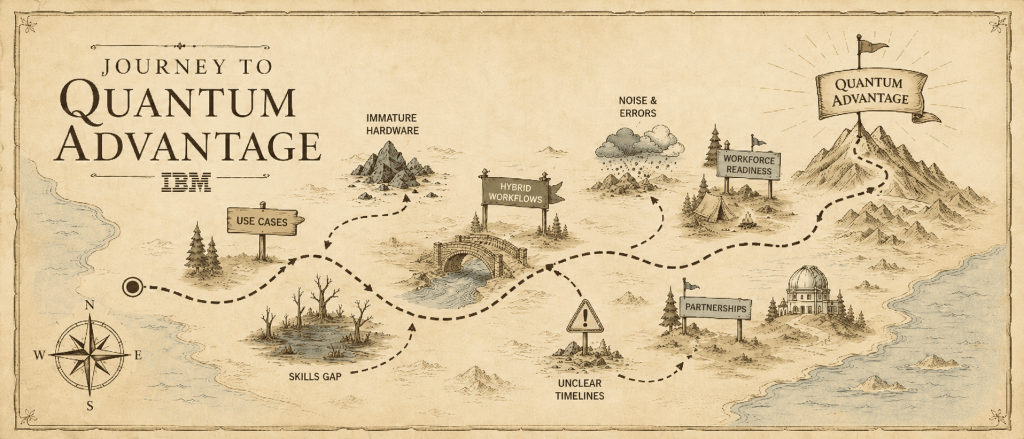
- IBM identifies skills shortages, immature technology and uncertain timelines as major barriers, while stressing that partnerships and ecosystems are becoming central to quantum preparation.
Quantum computing is entering a new phase, according to a recent report from IBM’s Institute for Business Value. The question is no longer whether organizations should pay attention to the technology. It is swiftly becoming how they should prepare for a future in which quantum systems may solve specific problems faster, more accurately or more efficiently than today’s most powerful classical computers.
The report, “Journey to Quantum Advantage,” draws on interviews with leaders from industries including aerospace, energy, finance, life sciences, manufacturing and higher education. Rather than focusing on hardware specifications or scientific milestones, the report examines how organizations are navigating the uncertainty surrounding an emerging technology whose timeline remains difficult to predict.
The experts report that quantum readiness has become a strategic discipline in its own right.

“Quantum computing stands at a pivotal moment,” the report says. “The science has moved decisively beyond theory: organizations are far along the path to quantum advantage, when quantum computers can run a computation more accurately, cheaply, or efficiently than any classical method.”
To add to the complexity of an already highly complex field, the analysts point out that there is no single definition of quantum advantage. The meaning depends heavily on the industry, use case and business objective involved.
From Technical Milestones to Commercial Uses
According to the report, many early movers in quantum are reframing quantum advantage in practical rather than purely scientific terms.
At Boeing, the focus is not on achieving an abstract computational benchmark. Instead, the aerospace giant evaluates whether quantum methods could improve how it designs and certifies aircraft.
“The only way to talk about quantum advantage is in the context of a particular, precise definition of an application or use case,” Dr. Jay Lowell, Principal Senior Technical Fellow at Boeing, says in the report. “It should mark a transition point to a new way of doing something because of accuracy or speed, for example.”
For Boeing, potential applications include quantum chemistry and materials science. But the company approaches those opportunities cautiously knowing that any computational method that contributes to aircraft design must ultimately be explainable, validated and certifiable.
That requirement — which reflects a theme that emerges across the report — is shared by other organizations that appear increasingly willing to explore quantum computing, but they want evidence that it can solve meaningful problems.
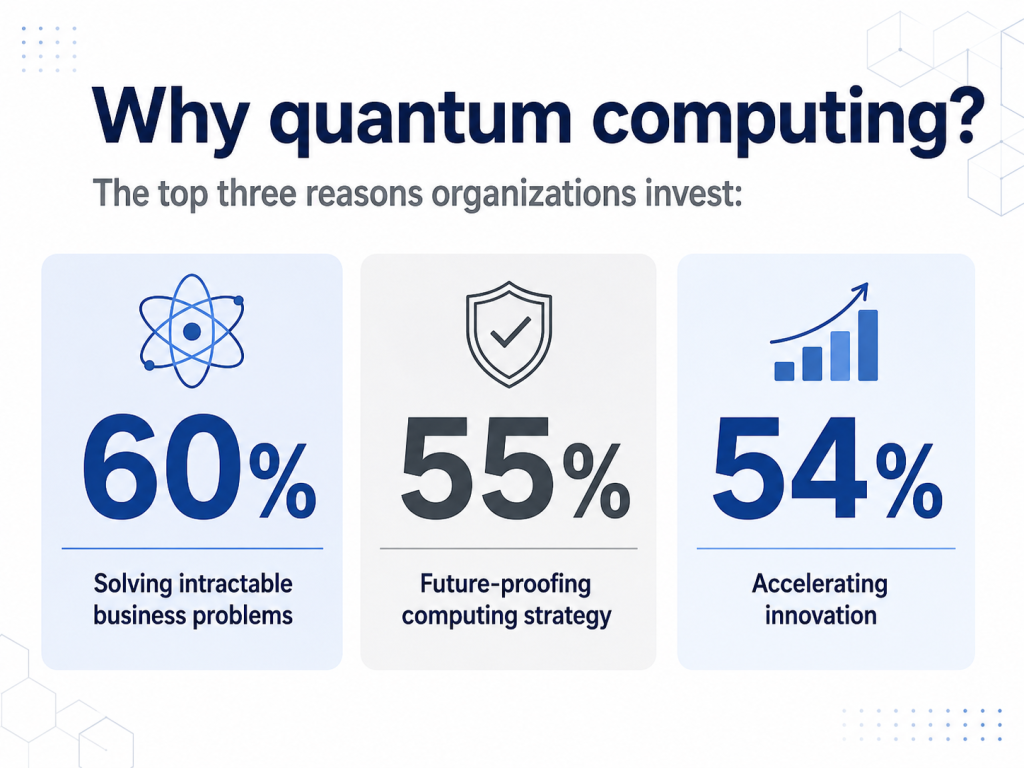
The report indicates that the top reasons organizations invest in quantum computing are solving intractable business problems, future-proofing computing strategies and accelerating innovation.
Prep First, Then Payoff
IBM carefully selected the organizations in the report not because they have already achieved quantum advantage, but because they are investing in preparation.
Vanguard, for example, launched its quantum efforts in 2022 with the goal of understanding whether hybrid quantum-classical methods could eventually address difficult financial problems. The investment firm’s research team explored applications including anti-money laundering, risk modeling and portfolio optimization.
“For us, quantum advantage only matters if it’s usable,” Bimal Mehta, Vanguard’s Chief Research Scientist for Emerging Technologies, said, echoing a theme in the report. “A demonstration of advantage in physics or chemistry is impressive, but the real question is whether it helps us solve problems that matter to our clients. If advantage allows us to deliver better portfolio outcomes, better risk management, or a better client experience, then it’s meaningful. Otherwise, it’s just a technology milestone.
Organizations increasingly appear to be treating quantum computing as a long-term capability-building exercise rather than a near-term source of disruption. The strategy involves cultivating internal expertise, identifying promising use cases and developing relationships with technology partners.
According to IBM’s findings, inadequate quantum skills represent the largest barrier to adoption, cited by 61% of respondents. Immature technology followed at 56%, while unclear timelines for practical use cases ranked third at 46%.
Those numbers illustrate a tension confronting many organizations. They recognize the technology’s potential but remain uncertain about when significant returns might materialize.
Managing expectations
The report also provides a candid assessment of how organizations are adjusting expectations as the realities of quantum development become clearer.
E.ON, one of Europe’s largest energy companies, offers one example.
The company initially pursued a series of proof-of-concept projects involving optimization, quantum machine learning and scenario modeling. While those efforts highlighted quantum’s potential, they also exposed limitations related to qubit counts, noise levels and circuit depth. As those constraints became more apparent, rather than abandon efforts, E.ON recalibrated its roadmap.
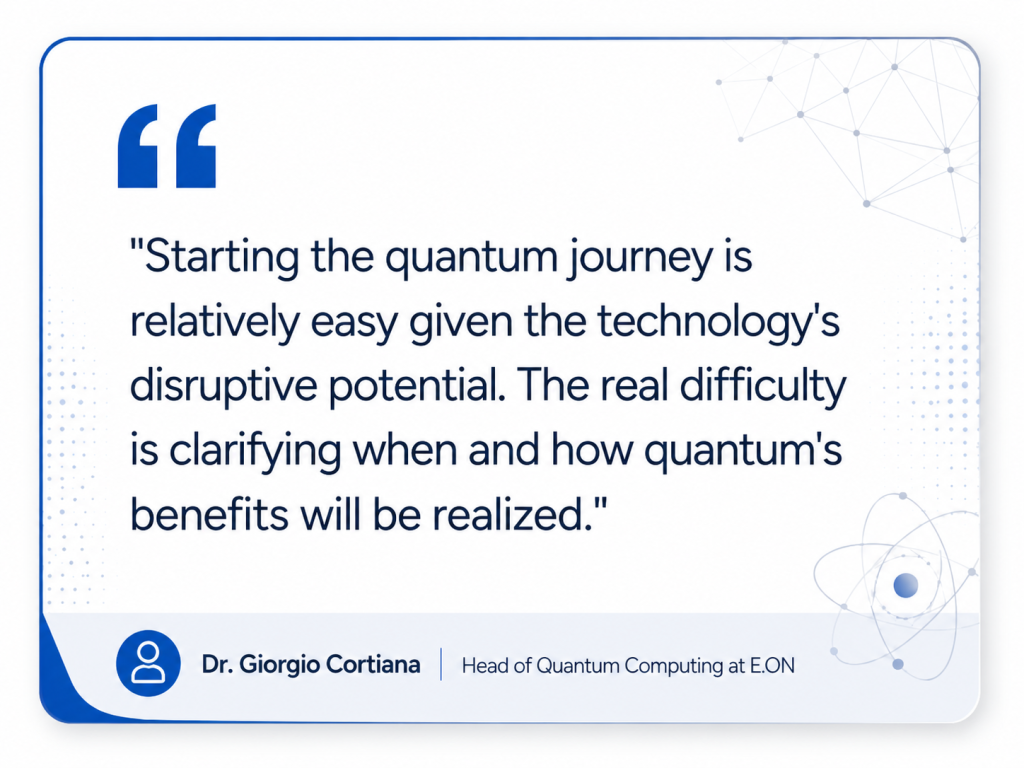
“Starting the quantum journey is relatively easy given the technology’s disruptive potential,” Dr. Giorgio Cortiana, Head of Quantum Computing at E.ON, says in the report. “The real difficulty is clarifying when and how quantum’s benefits will be realized.”
Rather than abandoning its efforts, the company adjusted its definition of success.
Near-term initiatives increasingly focused on hybrid workflows capable of generating incremental value, while longer-term investments continued to prepare for fault-tolerant quantum systems.
Bosch experienced a similar evolution, according to the report, with the engineering company achieving early milestones involving materials simulations on noisy quantum hardware. But scaling those demonstrations into industrial applications proved more difficult.
The report indicates that Bosch subsequently shifted toward developing algorithms and workflows designed for future fault-tolerant systems while maintaining a focus on use cases capable of generating nearer-term feedback.
Healthcare and Life Sciences Emerging
Several examples highlighted in the report point to healthcare and life sciences as areas where quantum computing could eventually have significant impact.
Yonsei University has integrated quantum computing into broader efforts aimed at accelerating medical research.
Dr. Jae-Ho Cheong, who directs the Yonsei Quantum Initiative, describes drug discovery as a process constrained by time and complexity.
“The drug discovery process typically takes about 15 years,” he says in the report. “If quantum computing helps us reduce that time by, say, 10% or 20%, that changes lives.”
Cheong said that investigations into how quantum can boost human health isn’t relegated to drug discovery, however.
“But quantum computing can also enable new methods that are impossible with classical computing,” Cheong continued. “For example, we could potentially see better classification of cancer patients into more homogenous clinical sub-segments for better treatment matching.”
The university has paired quantum resources with classical supercomputing capabilities to investigate complex biological questions involving mitochondrial processes and electronic structures.
Meanwhile, researchers at the Wellcome Sanger Institute and the University of Oxford are exploring whether quantum approaches might help address emerging computational challenges in genomics.
The report identifies pangenomics, which analyzes genetic variation across populations, as a relatively young field — without decades of entrenched classical optimization techniques — that creates an opportunity to evaluate quantum methods before existing approaches become dominant.
“The goal is to understand where the boundary of classical–quantum advantage really is, and what minimum effort is required to do something genuinely novel with quantum computation,” Dr. Sergii Strelchuk, Associate Professor of Computer Science at Oxford, says in the report.
Building Ecosystems
Beyond the technological aspect of quantum, the analysts stress the importance of collaboration, pointing out that the progress of quantum increasingly depends on ecosystems connecting industry, government, universities and technology providers.
The report finds that one in two quantum-ready organizations participate in one or more ecosystems.
Illustrating that approach, Volkswagen collaborates with universities, startups and quantum technology companies as it explores applications ranging from materials science to traffic simulations.
“No single company has all the answers,” Dr. Nikolai Ardey, Executive Director of Volkswagen Group Innovation, according to the report. “Partnerships are how we explore use cases, build capability, and prepare the organization for what comes next.”
Offering another pathway, Chicago State University has positioned quantum education as a workforce development priority, according to the report, creating certificate programs and community partnerships designed to broaden participation in emerging industries.
The Basque Country in Spain has similarly pursued a coordinated regional strategy through its BasQ initiative, aligning public policy, academic research and industrial development around shared objectives.
The examples suggest that organizations increasingly view quantum computing not as an isolated technical endeavor but as part of broader innovation systems.
A Long Journey Ahead
Despite the optimism reflected throughout the report, IBM does not portray quantum advantage as imminent across all sectors.
Instead, the report depicts a field moving through an intermediate phase characterized by experimentation, capability-building and strategic patience.
Organizations continue to confront significant technical uncertainties, such as hardware limitations, skills shortages and nearly unpredictable timelines.
Yet the organizations in the report appear to be continuing their quantum programs because waiting for certainty could prove costly.
Because the path toward quantum advantage may not be defined by a single breakthrough moment. they are building expertise, testing assumptions and establishing partnerships now in anticipation of future opportunities.

Keep track of everything going on in the Quantum Technology Market. In one place.
Topics

Matt Swayne
With a several-decades long background in journalism and communications, Matt Swayne has worked as a science communicator for an R1 university for more than 12 years, specializing in translating high tech and deep tech for the general audience. He has served as a writer, editor and analyst at The Quantum Insider since its inception. In addition to his service as a science communicator, Matt also develops courses to improve the media and communications skills of scientists and has taught courses.
[email protected]

Stay Ahead of Quantum
Get the latest research, company news, and market intelligence every week.
MENTIONED IN THE ARTICLE

IBM
IBM is an iconic technology pioneer founded in 1911 as the Computing-Tabulating-Recording Company and officially renamed International Business Machines Corporation in 1924. Beyond foundational computing, IBM possesses a deep legacy in aerospace and defense from building the guidance computers and Instrument Unit for NASA's historic Apollo missions to partnering with Airbus on CIMON, the first AI assistant on the ISS.
→

E.ON
The E.ON Group is one of Europe's largest operators of energy networks and energy infrastructure and a provider of innovative customer solutions for 50 million customers.
→

Bosch
Robert Bosch GmbH, commonly known as Bosch, is a German multinational engineering and technology company headquartered in Gerlingen.
→

University of Oxford
Oxford stands as a hub for education, instruction, and scholarly exploration, holding the distinction of being the oldest university in the English-speaking realm.
→