Speakers Point to Risk Appetite And Capital as UK Deep-Tech Bottlenecks at City Quantum & AI Summit


Insider Brief
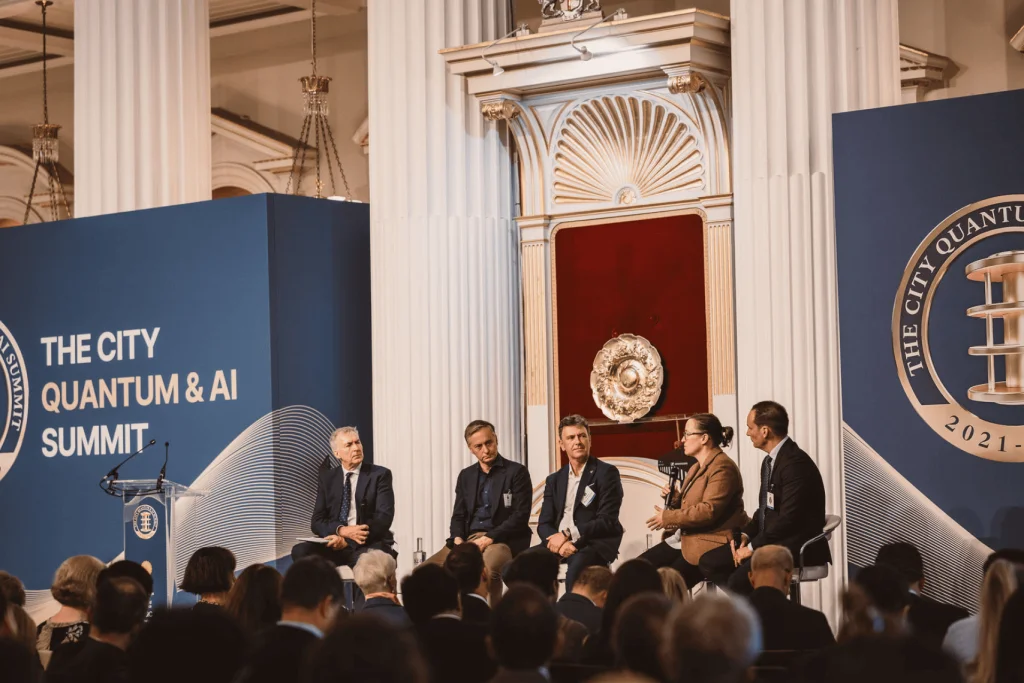
- A defense panel at the sixth City Quantum & AI Summit, held at Mansion House in London on October 7, 2026, said the main barrier to getting AI and quantum technologies to UK forces is institutional risk appetite rather than procurement rules.
- Admiral Sir Tony Radakin, former Chief of the Defence Staff, said completing a UK defense business case for a program over £200 million takes more than 1,000 days on average, before any contract is signed.
- Speakers from Helsing, Thales, Multiverse Computing and quantum sensing start-up Delta.g described sovereignty as a base of national capability shared with trusted allies, not isolation.
- In an evening keynote, British Business Bank Chair Stephen Welton said the bank’s £100 million commitment to OQC’s £260 million Series C was meant to show private UK investors that British capital can anchor British deep tech companies.
- Images: Paulina Roots Photography
Speakers at the City Quantum & AI Summit in London said the UK has much of what it needs to put quantum and AI technology into the hands of its armed forces and to grow the companies that build it, but that the institutions buying the technology and holding the capital are moving too slowly.
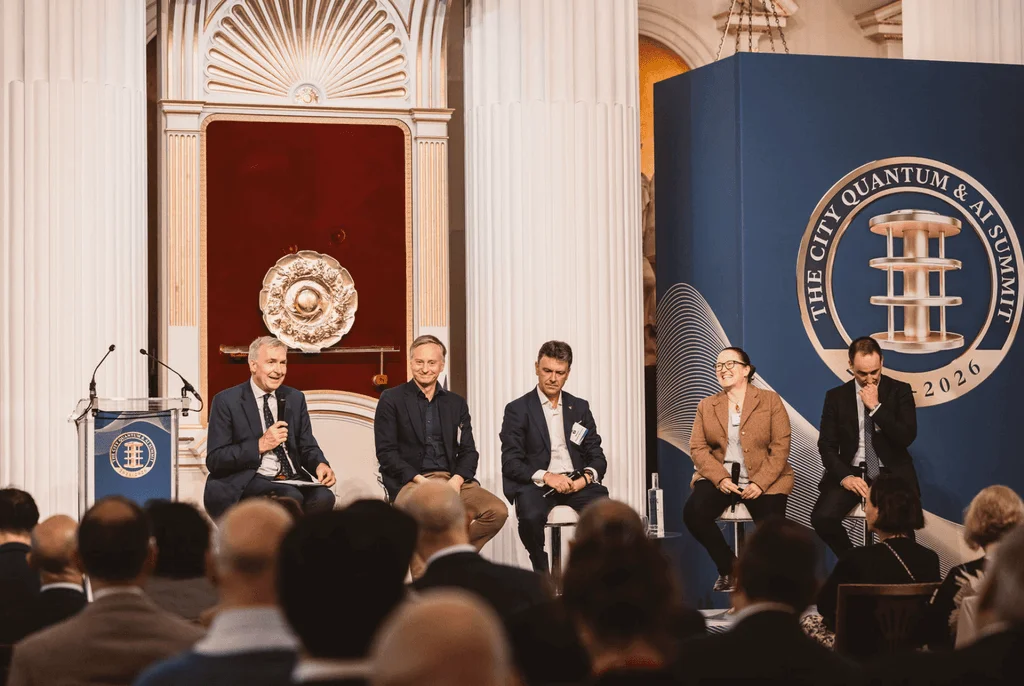
The summit, organized by Redcliffe Advisory, held its sixth edition on October 7, 2026, at Mansion House, the residence of the Lady Mayor of the City of London, under the theme “Connections in Chaos.” Two sessions that dealt most directly with that gap included an afternoon panel titled “Defence: Safety and Security in Troubled Times,” chaired by Admiral Sir Tony Radakin, GBE, KCB, former Chief of the Defence Staff, and an evening keynote, or Qnote, “Financing British Innovation at Scale,” given by Stephen Welton, CBE, Chair, British Business Bank.
Defense Procurement: ‘A Cultural Thing, Not a Process’
Radakin’s panel brought together Ned Baker, Managing Director UK of defense AI company Helsing; Jeanette van Halteren, Managing Consultant at Thales and a former director at NATO; Alberto Reguera Guerrero, Head of Defence at Multiverse Computing; and Tony Lowe, CEO of Delta.g, a University of Birmingham spin-out that uses a quantum gravity sensor to find what lies underground without digging.

Radakin opened by describing a period of open conflict, from the war in Ukraine to hybrid attacks on European states, set against a technological revolution in private life, slow adoption by defense, and rising budgets.
“There’s an increase in money, but the money isn’t always easy to find,” said Radakin.
He then gave an example from his own time in office. The UK’s £3 billion a year in military support for Ukraine, increased by interest earned on Russian assets held in London, was spent through Task Force Kindred, the Ministry of Defence unit that sources equipment for Ukraine. That, Radakin said, facilitated buying kit – or, gear – and equipment for the Ukraine armed forces.
However, buying for the UK’s own forces was different.
“… to buy kit for the UK armed forces, the processes, the system means that if anything was over 200 million, then just on average, just to finish off the business case would take over 1,000 days,” said Radakin.
Asked whether that was changing, Baker said: “No, and not fast enough.”
He said the cause was not the rulebook.
“I was asked this just this morning, actually. I was asked if I had a magic wand and I could wave away any kind of silly rule that existed in DENS or MOD, which silly rule would I get rid of? And I said, well, I wouldn’t really get rid of any of them,” said Baker. “It’s a cultural thing. It’s about people feeling empowered to actually take risks and to do things.”
Van Halteren agreed and pointed to ASGARD, a recent Ministry of Defence initiative she called “superb,” which she said has since fallen back culturally to being a programmatic approach.
Radakin added that the people involved in Kindred were the same mix of armed forces personnel and civil servants as elsewhere. What changed was permission to take operational and financial risks. The debate still under way, he said, is whether to make those rules the default, with exceptions for nuclear submarines, fast jets and major munitions.
Van Halteren said Thales, which is involved in building submarines and ships, among other defense-related missions, sees the same pressure in large programs that are unable to turn fast. She said water, electricity and gas companies and manufacturers have become more aware of the threat after cyber and gray-zone attacks hit the industrial base that supplies defense.
Software-Defined Systems
Baker described three linked changes in defense during the session. The first is military AI, which lets capabilities adapt faster than hardware-centric systems. The second is the iteration cycle now seen in Ukraine, where systems are upgraded in response to enemy countermeasures and user feedback “in hours and days rather than the traditional years and decades.” The third is an influx of private capital in Europe
“And so, private capital has led to the emergence of a number of different companies, Helsing is one of them, probably the largest in Europe at the moment that is able to put this capital to work, applying military AI to the new situation we find ourselves in, and performing very fast R&D, creating new capabilities, and then bringing them to MODs and saying, ‘right, now let’s take the next steps together’,” Baker said. “So, those are the sorts of changes that we’re going through. How does it feel? It feels like a win is not guaranteed by any stretch of the imagination. It feels like we’ve got unprecedented threat, unprecedented opportunity, and I genuinely couldn’t say which way it is going to go.”
Reguera Guerrero said Multiverse addresses the cost of running AI: bigger models, larger infrastructure and higher energy use. He said the company’s compression technology can deliver a model at 5% of the original size, cut energy consumption by 50% and run two to three times faster. That, he said, allows current models to run on a drone, sensor or vehicle with current software and no waiting for new chips.
Sovereignty as a Base, Not a Wall
The panelists described sovereignty as a foundation of national capability shared with trusted partners.
Lowe said trust is vital to this new era of sovereignty.
“It’s a new form of globalization — globalization with like-minded parties — and getting that trust so that we can share the data with the parties that will benefit from using it, rather than just being completely nationalistic and isolationist,” Lowe said.
Reguera Guerrero said Europe should have its own AI models in the medium term, so that it controls them in a crisis.
He added that Multiverse has technology to check whether a model contains a back door and has removed censorship from Chinese models.
Van Halteren set out the questions behind sovereignty: where the data sits, where products are made, who the subcontractors are and “who owns the keys.” Without that control the UK in a crisis would be reliant on partners that might be out of reach, she said.
Baker said Helsing was set up to give Europe a choice in defense technology, and has also opened a factory in the US.
“Sovereignty doesn’t mean isolationism, is a really key point,” said Baker. “You can have a base layer of your own sovereign capability that you can depend upon, but that doesn’t mean you stay within that. You should always — in my view — go outside of that.”
He added that a senior Ministry of Defence and industry working group he sits on has been debating the definition of sovereignty for about 18 months.
Welton: Public Capital as a Private Investor Signal
In the QNote, Stephen Welton, Chair of the British Business Bank, described the UK’s challenge as a plumbing problem. The specific challenge is how to better connect the huge pool of savings in the UK with the innovative economy, according to Welton, noting that the Mansion House Accord on pension investment was written in the same building.
Welton described the British Business Bank, which is wholly owned by the government, as the UK’s economic development bank. He said a good proxy for its investment work is the size of the UK venture capital market, already the largest in Europe, and that the bank’s job is to make it bigger.
“Our chief investment officer talks about a barbell strategy,” said Welton. “At the top end, we want the larger funds to be able to write larger checks so they can anchor British companies that are scaling, that are clearly going to scale globally, more in the UK for longer. And capital does matter. The ability to write larger tickets in later rounds is key to being able to extend your influence and we’re trying to be very innovative in doing that.”
At the other of the barbell, the bank backs first-time fund managers, some of which are now raising their seventh, eighth or ninth funds.
As an example of bringing in outside talent, he cited the bank’s planned commitment of up to £150 million to a new UK-focused fund from Playground Global, a deep tech investor based in Palo Alto. The bank has said that commitment is subject to due diligence and legal negotiations. Welton said the fund is in the process of being created.
OQC – Oxford Quantum Circuits — was his main case. The bank first invested in the Oxford University spin-out through funds it manages, which Welton said gave it knowledge, access, understanding. OQC closed a £260 million Series C in June 2026. Welton said £100 million of that came from the British Business Bank. “I don’t think there is a British investor who is currently doing that,” he said. “If they are, we’d love to see you in the next round.”
“We are putting public capital to work because we think it’s a good investment,” Welton said. “More importantly, we think that other investors, private investors, should see us doing that.”
He said the investment wasn’t protectionist and tied it to sovereignty and data security, describing such investment as important for the country in terms of critical national infrastructure.
He said the next step is the UK Scale-up Fund, a proposed vehicle of more than £1 billion announced in July by a group of UK pension schemes, with the British Business Bank and the Office for Investment supporting it. Welton said the backers include local government pension schemes, defined contribution schemes and defined benefit schemes.
“These are the bullseye, if you want, in terms of where the capital sits and the fact that they are looking actively at this marketplace, I think, is a maturing of their view about venture capital as an asset class that sits within a broader asset allocation,” said Welton. “And that is the way we need to talk to investors, because they have a fiduciary duty to generate returns. I think it’s a big win, ultimately,”
Resonance, the parent company of The Quantum Insider, was sector media partner for the City Quantum & AI Summit 2026.

Keep track of everything going on in the Quantum Technology Market. In one place.
Topics

Matt Swayne
With a several-decades long background in journalism and communications, Matt Swayne has worked as a science communicator for an R1 university for more than 12 years, specializing in translating high tech and deep tech for the general audience. He has served as a writer, editor and analyst at The Quantum Insider since its inception. In addition to his service as a science communicator, Matt also develops courses to improve the media and communications skills of scientists and has taught courses.
[email protected]

Stay Ahead of Quantum
Get the latest research, company news, and market intelligence every week.
MENTIONED IN THE ARTICLE

Thales Group
Thales Group is a French multinational company that designs and builds electrical systems and provides services for the aerospace, defense, transportation and security markets.
→

Multiverse Computing
Multiverse Computing provides software for companies wanting to gain an edge with quantum computing and artificial intelligence.
→

Delta G Ltd
Delta g is a UK-based gravity sensing hardware and technology development company that has developed a cutting-edge underground imaging system that leverages quantum technology to measure gravity gradients.
→

British Business Bank
British Business Bank plc is a state-owned economic development bank established by the UK Government.
→