Advance Could Lead to Bigger, More Reliable Quantum Computers, University of Edinburgh Scientists Say


Insider Brief
- Researchers developed an algorithm that allows standard computers to simulate photonic quantum devices using about 5% of the computing power previously required, according to the team.
- In tests involving Gaussian boson sampling, classical computers using the algorithm matched or exceeded the performance of some current quantum devices.
- The team is working to scale up the algorithm to support larger simulations that could help researchers assess current devices and design improved photonic quantum computers.
PRESS RELEASE — Researchers have developed an algorithm that enables off-the-shelf computers to run quantum simulations previously only possible using the world’s most powerful supercomputers.
It means the simulations can be run using around five percent of the computing power previously needed to perform them with a supercomputer, the team says.
Quantum experiments
The advance could make it cheaper and easier to run experiments vital for understanding the limitations of current quantum computers and informing the design of improved devices, experts say.

Quantum computers could, in theory, perform calculations far beyond the capabilities of even the most advanced supercomputers, but current devices are small and error-prone, hindering their performance.
Key to informing the creation of bigger, more reliable quantum computers is the development of algorithms to simulate how devices might work in reality.
However, running these simulations has until now required vast amounts of computing power available at only a handful of facilities worldwide.
Light-based technology
The new algorithm was developed by a team led by scientists at Edinburgh and EPCC, the UK’s first National Supercomputing Centre, which is part of the University.
The work could aid the development of light-based quantum devices, one of several branches of current quantum research by academics and industry, the team says.
Computing power
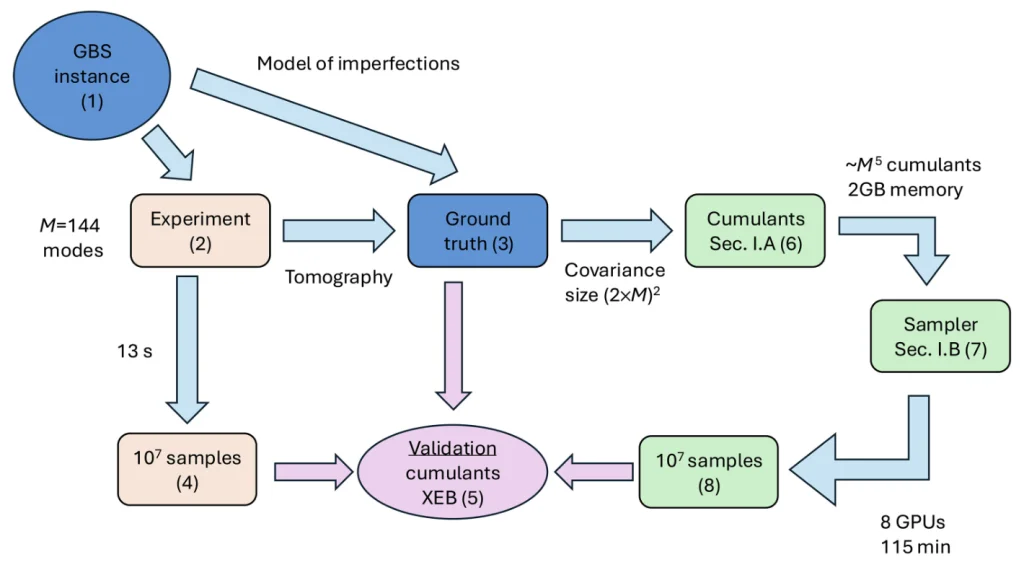
For the first time, the algorithm enables standard computers to run so-called Gaussian boson sampling, a simulation designed to demonstrate the superior capabilities of quantum devices powered by light – known as photonic quantum computers.
In tests, researchers found that classical computers using the algorithm could match and even outperform some current quantum devices’ ability to run the simulations.
Larger simulations
Researchers are working on scaling up how the algorithm is used, potentially enabling much larger simulations to be run using the same computing power.
This could allow scientists to simulate photonic quantum computers in unprecedented detail, the team says.
The research, published in the journal Science Advances, also involved scientists from Polytechnique Montréal, Canada.
It received support from the UK’s Engineering and Physical Sciences Research Council (EPSRC) and the Natural Sciences and Engineering Research Council of Canada.
“Classical simulation of large-scale quantum computing circuits has been achieved so far via a combination of clever algorithms and the intensive use of supercomputing facilities. Our work has contributed significant improvements in memory use, running time and energy costs in the simulation of photonic quantum computing devices, making mainstream what was before only accessible to a handful of facilities in the world.” — Dr Raul Garcia-Patron SanchezSchool of Informatics

Keep track of everything going on in the Quantum Technology Market. In one place.

Matt Swayne
With a several-decades long background in journalism and communications, Matt Swayne has worked as a science communicator for an R1 university for more than 12 years, specializing in translating high tech and deep tech for the general audience. He has served as a writer, editor and analyst at The Quantum Insider since its inception. In addition to his service as a science communicator, Matt also develops courses to improve the media and communications skills of scientists and has taught courses.
[email protected]

Stay Ahead of Quantum
Get the latest research, company news, and market intelligence every week.
MENTIONED IN THE ARTICLE

The University of Edinburgh
The University of Edinburgh is a public research university located in Edinburgh, Scotland. It was established by the town council with a royal charter from King James VI in 1582 and officially inaugurated in 1583. It is among Scotland's four ancient universities and holds the distinction of being the sixth-oldest continuously operating university in the English-speaking world.
→

Engineering and Physical Sciences Research Council
The Engineering and Physical Sciences Research Council (EPSRC) is part of UK Research and Innovation council. EPSRC is the main funding agency for engineering and physical sciences research in the UK.
→

Natural Sciences and Engineering Research Council of Canada (NSERC)
NSERC is a government agency in Canada responsible for awarding research grants in the fields of natural sciences and engineering. The agency's financial support also fosters alliances and joint efforts that bridge the gap between the business sector and new findings along with the individuals responsible for them. Collaborative endeavors between researchers and industries facilitated by NSERC play a role in guiding research and development, tackling issues related to scaling up, and minimizing the uncertainties associated with advancing high-potential technologies.
→