Second QDA Forum Focuses on Real-World Deployments And Progress of Quantum Computing

Insider Brief
- Leaders from across classical and quantum computing met to accelerate the path to fault tolerant quantum computing and integration with high performance computing and AI infrastructures.
- The second QDA highlighted the fast approaching horizon of commercial use of quantum computers, with examples of partnerships and deployments today.
- Speakers from NVIDIA, IBM, Coherent, Equinix, Quantinuum, Atom Computing, DSIT, Nu Quantum, and more presented lessons learned from real world commercial deployments and projects and discussed outstanding challenges.
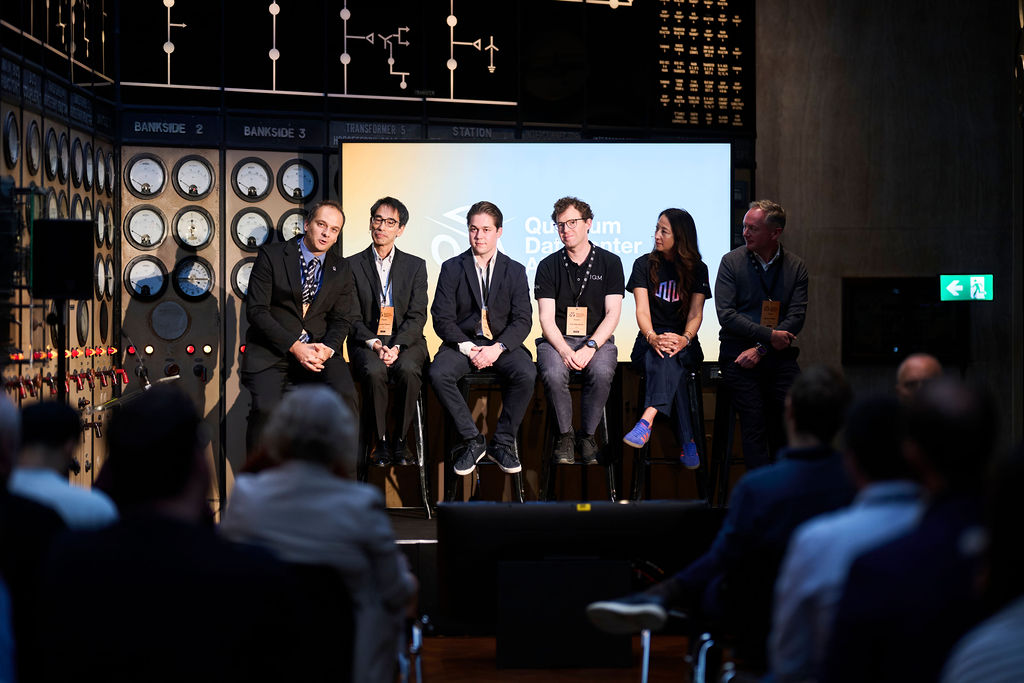
- Image: Panel for Where Are We Today: QPU-HPC Deployments (Nick Beard)
PRESS RELEASE — The second international Quantum Datacenter Alliance (QDA) Forum highlighted the progress towards commercial deployments and acceleration of distributed quantum computing architectures, while also outlining the next critical areas of focus for progress.
At the iconic Battersea Power Station, London, the QDA brought together technical, business, and government leaders to address one of the most pressing technical and ecosystem challenges: how to integrate emerging quantum hardware into existing and future data center infrastructure.
The agenda explored how quantum systems are moving from lab-scale demonstrations toward commercial deployment, highlighting that system level architecture, control, error correction, interoperability and power consumption have become as critical as the qubits themselves. Attendees also emphasised the importance of open sharing, interoperability, and collective thinking about the direction and future uses of quantum technologies.

Dr. Carmen Palacios-Berraquero, Founder and CEO of Nu Quantum said, “As quantum computing moves towards large-scale utility, collaboration becomes critical. The QDA brings the industry together to tackle the shared challenges of building quantum computing as infrastructure — scalable, interoperable, reliable and efficient — and ultimately making quantum compute accessible to the world, responsibly.”
Dame Wendy Hall, speaking about lessons from classical computing and AI,said, “It’s all about communication. It is so important to get the positive messages out about any new technology ahead of the inevitable scare stories about the risks and potential harms which the media love to pick up on. Of all the new technologies on the horizon though. Quantum computing is the hardest to explain to non technical audiences. That messaging will need a lot of work as the technology begins to emerge into the public arena.”
Hannah Boardman, Director responsible for AI, Quantum, Engineering Biology, Semiconductors, Robotics, Department for Science, Innovation & Technology, said, “Initiatives like this QDA show the power of bringing together different sections of the ecosystem across technologies, thinking in a different kind of way and focusing on delivering common goals to be identified in the room.”
Petrina Anne Steele, Head of Emerging Technologies at Equinix, said, “Quantum is an incubating technology that sits alongside classical HPC and now AI environments, and is highly complementary. Hybrid infrastructure is making quantum commercially actionable today. We already have companies doing high precision molecular modelling and exploring FX trading optimisation.”
Ben Bloom, Founder and CEO at Atom Computing, said, “Over the past two days, Nu Quantum and its partners have been exploring how to integrate quantum systems into a data center. This is an incredibly important topic as we continue to expand the reach of quantum computers to more and more industries and more and more users. Building a utility scale quantum computer doesn’t just fall to one company, and doesn’t even just fall to one technology. It’s the combination of multiple components together that will actually bring out a utility scale quantum computer.”
Looking ahead, the QDA will continue to convene industry leaders through future forums, working groups, and events, driving the industry toward scalable, robust, commercially viable quantum computing.

Keep track of everything going on in the Quantum Technology Market. In one place.
Topics

Matt Swayne
With a several-decades long background in journalism and communications, Matt Swayne has worked as a science communicator for an R1 university for more than 12 years, specializing in translating high tech and deep tech for the general audience. He has served as a writer, editor and analyst at The Quantum Insider since its inception. In addition to his service as a science communicator, Matt also develops courses to improve the media and communications skills of scientists and has taught courses.
[email protected]
Stay Ahead of Quantum
Get the latest research, company news, and market intelligence every week.
MENTIONED IN THE ARTICLE
NVIDIA
NVIDIA Corporation is an American multinational technology company and a global player in accelerated computing and Artificial Intelligence (AI). Founded in 1993, the company pushes the aerospace frontier with the Space-1 Vera Rubin Module, a platform for orbital data centers that delivers massive AI-compute Space Computing. This NVIDIA technology enables satellites and autonomous spacecraft to process and fuse sensor data rapidly Space Computing.
→
IBM
IBM is an iconic technology pioneer founded in 1911 as the Computing-Tabulating-Recording Company and officially renamed International Business Machines Corporation in 1924. Beyond foundational computing, IBM possesses a deep legacy in aerospace and defense from building the guidance computers and Instrument Unit for NASA's historic Apollo missions to partnering with Airbus on CIMON, the first AI assistant on the ISS.
→
Coherent
II-VI Incorporated, now known as Coherent Corp., is a leading global company specializing in the production of lasers and laser-based solutions. Their extensive product range serves various industrial, commercial, and scientific applications, making their technology integral to numerous sectors and industries.
→

Equinix
Equinix specializes in digital infrastructure, operating a global network of data centers that provide colocation, connectivity, and managed solutions for enterprises, cloud providers, and network service providers. The company enables direct, secure interconnection between partners and platforms, supporting mission-critical applications, AI workloads, and hybrid multicloud environments. Equinix emphasizes reliability, scalability, and compliance, serving over 10,000 customers worldwide and facilitating digital transformation through its extensive ecosystem and advanced infrastructure.
→

Quantinuum
Quantinuum builds full-stack quantum computing solutions for practical deployment. Leveraging proprietary enhancements to trapped-ion QCCD architecture, the company has launched multiple commercial hardware generations that deliver leading two-qubit gate fidelity and industry-topping accuracy.
→

Atom Computing
Atom Computing builds quantum computers using nuclear spin qubits formed from arrays of optically-trapped neutral atoms.
→
Department for Science, Innovation and Technology (DSIT)
The Department for Science, Innovation and Technology (DSIT) is a department of the government of the United Kingdom. Established in February 2023, DSIT took on policy responsibilities from the former Department for Business, Energy and Industrial Strategy (BEIS) and the Department for Digital, Culture, Media and Sport. The new department is responsible for helping to encourage, develop and manage the UK's scientific, research, and technological outputs. DSIT is also responsible for managing the necessary physical and digital infrastructure and regulation to support the British economy, UK public services, national security, and wider UK Government priorities. The DSIT has launched a National Quantum Strategy, which is a 10-year vision and actions for the UK to be a leading quantum-enabled economy, recognizing the importance of quantum technologies for the UK's prosperity and security.
→

Nu Quantum
Nu Quantum develops Entanglement Fabric and Quantum Networking Units to interconnect discrete processing cores. Founded in 2018 as a Cambridge University spinout, the company's hardware enables secure quantum networks suitable for aerospace, aviation, and satellite telecommunications, facilitating distributed quantum computing.
→