

Insider Brief
- D-Wave reported sharply higher first-quarter bookings and future contracted revenue obligations, signaling growing commercial demand for its quantum computing systems, as well as increased volatility in the industry.
- The company’s revenue fell 81% to $2.9 million because the prior-year quarter included a large one-time quantum computer system sale, while bookings rose nearly 2,000% to $33.4 million.
- D-Wave expanded its long-term gate-model quantum computing ambitions through its acquisition of Quantum Circuits and outlined a roadmap targeting error-corrected quantum systems through 2032.
D-Wave Quantum reported a sharp rise in bookings for the first quarter even as revenue fell from a year earlier, reflecting the uneven but accelerating commercialization cycle of the quantum computing industry.
In a statement, the quantum computing company reported first-quarter bookings reached $33.4 million, up nearly 2,000% from the same period a year ago, driven by a $20 million system sale to Florida Atlantic University and a $10 million enterprise agreement with a Fortune 100 company. Revenue, however, fell 81% to $2.9 million because the prior-year quarter included the company’s first major annealing quantum computer system sale, which contributed $12.6 million in recognized revenue.
“D-Wave’s first quarter performance highlights what sets this company apart: strong execution, expanding commercial adoption, and differentiated technology leadership across both annealing and gate model quantum computing,” said Dr. Alan Baratz, CEO of D-Wave. “As the only quantum computing company pursuing both annealing and gate-model quantum computing systems, we believe that D-Wave is uniquely positioned to participate in the full addressable quantum computing market. Our acquisition of Quantum Circuits is expected to meaningfully accelerate our delivery of a scalable, error-corrected gate model system, while our record-setting $10 million quantum computing as a service agreement with a Fortune 100 company reinforced growing demand for our annealing systems. We believe that D-Wave’s combination of commercial proof, technical breadth, and a differentiated path to gate-model error correction and scaling will be increasingly prominent as this market matures.”

Future Revenue
Besides offering a snapshot of D-Wave’s financial status, the results hint at both the volatility and growing scale of the emerging quantum computing market. Unlike traditional software companies that recognize recurring subscription revenue steadily over time, quantum firms often report results shaped by a small number of large research, government or enterprise contracts.
D-Wave’s remaining performance obligations, a measure of contracted future revenue, rose to $42.4 million as of March 31, up 563% from a year earlier and more than triple the level reported at the end of 2025. The company said about 54% of those obligations are expected to convert into revenue within the next 12 months.
The company also expanded aggressively during the quarter through its acquisition of Quantum Circuits, a developer of superconducting gate-model quantum systems focused on error correction. The acquisition broadens D-Wave’s strategy beyond its long-standing annealing quantum computing business and positions the company as one of the few quantum firms attempting to commercialize multiple hardware approaches simultaneously, according to the statement.
Quantum computing remains a highly experimental field in which companies are pursuing different technical architectures in the race to build machines capable of solving commercially valuable problems beyond the reach of classical computers. Annealing systems, the category where D-Wave has historically specialized, are designed primarily for optimization tasks such as logistics, scheduling and resource allocation. Gate-model systems are viewed by many researchers as a pathway toward more general-purpose quantum computing.
D-Wave said the Quantum Circuits acquisition gives it access to dual-rail superconducting qubits, a design the company believes could improve error correction performance while maintaining the speed advantages of superconducting systems. The company laid out a roadmap that targets a roughly 175 physical qubit dual-rail system by 2028, scaling to 1,000 physical qubits by 2030 and eventually systems supporting 100 logical qubits by 2032.
Logical qubits are considered a key benchmark in the industry because they represent error-corrected quantum bits capable of performing reliable computations over longer periods. Most current quantum computers operate with physical qubits that remain highly sensitive to environmental noise and errors.
The acquisition and accelerated development plans significantly increased operating costs during the quarter. D-Wave reported a net loss of $18.4 million, compared with a loss of $5.4 million a year earlier. GAAP operating expenses more than doubled to $56.5 million, driven partly by acquisition-related costs, increased hiring in research and sales, fabrication spending and higher stock-based compensation.
Loss Widens
Adjusted EBITDA loss widened to $32.8 million from $6.1 million in the prior-year quarter. EBITDA is a financial measure that helps financial analysts understand the underlying performance of a business by stripping out interest costs, taxes, depreciation and amortization.
The results underscore a broader trend across the quantum sector, where companies are spending aggressively on engineering talent, fabrication capacity and commercialization efforts while still generating relatively modest revenue. Investors have increasingly focused on bookings growth, customer expansion and technical milestones rather than near-term profitability.
D-Wave said it recognized revenue from more than 100 customers during the quarter, with more than half coming from commercial enterprises rather than research institutions or government users.
The company also highlighted several technical and commercial projects intended to demonstrate practical uses for quantum systems.
Drug Discovery Advance
One of the most closely watched initiatives involved a collaboration with Shionogi, a Japanese pharmaceutical company using D-Wave’s annealing systems in drug discovery research. According to the company statement, the second phase of the project produced a tenfold increase in desirable molecular candidates compared with results generated using classical machine-learning approaches.
D-Wave also announced progress in quantum blockchain research through work with Postquant Labs. The companies launched a quantum-classical blockchain test network involving more than 1,600 nodes, including D-Wave’s Advantage2 quantum processing unit. According to the company, the quantum system outperformed classical computing nodes in mining operations, though broader benchmarking studies remain ongoing.
The company continued expanding the capabilities of its annealing platform as well. D-Wave published research describing new multi-color annealing protocols that allow certain gate-model-like operations to run on its commercial annealing systems. The work could blur distinctions between different categories of quantum hardware if the techniques prove scalable.
In software, D-Wave introduced new hybrid solver tools designed to integrate machine learning models into optimization workflows. Hybrid quantum systems combine classical and quantum computing resources in an effort to make current quantum hardware more useful for commercial applications before fully fault-tolerant systems become available.
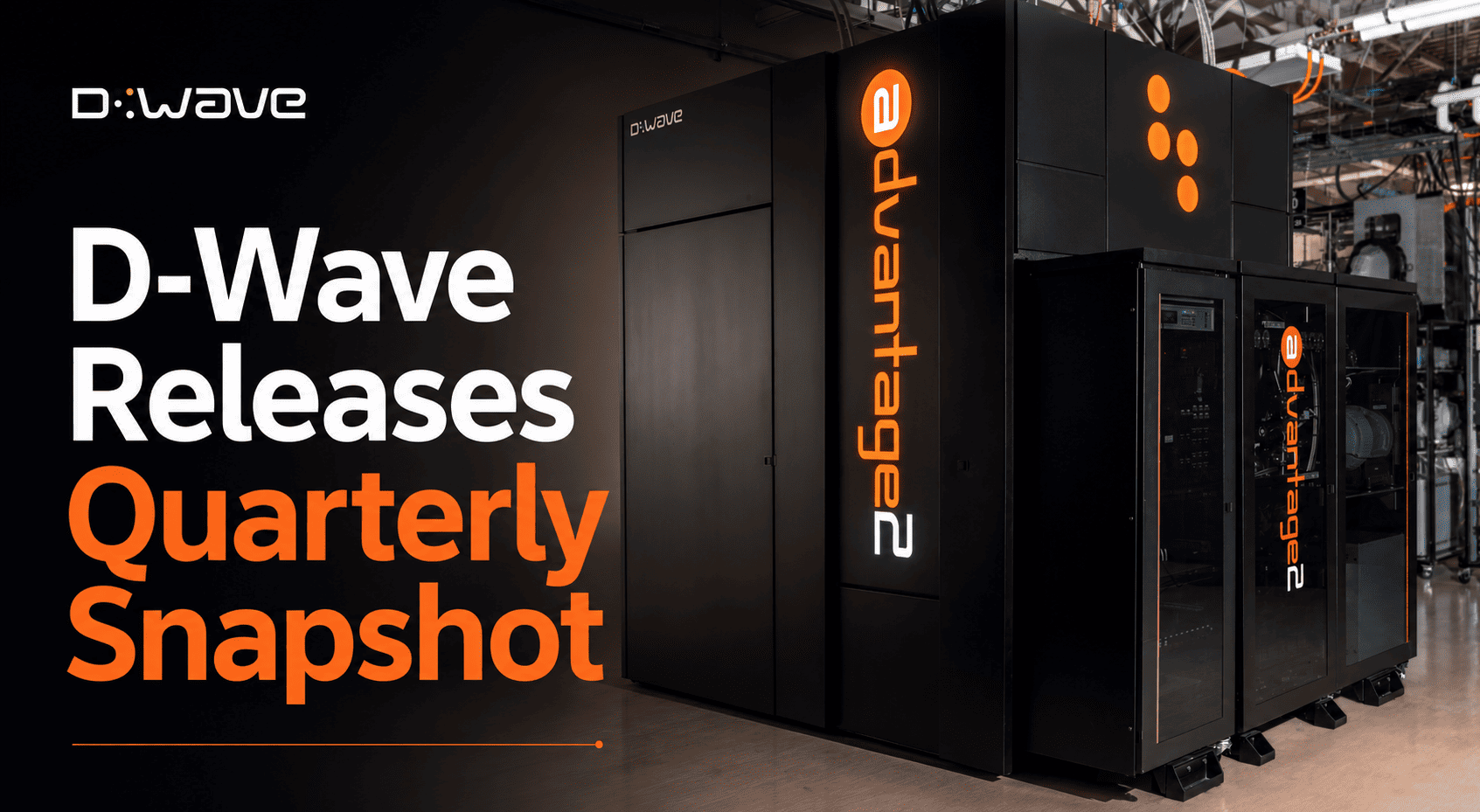
The company’s largest announced commercial transaction during the quarter came from Florida Atlantic University, which agreed to purchase an Advantage2 annealing quantum computer for $20 million. D-Wave said installation is expected to begin before the end of 2026 as part of Florida’s broader effort to establish itself as a quantum technology hub.
D-Wave plans to provide additional details about its long-term technology roadmap and commercialization strategy during an investor day scheduled for June 1 at the New York Stock Exchange.