Educators Named to Chattanooga/Hamilton County’s Inaugural QCaMP Cohort


Insider Brief
- The Chattanooga Quantum Collaborative announced the first local QCaMP cohort, bringing together 23 educators from 16 schools to participate in a national quantum-focused professional development program led by Sandia National Laboratories.
- Chattanooga/Hamilton County was selected as one of only 20 QCaMP sites nationwide and one of just two in Tennessee, highlighting the region’s growing role in quantum education and workforce development.
- The summer program will provide K–12 educators with hands-on training in quantum computing, networking, physics and mathematics, with the goal of helping teachers introduce emerging quantum concepts into their classrooms and prepare students for future careers.
PRESS RELEASE — The Chattanooga Quantum Collaborative (CQC) announced today the first Chattanooga/Hamilton County-area cohort of educators participating in QCaMP (Quantum Computing, Mathematics and Physics Camp), a professional learning experience designed by Sandia National Laboratories as part of the U.S. Department of Energy’s Quantum Systems Accelerator (QSA), to help K–12 teachers explore emerging quantum concepts and bring new ideas back into their classrooms.
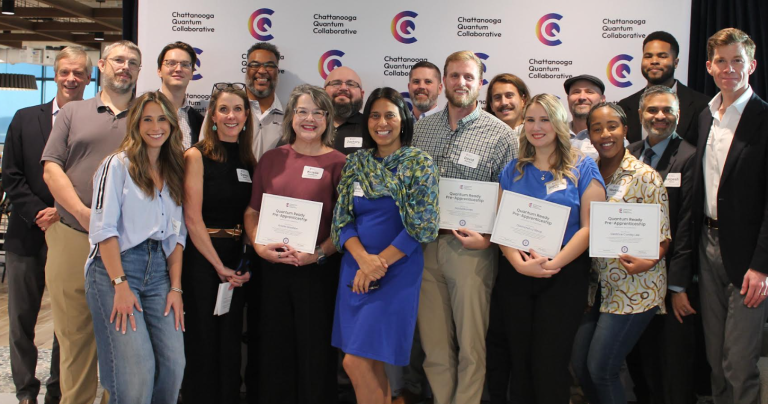
The inaugural cohort includes 23 educators representing 16 public and private schools across the Chattanooga and Hamilton County region, including educators from Hamilton County Schools as well as independent schools and neighboring districts.
Chattanooga/Hamilton County is one of only 20 QCaMP cohorts nationwide and one of only two in Tennessee selected for participation by Sandia National Laboratories.

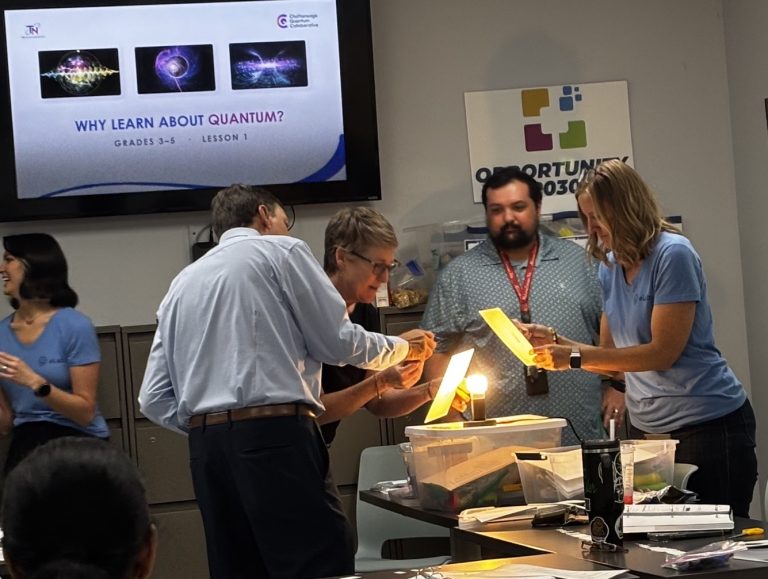
Hosted this summer in Chattanooga, QCaMP introduces educators to foundational concepts in quantum computing, networking, physics, and mathematics through hands-on learning, collaboration with researchers and industry professionals, and classroom-focused discussions about how quantum technologies may shape the future workforce.
The program curriculum was developed by scientists and instructors at Sandia National Laboratories in New Mexico, which also leads instruction for the program. Sandia has helped support educator-focused quantum learning initiatives across the country as interest in quantum science and technology continues to grow.
The program is supported through a National Science Foundation planning grant awarded to The University of Tennessee at Chattanooga, with CQC serving as a subawardee focused on ecosystem coordination and workforce engagement.
The Chattanooga cohort was selected from a larger pool of applicants that included educators, professionals, and community members from multiple regions. Priority for this cohort was given to currently active K–12 educators within practical commuting distance of Chattanooga in order to support collaboration and classroom implementation during the program.
“Quantum technology is advancing quickly, and programs like QCaMP help create opportunities for educators to engage with these ideas early,” said Charlie Brock, CEO of CQC. “What’s exciting is not just the content itself, but the willingness of these teachers to explore something new and think about how it connects to students’ futures.”
“Part of UTC’s role in this work is helping connect research, education, and workforce development in ways that are meaningful for our region,” said Chancellor Lori Mann Bruce. “These educators represent an important bridge between emerging technologies and the students who will eventually shape how they’re used.”
“Chattanooga came in strong for its first year,” said Lillian Brunacini, QCaMP 2026 Program Manager at Sandia National Laboratories. “We saw real enthusiasm from educators who are eager to learn, collaborate, and think creatively about how quantum concepts can be introduced in accessible ways for students. That level of engagement says a lot about the momentum already building in the region.”
Participants represent a range of grade levels and subject areas, reflecting growing interest in making quantum concepts more approachable and interdisciplinary for students.
“Supporting educators with access to high-quality professional development is a reflection of Hamilton County Schools’ commitment to investing in educator learning,” said HCS Chief Academic Officer Blake Freeman. “QCaMP provides our educators with the opportunity to engage with innovative ideas and strategies that foster engaging learning environments and prepare students to be life-ready after graduation.”
QCaMP is part of a broader effort underway in Chattanooga and across Tennessee to strengthen quantum education, workforce readiness, and industry engagement as the field continues to evolve.
Participants are coming from the following schools:
- Brainerd High School
- Chattanooga Christian School
- Chattanooga Girls Leadership Academy
- Chattanooga School for the Arts and Sciences
- Collegedale Academy
- Girls Preparatory School
- Hamilton County Virtual School
- Howard School
- Hunter Middle School
- McMinn County High School
- Red Bank Elementary School
- Red Bank Middle School
- Red Bank High School
- Signal Mountain Middle School
- Soddy Daisy Middle School
- University High at UTC
Additional information about Chattanooga’s quantum initiatives and educational resources is available at www.ChattanoogaQuantum.com.

Keep track of everything going on in the Quantum Technology Market. In one place.

Matt Swayne
With a several-decades long background in journalism and communications, Matt Swayne has worked as a science communicator for an R1 university for more than 12 years, specializing in translating high tech and deep tech for the general audience. He has served as a writer, editor and analyst at The Quantum Insider since its inception. In addition to his service as a science communicator, Matt also develops courses to improve the media and communications skills of scientists and has taught courses.
[email protected]

Stay Ahead of Quantum
Get the latest research, company news, and market intelligence every week.
MENTIONED IN THE ARTICLE
Chattanooga Quantum Collaborative
Chattanooga Quantum Collaborative is a non-profit membership organization created to help the community, region, and state realize the vast potential of quantum technology.
→
Sandia National Laboratory
The Sandia National Laboratories is one of three National Nuclear Security Administration research and development laboratories in the United States, managed and operated by the National Technology and Engineering Solutions of Sandia.
→

U.S. Department of Energy (DOE)
The mission of the Department of Energy is to ensure America's security and prosperity by addressing its energy, environmental, and nuclear challenges through transformative science and technology solutions. In September, 2022, Research supported by ASCR demonstrated that classical machine learning algorithms can accurately predict ground state properties and classify quantum phases of matter using data generated from quantum experiments. In November, 2022, Research supported by Q-NEXT revealed that the performance of a sensor network is constrained by the intrinsic noise associated with the quantum states used in the network. In March, 2023, Research funded by DOE SC NP achieved the first experimental observation of entanglement between dissimilar particles, specifically positive and negative pions. In August, 2023, Research funded by DOE SC BER demonstrated strong preservation of entanglement in a two-photon absorption process involving organic molecules, offering a new approach for developing quantum light-based spectroscopy and microscopy.
→
University of Tennessee
The University of Tennessee, located in Knoxville, Tennessee, United States, is a public land-grant research university. It was established in 1794, two years prior to Tennessee becoming the 16th state. The university serves as the main campus of the University of Tennessee system.
→