

Insider Brief
- A new qubit platform developed at Argonne National Laboratory uses electrons trapped on solid neon and demonstrates noise levels 10–10,000 times lower than most semiconductor-based qubits, positioning it as a strong candidate for scalable quantum computing.
- The system achieves a coherence time of about 0.1 milliseconds—nearly 1,000 times longer than prior semiconducting qubits—while maintaining high gate fidelity, indicating improved stability and accuracy in quantum operations.
- Researchers attribute the low noise to neon’s chemically inert, impurity-free properties, though remaining challenges include mitigating stray electrons and surface imperfections to further optimize performance.
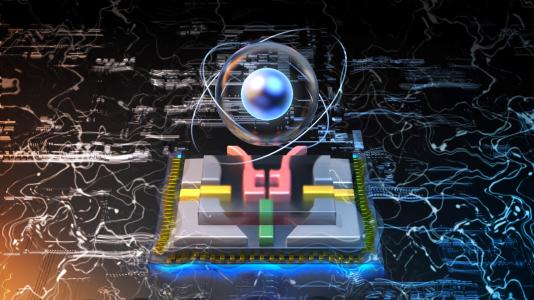
- Image by Xu Han/Argonne National Laboratory.
PRESS RELEASE — Quantum bits (qubits) are the fundamental building blocks of quantum information processing. A novel qubit platform invented at the U.S. Department of Energy’s (DOE) Argonne National Laboratory exhibits noise levels thousands of times lower than those of most traditional qubits. Noise refers to disturbances in the environment that diminish a qubit’s performance. The platform was built by trapping single electrons on the surface of frozen neon gas. The recent finding positions Argonne’s platform as a strong contender in the field of high-performance quantum technologies.
The new study, jointly led by Argonne and the University of Notre Dame, was published in Nature Electronics. Collaborating institutions included the University of Chicago, Harvard University, Northeastern University and Florida State University (FSU).
“In previous work, we demonstrated the outstanding performance of our electron-on-neon qubit,” said Xu Han, an Argonne scientist and co-corresponding author. “By thoroughly characterizing the qubit’s noise properties, this latest study shows why its performance is so good. Our results prove that our technology is promising for quantum information processing at larger scales.”

Quantum computing: Potentially transformative, but challenged by noise
Today’s computers and smartphones run on bits, which are tiny switches that can be either 0 or 1. Quantum computers use a special kind of bit known as qubits that can be 0 and 1 at the same time. What’s more, the state of one qubit can instantly affect another qubit’s state, even if they are on opposite sides of the planet. Many different types of physical objects can be used to build qubits, including electrons, photons and loops of wire.
“In previous work, we demonstrated the outstanding performance of our electron-on-neon qubit. By thoroughly characterizing the qubit’s noise properties, this latest study shows why its performance is so good. Our results prove that our technology is promising for quantum information processing at larger scales.” — Xu Han, Argonne scientist
The remarkable properties of qubits can endow quantum computers with exponentially greater computational power than that of classical computers. This opens the door to solving challenging problems like inventing disease-curing drugs and optimizing complex supply chains.
Yet, quantum computers are still an emerging technology. Qubits are extremely sensitive to noise — tiny disturbances in the environment such as electromagnetic fields, heat and particle vibrations. As a result, qubits tend to have short coherence times, meaning that they can only retain information for a fraction of a second. This makes quantum computers very error-prone.
Most of today’s chip-based qubits are made of semiconducting or superconducting materials. Semiconductors have controllable conductivity while superconductors have no electrical resistance. In experiments, industry-leading qubit platforms have performed reasonably well. However, qubits based on both semiconducting and superconducting materials are often challenged by noise from material defects, embedded charges and fabrication variability. The electron-on-neon qubit has the potential to address these limitations.
Solid neon is less noisy
In 2022, Argonne scientists at the Center for Nanoscale Materials (CNM) invented a fundamentally new type of qubit made by freezing neon gas into a solid and spraying electrons from a light bulb filament onto the solid. A special electrode traps a single electron just above the neon’s surface. The electron serves as the qubit, with the electron’s motion in space representing the qubit’s 0 and 1 states. An important part of the platform is a device, called a resonator, that sends out microwave pulses to control and measure the qubit’s state. The CNM is a DOE Office of Science user facility.
A follow-up Argonne-led study in 2024 found that the electron-on-neon qubit can attain a coherence time of 0.1 milliseconds. This is nearly a thousand times better than the previous record for conventional semiconducting qubits and competitive with the highest-performing superconducting qubits. The study also demonstrated the qubit’s high gate fidelity, which is a measure of how accurately the qubit can control quantum information processing.
When it comes to noise, solid neon is inherently much quieter than semiconducting and superconducting materials because it is chemically inert and free of impurities.
A systematic noise characterization
The present study evaluated the platform’s quietness with a systematic noise characterization performed at the CNM. This involved directing carefully timed sequences of microwave pulses through the resonator at various frequencies. The sequences manipulate the qubit and probe noise in its local environment.
“There’s a particular frequency called the ‘sweet spot’ where the electron qubit becomes relatively insensitive to nearby electrical noise,” said Dafei Jin, the research project leader. Jin was previously a scientist at Argonne and is now an associate professor at the University of Notre Dame. “However, in this work, we intentionally looked at frequencies outside this sweet spot. This enabled us to investigate how the solid-neon environment disturbs the qubit and to compare it with other materials.”
The study team found that the noise in the neon qubit platform is 10-10,000 times lower than that in most semiconducting qubits and rivals the lowest semiconductor noise records. Yet, there is still room for improvement. The scientists discovered some limited noise due to stray electrons and unevenness in the neon surface.
“We have begun follow-up work to mitigate this noise and further optimize the qubit,” said Jin.
In addition to its excellent noise properties, the neon qubit has other advantages. Relative to semiconducting and superconducting qubits, it has a much simpler, lower-cost fabrication process. For example, electrons are freely available from light bulb filaments.
Besides Han and Jin, the study’s other authors were Yizhong Huang at Argonne and Xinhao Li, who was at Argonne when this research was conducted; Yutian Wen at the University of Notre Dame; Christopher S. Wang and Brennan Dizdar at the University of Chicago; Wei Guo and Xianjing Zhou at FSU and the Florida A&M University (FAMU)-FSU College of Engineering; and Xufeng Zhang at Northeastern University.
The research was supported by DOE’s Office of Basic Energy Sciences, Argonne’s Laboratory Directed Research and Development program, Julian Schwinger Foundation for Physics Research, Air Force Office of Scientific Research, National Science Foundation, Gordon and Betty Moore Foundation, Office of Naval Research Young Investigator Program, and the France and Chicago Collaborating in the Sciences program.