

Insider Brief
- Pasqal reported research showing that logical qubits on its neutral-atom quantum processor outperformed conventional physical-qubit approaches when solving differential equations on real hardware, marking a step toward fault-tolerant quantum computing.
- The company said its logical-qubit implementation improved accuracy by more than 50% on average and by up to 10 times on certain nonlinear problems across tests involving 1,000 equations.
- Pasqal said the work, conducted on hardware with 99.4% gate fidelity, could support future hybrid quantum-classical applications in areas including aerospace, energy, pharmaceuticals, and financial modeling.
PRESS RELEASE — Pasqal Holding SAS (“Pasqal”) today announced new research showing a more advanced approach to quantum computing that can deliver significantly better results on practical problems. For the first time, the company demonstrated that “logical qubits”—a method designed to reduce errors—outperform standard quantum computing techniques when solving differential equations on real hardware. Pasqal recently announced plans to go public through a business combination with Bleichroeder Acquisition Corp. II (NASDAQ: BBCQ).
In the study, published on arXiv, Pasqal used its quantum processor to solve differential equations, a class of problems that underpin many real‑world applications, from energy systems and materials science to financial modeling. These equations are notoriously difficult to solve accurately and are often used as benchmarks for advanced computing systems.
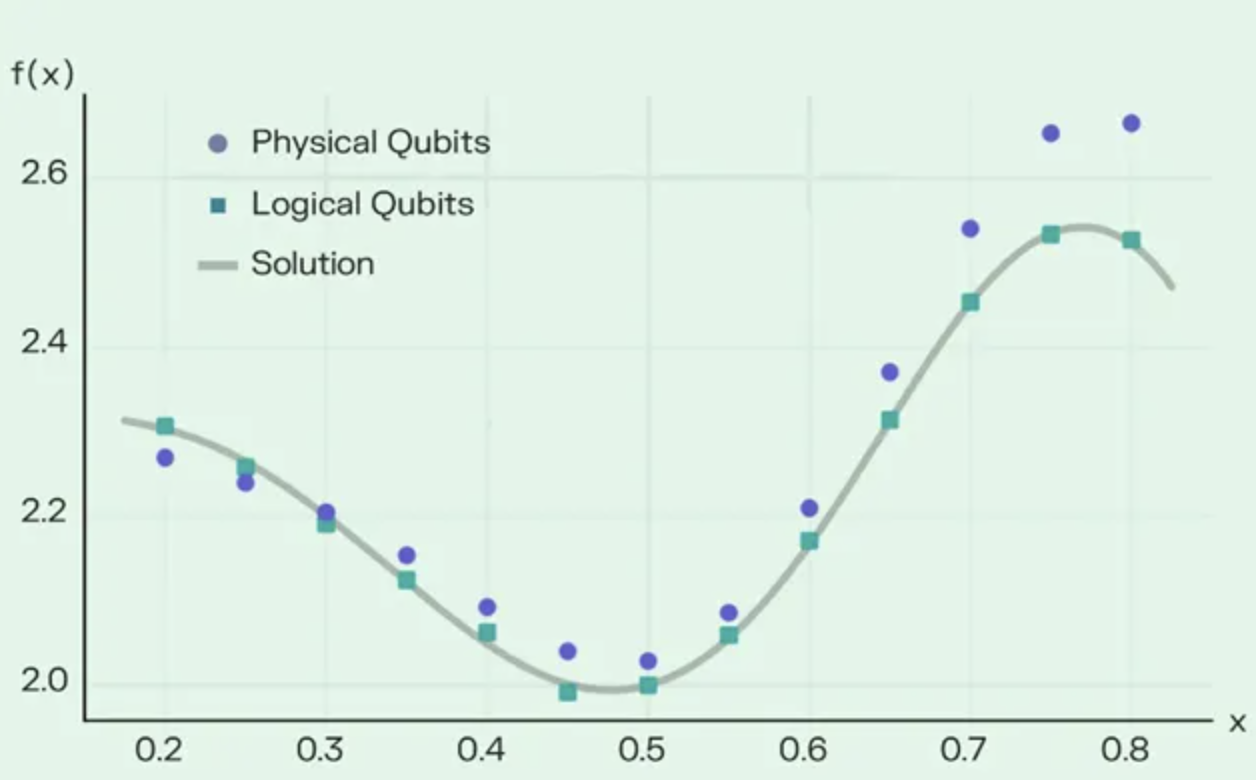
The results showed that Pasqal’s logical‑qubit approach produced more accurate answers than conventional methods, improving performance by more than 50% on average, and by up to ten times on certain challenging problems. Notably, this improvement was achieved even though the logical‑qubit method is more complex, underscoring its practical value.

“What this work demonstrates is that logical qubits are not only theoretically preferable — they are already performing better on a real computational task,” said Loïc Henriet, Chief Technology Officer at Pasqal. “More importantly, by running a complete application rather than isolated subroutines, we were able to identify precisely which error sources matter most for this class of problem. That understanding is what will guide the next phase of hardware development.”
Addressing a Foundational Challenge in Quantum Computing
Quantum computers have long promised to solve problems beyond the reach of classical systems, but their progress has been limited by errors that build up during calculations.
Pasqal’s research provides clear, real-world evidence that logical qubits can overcome this challenge. By organizing multiple physical qubits into more stable units, logical qubits are better able to detect and filter out errors before they affect results.
Until now, the performance benefit of logical encoding had been validated primarily on elementary operations — entangled state preparation, algorithm subroutines — rather than on complete, application-level computations. This work closes that gap.
Running on Pasqal’s neutral-atom processor, which has achieved a gate fidelity of 99.4%, the research team implemented a quantum kernel algorithm to solve differential equations at both the physical and logical qubit levels, then compared results systematically across 1,000 equations.
Logical qubits outperformed their physical counterparts by more than 50% on average, and by a factor of 10 on a representative nonlinear problem. The logical implementation used a more complex circuit — and still produced more accurate results.
From Analog to Fault-Tolerant: A Deliberate Research Progression
Pasqal has established a track record in analog quantum computing, with applications in optimization, simulation, and machine learning across multiple industries. The extension into logical qubit computation reflects a deliberate research progression: the team pursued this direction once the underlying hardware performance — now at 99.4% combined gate fidelity — reached a level where application-grade results became achievable.
The type of problems tackled in this research, differential equations, govern the behavior of complex systems across a wide range of industries. In aerospace, they model structural loads and fluid dynamics;in energy, heat transfer and grid stability;in pharmaceutical development, reaction kinetics and molecular behavior;in finance, risk and volatility modeling. The ability to solve these problems with greater accuracy using quantum processors — operating as accelerators within hybrid quantum-classical workflows — represents a concrete step toward quantum utility at scale.
Pasqal’s research program extends this work to additional application domains including materials, finance and energy. Near-term priorities include improving gate performance, increasing the number of logical qubits, and advancing error detection and correction capabilities. Improving how these problems are solved could unlock new efficiencies, better predictions, and faster innovation.
“What surprised us is that our logical qubits turned out to be naturally resistant to exactly the types of noise that make solving differential equations harder. We got better results than we had initially anticipated. This is why running complete applications matters;you discover things that testing individual building blocks alone never reveals. This result is a direct product of the PROQCIMA programme, which has created exactly the right conditions for this kind of foundational, application-driven research to happen at scale in France”, Henriet said.