Study: Majorana States Get Easier to Find as Quantum Chains Grow Longer


Insider Brief
- Brazilian researchers show that extending engineered quantum dot chains transforms fragile Majorana states into robust, topologically protected regions, potentially easing the path to practical quantum computing.
- Simulations indicate that increasing chain length expands narrow “sweet spots” into stable “topological islands,” where Majorana states persist even under significant disorder and parameter variation.
- The findings suggest longer chains reduce qubit sensitivity to noise and provide a clear electrical signature for detection, though scaling experiments and accounting for additional physical effects remain challenges.
Brazilian physicists have shown that the notoriously finicky quantum states needed for fault-tolerant quantum computing become dramatically more stable and easier to find as the chain of engineered particles that hosts them grows longer, a finding that could accelerate the race to build a practical quantum computer.
The work, published in Physical Review B, maps in precise mathematical detail how quantum states known as Majorana bound states evolve from fragile, needle-in-a-haystack curiosities into robust, topologically protected features of a larger system.
Majorana bound states — named after Italian physicist Ettore Majorana, who in 1937 predicted a class of particle that is its own antiparticle — are prized in quantum computing because they are theoretically immune to the environmental noise that destroys quantum information, according to the University of São Paulo scientists. Ordinary quantum bits, or qubits, are notoriously delicate: stray electromagnetic fields, heat, even cosmic rays can scramble them. Majorana-based qubits, by contrast, store information in a way that is distributed across space, making local disturbances far less damaging. That property, known as topological protection, is a goal of a major strand of quantum computing research, including more recent efforts by Quantinuum and Microsoft.

“In conventional quantum platforms, information is encoded in local degrees of freedom and, as a result, becomes extremely sensitive to microscopic imperfections, leading to rapid loss of coherence. In systems that host Majorana states, however, quantum information is stored non-locally, distributed across spatially separated regions of the device and protected by the system’s global topological properties, reducing dependence on local details and making these states particularly promising candidates for implementing more stable qubits,” Poliana Heiffig Penteado, a University of São Paulo researcher, said in a news release.
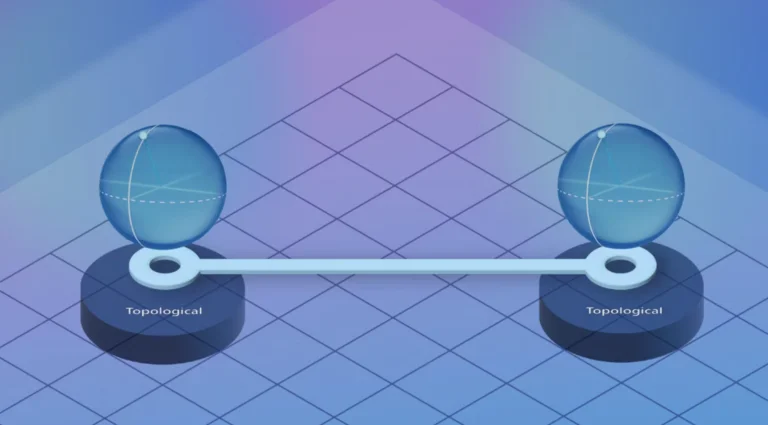
The problem is producing Majorana bound states in the first place. Physicists have sought to create them in semiconductor nanowires coupled to superconductors. One of the most promising recent approaches uses arrays of tiny engineered quantum dots — nanoscale islands that trap individual electrons — alternating with short superconducting segments. These structures, called artificial Kitaev chains after a theoretical model proposed by Russian physicist Alexei Kitaev in 2001, can in principle host Majorana states at their ends.
But in the smallest such chains — just two quantum dots linked by a superconductor — Majorana states exist only at extremely precise settings of voltage and magnetic field, a narrow target that experimenters call a “sweet spot.” Drift even slightly from those conditions and the states split in energy, losing their special properties. Because of their lack of robustness, these two-site Majorana states have been called “poor man’s Majoranas”.
Sweet Spots Become Islands
The team investigated what happens to those sweet spots as more quantum dots are added to the chain. Using mathematical frameworks standard in condensed matter physics, the researchers calculated the energy spectrum and spatial character of the zero-energy states for chains ranging from two to 50 sites. One method the team relied on is called the Bogoliubov-de Gennes formalism, framework that describes how electrons and their quantum-mechanical mirror images, called holes, behave in superconductors.
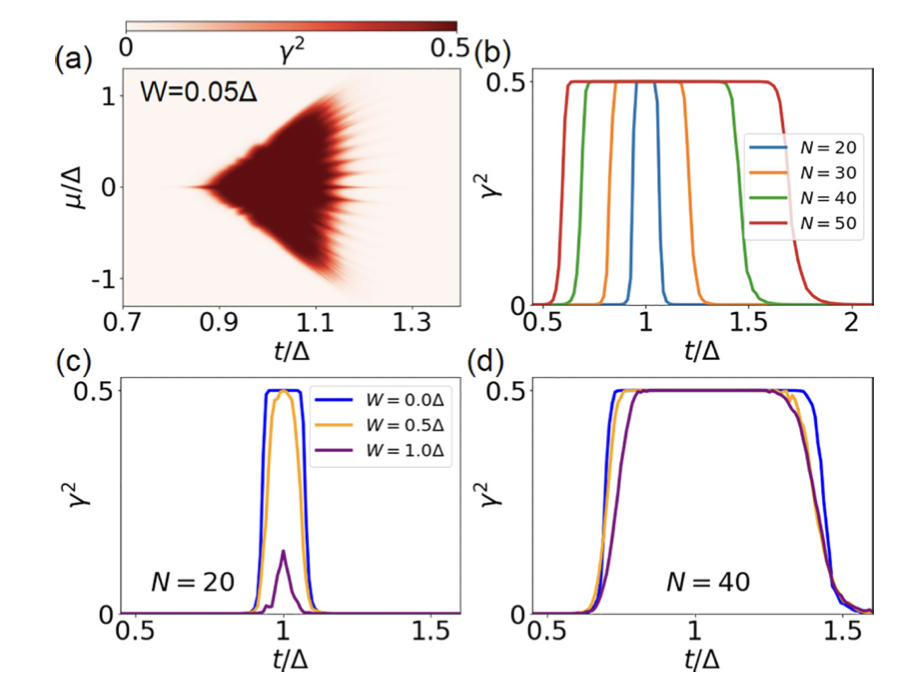
According to the team, each time a site is added to the chain, a new line of parameter settings emerges along which zero-energy states can exist. These lines converge on the original two-site sweet spot. As more lines pile up at that location, the single narrow target expands into a broad region. By the time the chain reaches nine sites, what was once a point in parameter space has grown into a visible area. By 20 or more sites, it becomes a well-defined zone — or a “topological island” — where the states remain at exactly zero energy even when disorder is introduced into the system.
The team also ran simulations of a more realistic model that includes the effects of magnetic fields needed to polarize the quantum dots’ electron spins, a step necessary in actual devices. That more complex model reproduced the same essential behavior, giving the researchers confidence that the idealized results translate to experimental conditions.
Disorder Resilience
To confirm that the expanded regions represent genuine topological protection rather than accidental near-zero energies, the researchers calculated a quantity they call gamma-squared, which distinguishes between two types of quantum operators: ordinary fermionic operators, which obey the Pauli exclusion principle and take a value of zero, and Majorana operators, which are self-adjoint. That means they are their own conjugate and take a value of one-half. A gamma-squared value of one-half is a precise mathematical fingerprint of a true Majorana state.
Within the topological islands of long chains, gamma-squared remained pinned at one-half even when the researchers introduced random disorder — simulated imperfections in the voltage settings at each quantum dot — of up to 100% of a characteristic energy scale in the system. Shorter chains showed plateaus that shrank and eventually vanished under comparable disorder. Chains of 40 sites held up far better than those of 20, with the zero-energy plateau remaining intact even for the strongest disorder tested.
The team also disclosed an important theoretical implication for quantum computing in the paper. They report that the rate at which the qubit energy splitting changes with parameter fluctuations — a quantity that governs how quickly quantum information decays — goes to zero inside a topological island. That means longer chains not only make Majorana states easier to find but also make them inherently quieter.
The next step — knowing how to detect them in a real device — will be essential. The researchers proposed and analyzed a measurement scheme in which a single probe quantum dot is attached to the side of the Kitaev chain. When a Majorana state leaks into the probe dot, the conductance — a measure of how easily current flows — becomes quantized at a specific value, one-half of the fundamental conductance quantum, a unit equal to the square of the electron charge divided by Planck’s constant. The team writes this is a distinctive electrical signature:
To put it simply, when a true Majorana state is present, tweaking the voltage on the detector doesn’t change the strength of the electrical signal, it stays locked at the same value regardless. That independence is a powerful diagnostic that separates genuine Majorana-mediated conduction from ordinary resonant tunneling, which does shift with dot energy. The researchers showed mathematically that the conductance value is directly tied to the gamma-squared quantity, providing a clean experimental link between a measurable electrical signal and the underlying quantum algebra.
At finite temperatures, the precision of the conductance mapping degrades, but the team showed it can be recovered by detuning the probe dot’s energy level, which reduces the Majorana mode’s effective coupling to the leads and sharpens the spatial resolution of the measurement, at the cost of a smaller overall signal.
Limitations and Future Work
Like all papers, this study has limitations to consider. The theoretical models, even the more realistic spinful version with magnetic fields, omit Coulomb interactions — the electrostatic repulsion between electrons on the same dot — which become important when magnetic fields are weak. The researchers acknowledged this in the paper. The disorder model is also stylized: real devices may have correlated imperfections that behave differently from the random, site-by-site fluctuations the team simulated.
The chain lengths that show the clearest topological protection, 20 to 50 sites, also exceed what has been demonstrated experimentally to date. The longest artificial Kitaev chains reported in published experiments have reached three sites, with a 2023 Nature paper from Delft University realizing a two-site chain, a 2024 Nature paper demonstrating the two-site architecture in a two-dimensional electron gas, and a 2025 Nature Nanotechnology paper reporting enhanced stability in a three-site chain. This paper’s theoretical results are consistent with those experiments, and the researchers state that extending to just four or five sites in current setups would already produce a measurable improvement in stability.
The results suggest that rather than seeking perfection in the two-site case, experimenters may be better served by pushing chain lengths into the intermediate regime of five to 10 dots as a near-term goal, before tackling the longer chains where topological protection becomes unambiguous. Future work will likely address how quickly the engineering challenges of building and controlling those longer arrays can be addressed will determine whether Majorana-based qubits move from theoretical promise to demonstrated hardware.
The research was conducted by Rodrigo A. Dourado and J. Carlos Egues also worked on the study with Penteado.

Keep track of everything going on in the Quantum Technology Market. In one place.
Topics
Matt Swayne
With a several-decades long background in journalism and communications, Matt Swayne has worked as a science communicator for an R1 university for more than 12 years, specializing in translating high tech and deep tech for the general audience. He has served as a writer, editor and analyst at The Quantum Insider since its inception. In addition to his service as a science communicator, Matt also develops courses to improve the media and communications skills of scientists and has taught courses.
[email protected]

Stay Ahead of Quantum
Get the latest research, company news, and market intelligence every week.
MENTIONED IN THE ARTICLE