


Insider Brief:
- Researchers at Quantum Source and the Weizmann Institute of Science trapped a single rubidium atom within 150–200 nanometers of a silicon-nitride photonic resonator, close enough for the atom to interact efficiently with light confined on a chip.
- The experiment addresses a key challenge in combining neutral atoms with integrated photonics: holding an atom near a stable, planar chip-based resonator without losing it to the nearby surface.
- The team used a “single-stroke loading” method that slows an approaching atom with an optical field and captures it after a single scattering event, reaching trapping probabilities of roughly 30 percent per loading pulse under optimal conditions.
- The trapped atom emitted photons into the resonator and showed measurable atom–photon coupling, including single-emitter behavior and a cooperativity value above one, suggesting a possible building block for future chip-integrated quantum photonic systems.
Quantum technologies often advance through small acts of control, such as holding an object still, placing it in the right field, or making it interact with light in a predictable way. In a recently published arXiv preprint, researchers at Quantum Source and the Weizmann Institute of Science report one such act of control by trapping a single rubidium atom within 150–200 nanometers of a silicon-nitride photonic resonator, close enough for the atom to interact efficiently with light confined on a chip.
The result matters because it addresses a practical gap between two major approaches to quantum information. Neutral atoms are valued for their well-defined quantum states and long coherence times. Integrated photonics, meanwhile, offers compact optical circuits that can be fabricated and scaled using techniques already familiar to the semiconductor industry. Bringing the two together could support quantum networks, photon-mediated logic, and chip-based quantum optical systems. The difficulty is that the atom must be held extremely close to the photonic structure, where the guided optical field is strongest, while still remaining far enough from the surface to avoid being lost.
The Difficulty of Working Near a Surface
The difficulty begins at the surface of the chip. To interact strongly with light in a photonic circuit, the atom has to sit very close to the structure, where the confined optical field is strongest. But at those distances, the chip itself becomes part of the problem. Surface forces can pull the atom away from the intended trap, and the margin for positioning is small.

Earlier experiments have trapped atoms near nanoscale optical structures, including suspended devices, optical nanofibers, and small resonators that guide light around their edge. Those demonstrations helped establish the physics of atom–photon coupling at small scales. But many of these systems are not easily translated into the kind of stable, planar photonic chips used in integrated optical circuits. The harder question is whether a single atom can be held near a flat, chip-based resonator while still coupling efficiently to the light traveling through it.
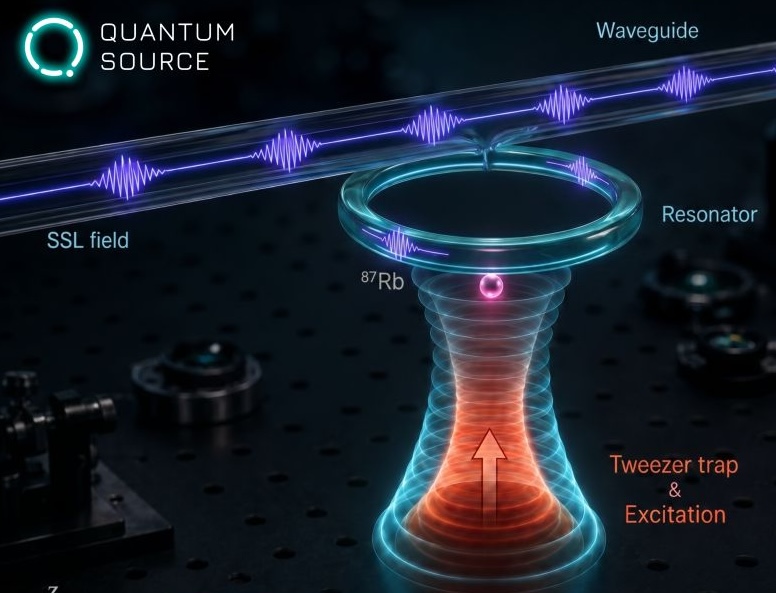
The new preprint demonstrates a method the authors call single-stroke loading. In the experiment, ultracold rubidium atoms are launched upward from a cold-atom source toward a silicon-nitride microring resonator. As an atom approaches the chip, it encounters a thin optical field extending just beyond the resonator surface. This field acts as an optical “crash cushion,” slowing the atom before it reaches the chip. A single scattered photon can then move the atom into another internal state, where it becomes trapped by a second optical field formed near the surface.
The importance of the scheme is its simplicity. The atom does not need to be cooled over many repeated cycles, nor does the experiment require fast feedback or the open optical access usually associated with more delicate suspended structures. One irreversible scattering event can remove enough kinetic energy to place the atom into the near-surface trap. Under optimal conditions, the researchers report trapping probabilities of roughly 30 percent per loading pulse. For a process in which each atom effectively gets one chance to be captured as it passes the chip, that is a meaningful result.
Reading Out a Single Atom Through the Chip
Once the atom is trapped, the researchers can detect it by looking for photons that are emitted into the resonator and carried through the chip. To confirm that the signal comes from one atom, rather than several atoms or stray light, they measure a property known as photon antibunching. This is a standard test in quantum optics: a single emitter cannot release two photons at exactly the same time. In the experiment, the team reports a measured value below the threshold typically used to identify single-emitter behavior.
The atom also interacts strongly enough with the resonator to change how it emits light. Ordinarily, an excited rubidium atom emits into open space with a lifetime of 26.2 nanoseconds. Near the resonator, that lifetime drops to 16.3 ± 0.4 nanoseconds for one trap configuration. This shortening is a sign that the resonator makes it more likely that the atom emits into the chip’s guided optical mode instead of radiating randomly into free space.
At the smallest atom–chip distance, the researchers report a single-atom cooperativity of C = 1.57 ± 0.36. Cooperativity is a way of measuring how strongly the atom and optical mode interact compared with the ways that information can be lost. A value above one does not mean the system is ready for fault-tolerant quantum computing or large-scale quantum networking. It does show that the atom is not merely sitting near the chip, but interacting with the guided light strongly enough to affect the emission process in a measurable way.
The lifetime results show both the promise and the remaining constraints of the platform. In some cases, trapped atoms remain in place for dark times extending up to one second, even without continuous cooling. More often, the signal fades across a wide range of timescales rather than following one simple decay curve. The authors attribute this to differences in how deeply atoms are loaded into the trap, and to atoms gradually escaping from the near-surface trap, likely toward the chip surface. They suggest that additional cooling steps could help extend the trapping lifetime in future versions of the system.
A Building Block, Not Yet a Machine
This is where the significance becomes clearer. The experiment is not a finished quantum processor, nor does it show an array of atoms performing logic on a chip. It shows a way of placing a single neutral atom in the near field of a planar integrated resonator, making it interact with the guided mode, and reading out the resulting photons through the chip. If it can be extended to many trapping sites, integrated with lower-loss resonators, and stabilized for longer operation, it could contribute to architectures in which atoms provide nonlinear optical interactions and photons carry quantum information across a circuit.
The authors also note that improved resonator fabrication, lower intrinsic losses, optimized couplers, and photonic crystal modes could increase cooperativity. These are demanding but familiar directions in integrated photonics. That makes the result interesting as an atomic physics demonstration, as well as a step toward systems where quantum emitters and photonic circuitry are designed together.
For now, the achievement is precise and limited in that a single atom has been trapped extremely close to a CMOS-compatible photonic resonator and shown to couple efficiently to its guided optical mode. The experiment brings neutral atoms closer to the chip in a literal sense, but it also narrows the distance between atomic quantum systems and integrated photonic platforms. While the remaining work is substantial, the result gives researchers a clearer place to begin.
For a deeper dive, the paper can be found here. Authors include Yair Margalit, Omri Davidson, Oded Zemer, Yoad Michael, Orel Bechler, Dror Liran, Noam Gross, Doron Azoury, Jeremy Raskop, Yaakov Yudkin, Gabriel Guendelman, Moshe Katzman, Michael Nagli, Yair Antman, Nadav Kandel, Geva Arwas, Idit Peer, Ofer Firstenberg, and Barak Dayan.