Foxconn Expects Quantum Commercialization in 2030


Insider Brief
- Foxconn said its quantum computing research is gaining international recognition, but the company expects commercialization to remain a few years away, with broader business opportunities emerging around 2030.
- The company’s Hon Hai Research Institute is advancing a trapped-ion quantum computing roadmap that includes two-qubit logical operations by 2026 and a 5- to 10-qubit programmable prototype by 2027 for government, academic and industrial users.
- Foxconn has also reported research progress through collaborations with the University of Tokyo on fault-tolerant quantum computing and with QunaSys on machine learning-enhanced quantum chemistry simulations.
Foxconn’s quantum computing ambitions are drawing attention beyond Taiwan, but company executives say the path from research success to commercial business remains a multi-year effort.
According to DigiTimes Asia, Foxconn Chairman Young Liu said the company’s work through the Hon Hai Research Institute has produced research that has been adopted internationally and cited by overseas companies. Liu said the challenge now is converting those scientific advances into products and services that can generate sustainable business opportunities.
Foxconn, headquartered in Taiwan, is one of the world’s largest contract electronics manufacturer, best known for assembling products for major technology companies including Apple, while also expanding into areas such as semiconductors, electric vehicles, artificial intelligence and quantum computing.

According to DigiTimes Asia, Liu said the company’s quantum-related activities may require about three more years before reaching a significant growth phase. Broader commercial opportunities are expected closer to 2030, reflecting the industry’s efforts to move beyond research and early experimentation.
Building Taiwan’s Quantum Infrastructure
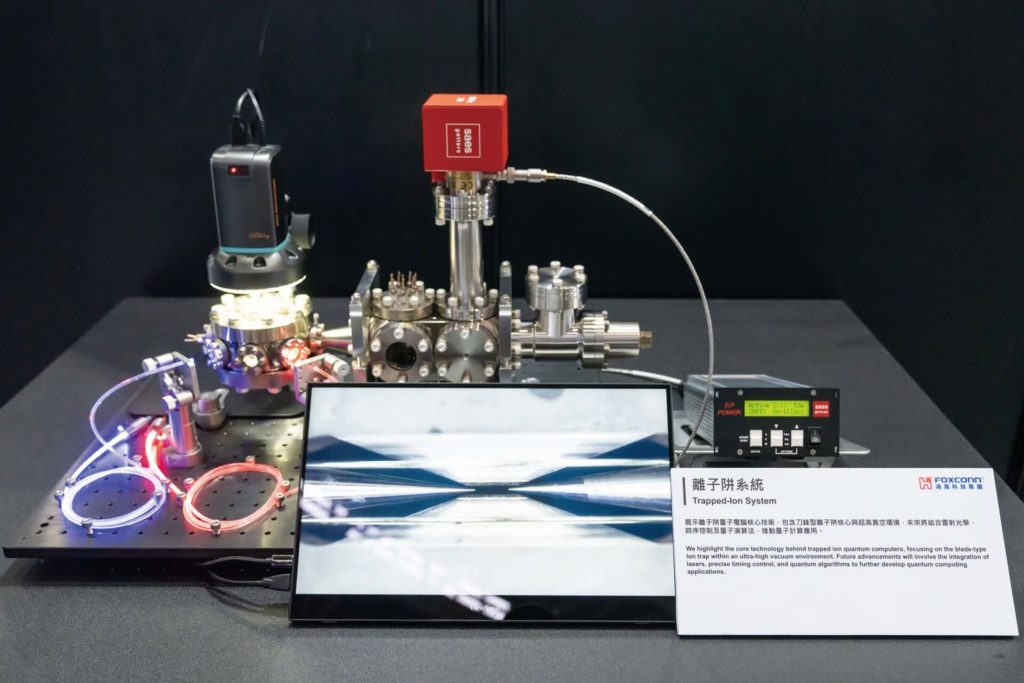
Foxconn has steadily expanded its presence in the field through the Hon Hai Research Institute, which launched its IonLab trapped-ion quantum computing laboratory in 2021. According to DigiTimes Asia, the facility officially opened in October 2023 and is considered Taiwan’s first quantum computing research laboratory fully funded by private industry.
Trapped-ion quantum computers store information in charged atoms held in electromagnetic fields. The approach is viewed as one of several competing architectures being pursued globally alongside superconducting, photonic and neutral-atom systems.
According to a previously disclosed roadmap, the comments largely reaffirm Foxconn’s previously disclosed quantum roadmap, which targets a 5- to 10-qubit trapped-ion prototype by 2027 and focuses on scaling technologies through the late 2020s, while providing a clearer estimate that broader commercial opportunities may emerge around 2030.
The emerging systems will find uses, according to the company post. However, rather than targeting immediate commercial deployment, the prototypes are expected to serve government agencies, universities and industrial users in Taiwan for education, testing and research activities. Pharmaceutical research and materials science have been identified as early application areas.
Research Progress Continues
While commercialization remains a future goal, Foxconn continues to report progress on the research front.
The institute collaborated with the University of Tokyo on fault-tolerant quantum computing research that was accepted at the QIP 2025 conference, according to DigiTimes Asia. The work examined how the overhead required for error-corrected quantum computing scales as systems become larger.
Error correction is widely viewed as one of the most important challenges facing the industry because quantum systems are highly sensitive to noise and operational errors. Any reduction in the resources needed to correct those errors could help accelerate the development of practical quantum machines.
The institute has also partnered with Japanese quantum software company QunaSys. According to DigiTimes Asia, the collaboration produced a fermionic compression encoding architecture that combines machine learning techniques with quantum chemistry simulations. The research was published in Physical Review Research.

Keep track of everything going on in the Quantum Technology Market. In one place.
Topics

Matt Swayne
With a several-decades long background in journalism and communications, Matt Swayne has worked as a science communicator for an R1 university for more than 12 years, specializing in translating high tech and deep tech for the general audience. He has served as a writer, editor and analyst at The Quantum Insider since its inception. In addition to his service as a science communicator, Matt also develops courses to improve the media and communications skills of scientists and has taught courses.
[email protected]

Stay Ahead of Quantum
Get the latest research, company news, and market intelligence every week.