Nu Quantum CEO: “The UK is Today a World Leader on Quantum”



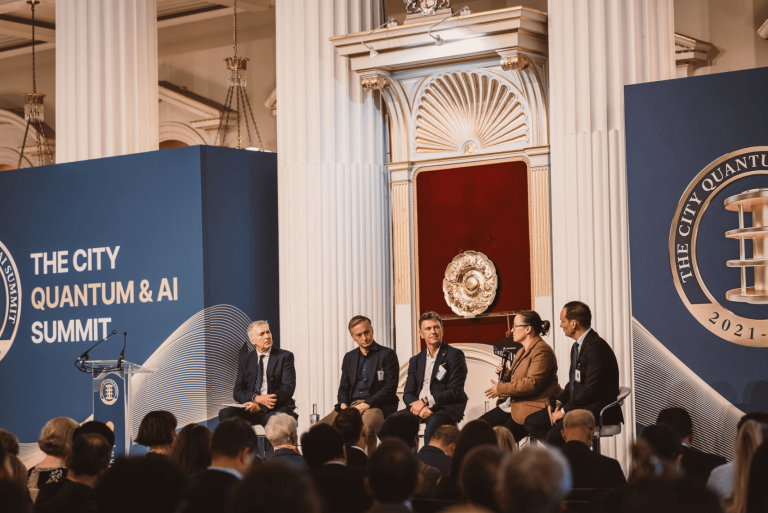
No doubt, the UK is steadily making a name for itself as a global leader in the emerging field of quantum computing. Although the technology is still in its nascent stages, the UK’s strategic investments and focus on developing talent have positioned it as a leading player in the sector. Carmen Palacios-Berraquero, the founder and CEO of Nu Quantum, a Cambridge-based quantum networking startup, is confident in the UK’s strength in quantum technology.
“The UK is today a world leader on quantum, on many metrics, so number of startups, funding, number of patents, it’s consistently top three,” said Palacios-Berraquero during a recent interview. She credits the nation’s strong scientific foundation as the driving force behind its quantum achievements, stating: “A lot of quantum science was developed in the UK. This is why people like me came to the UK to, to join that.”
Palacios-Berraquero underlined the UK government’s pioneering role in fostering quantum computing, lauding its foresight and commitment.
“Crucially, the government has had great strategy, pioneering strategy,” she said. “So, twelve years ago the government announced a first ten-year quantum strategy with £1 billion behind. Actually, most countries in the world have followed through and based their own strategies on the UK strategy.”

While the UK’s quantum ambitions are soaring, Palacios-Berraquero acknowledged the industry’s talent challenges, particularly in light of Brexit and potential visa restrictions.
“For a really fast-growing industry, talent is one of the key risks and the UK attracts top talent. But, of course, issues like visas and certain geopolitical restrictions continue to make that a bigger risk than it was before,” said Palacios-Berraquero.
Despite the talent hurdles, the funding environment for quantum computing remains robust in the UK.
“In the UK we’ve got great deep, deep tech investors. Some of them have invested in Nu Quantum and there has been billions invested in the quantum industry,” Palacios-Berraquero noted, adding, “And even with the downturn in investment in tech in 2023, quantum investment actually held up.”
As quantum computing continues to captivate the tech world, Palacios-Berraquero dismissed the notion that the technology is perpetually a decade away.
“I would like to debunk this myth that quantum computers are always ten years away,” she said. “The industry is barely ten years old. Most startups actually were founded in 2017 and 2018, and in the past six years we’ve made huge progress,” she added, projecting a commercially disruptive quantum computer by “around 2033, 2034.”
With its strategic vision, scientific prowess and supportive investment ecosystem, the UK is poised to play a pivotal role in shaping the quantum computing revolution, potentially giving rise to the industry’s first tech giants on par with Microsoft or NVIDIA.

Keep track of everything going on in the Quantum Technology Market. In one place.
Topics

James Dargan
James Dargan is a writer and researcher at The Quantum Insider. His focus is on the QC startup ecosystem and he writes articles on the space that have a tone accessible to the average reader.

Stay Ahead of Quantum
Get the latest research, company news, and market intelligence every week.
MENTIONED IN THE ARTICLE

Nu Quantum
Nu Quantum develops Entanglement Fabric and Quantum Networking Units to interconnect discrete processing cores. Founded in 2018 as a Cambridge University spinout, the company's hardware enables secure quantum networks suitable for aerospace, aviation, and satellite telecommunications, facilitating distributed quantum computing.
→
Microsoft
Microsoft engages in the creation and licensing of software for both consumer and enterprise use. The company is renowned for its development of Windows operating systems and the Office suite designed for productivity. Microsoft's structure encompasses three major segments of roughly equal size: productivity and business processes, which encompasses legacy Microsoft Office, cloud-based Office 365, Exchange, SharePoint, Skype, LinkedIn, and Dynamics; the intelligence cloud, which includes offerings like Azure, Windows Server OS, and SQL Server; and more personal computing, which covers Windows Client, Xbox, Bing search, display advertising, and a range of Surface laptops, tablets, and desktops.
→
NVIDIA
NVIDIA Corporation is an American multinational technology company and a global player in accelerated computing and Artificial Intelligence (AI). Founded in 1993, the company pushes the aerospace frontier with the Space-1 Vera Rubin Module, a platform for orbital data centers that delivers massive AI-compute Space Computing. This NVIDIA technology enables satellites and autonomous spacecraft to process and fuse sensor data rapidly Space Computing.
→



Related Articles