

Insider Brief
- Researchers demonstrated that single photons can travel kilometers through noisy fiber while preserving their quantum properties, marking progress toward practical quantum networks.
- The team used atomic clock–inspired stabilization techniques to correct fiber noise in real time, achieving over 99% photon indistinguishability and extremely low timing errors.
- The approach addresses key challenges in quantum networking and could support future applications such as distributed quantum computing, secure communications, and quantum sensor networks.
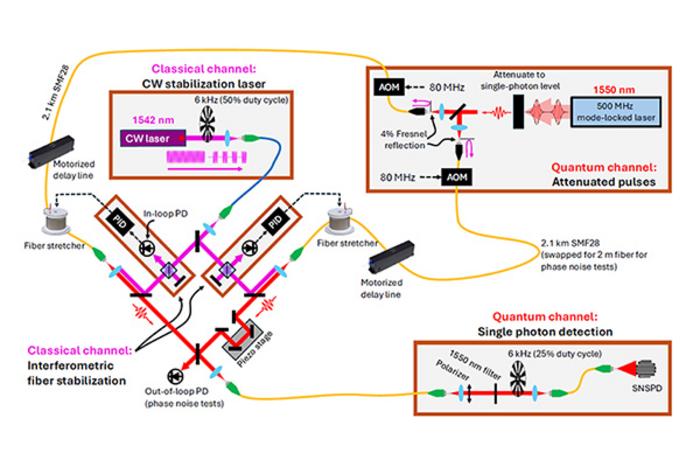
- Image: This diagram shows the experimental setup used for phase stabilization and noise measurement for a 2.1 km fiber link. (Nick Nardelli, NIST)
PRESS RELEASE — Researchers have shown that a single photon carrying quantum information can travel down kilometers of noisy real-world fiber and arrive at the far end with their quantum properties largely preserved. These highly stabilized fiber links represent a key step toward building a fast and reliable quantum network.
“Scalable quantum networks could support several emerging technologies such as distributed quantum computing, where multiple quantum processors are connected to work together, and quantum sensor networks, where spatially separated sensors share quantum correlations to improve measurement precision,” said the lead researcher Nick Nardelli from the National Institute of Standards & Technology (NIST). “Quantum networks are also expected to enable secure communication protocols that rely on the laws of quantum mechanics rather than computational assumptions.”
In the Optica Publishing Group journal Optica Quantum, researchers from NIST and the University of Colorado, Boulder, demonstrate that techniques borrowed from atomic clock networks can be used to stabilize the fiber’s optical path with nanometer precision while simultaneously detecting the single photons that carry the quantum signals. In other words, they were able to separate the trillions of photons per second needed for fiber stabilization from the quantum signal, which consists of just one photon at a time.

“Our demonstration combines three capabilities that are rarely achieved together: highly stabilized fiber links, strong separation between the classical stabilization light and the quantum signal — also known as the co-existence challenge — and compatibility with high-bandwidth optical pulses,” said Nardelli. “Overall, this helps move photonic quantum networking from laboratory experiments toward practical systems.”
Building a better quantum network
The new work is part of a larger project to build a complete quantum network that can distribute quantum signals for applications that require distributed quantum entanglement. Although other research teams have demonstrated various types of quantum networks, these networks often face challenges with fidelity and operate at rates that are currently too low for many practical applications.
“Building a complete and practical quantum network requires many new demonstrations, each tackling a different piece of the puzzle,” said Nardelli. “In this work, we specifically address how to take carefully prepared quantum states that we generate in the lab and send them to different nodes in the network — over messy, real-world optical fiber — and preserve the quantum information.”
The new work draws from NIST’s expertise in quantum optics, led by Krister Shalm at NIST, and optical frequency metrology, led by principal investigator Tara Fortier. The researchers adapted fiber stabilization methods originally developed to compare optical atomic clocks with 18-digit precision over long distances to stabilize quantum network links for high-fidelity quantum state distribution.
Nardelli, Fortier, and colleagues are exploring a network based on path entanglement, which uses the path that a single photon takes as the quantum state for the network. This approach could enable higher rates of entanglement distribution, which is a key requirement for scaling many quantum networking applications.
However, when single photons are sent through fiber optic cables to remote nodes of the network, environmental noise along the way can corrupt the fragile quantum state carried by the photons. For the network to transmit quantum information reliably and with high fidelity requires a way to sense that noise and correct it in real time.
To measure and correct this noise without disturbing the quantum photons, the researchers send a much brighter reference laser at a nearby wavelength through the same fiber. The bright laser detects fiber-induced distortions, which are then corrected in real time, stabilizing fiber length to the nanometer level.
To prevent the reference laser from overwhelming the quantum signal, the bright laser runs briefly to measure and correct noise, then switches off to let single photons travel through a quiet fiber. This cycle repeats thousands of times per second, keeping corrections valid. This allows a quantum photon to travel down a 2-kilometer-long noisy fiber and arrive at the far end looking almost identical to how it started, a requirement for quantum networking.
Keeping quantum signals intact
The researchers tested this approach by setting up two independently stabilized optical fiber links in an environment that was deliberately noisier than a typical underground installation. Rather than routing the fibers to two separate distant locations, the fibers were routed back to the same lab to enable a direct comparison of the photons coming out of each one.
Experiments showed that the separate photons traversing 2 kilometers of separate fibers were more than 99% indistinguishable. They also tested the fiber’s effect on timing because even tiny timing errors will scramble the quantum state. They were able to cancel out timing jitter added by the fiber to less than 100 attoseconds, ensuring that timing-induced phase errors remain negligible for quantum interference. Interference provides a way to extract quantum information from photons by revealing their relative phase, which is essential for verifying that quantum states remain intact after traveling through the network.
They also verified that the bright stabilization laser was not leaking into the quantum channel and contaminating the measurement, demonstrating an isolation ratio of more than 80 billion to one between the two channels. This is sufficient to ensure that, even at the laser powers used, the quantum detector would encounter less than one unwanted classical photon for every ten million quantum photons.
Next, the researchers plan to use this stabilized fiber infrastructure to demonstrate the key components of a “quantum repeater,” which is needed to extend quantum communication over long distances and lossy fibers. To accomplish this, they are developing some additional components including reliable, identical single-photon sources and more efficient single-photon detectors. Beyond entanglement distribution, the network will need to be scaled to many spatially distant nodes to enable more complex quantum protocols.
Paper: N. V. Nardelli, D. V. Reddy, M. Grayson, D. Sorensen, M. J. Stevens, M. D. Mazurek, L. K.
Shalm, T. M. Fortier, “Phase-Stable Optical Fiber Links for Quantum Network Protocols,” 3, 138-147 (2026).