


Insider Brief
- An IEEE-presented study tested whether output patterns from a 96-active-qubit IBM processor remained recognizable enough for validation and use by classical control systems in future distributed quantum workflows.
- The benchmark found that all 30 regional observations from five hardware runs matched their intended ideal references, while control circuits matched their own distinct reference patterns.
- A separate 16-qubit experiment translated a dominant measured quantum state into a “PING” command that triggered a standard data transmission between two conventional computers.
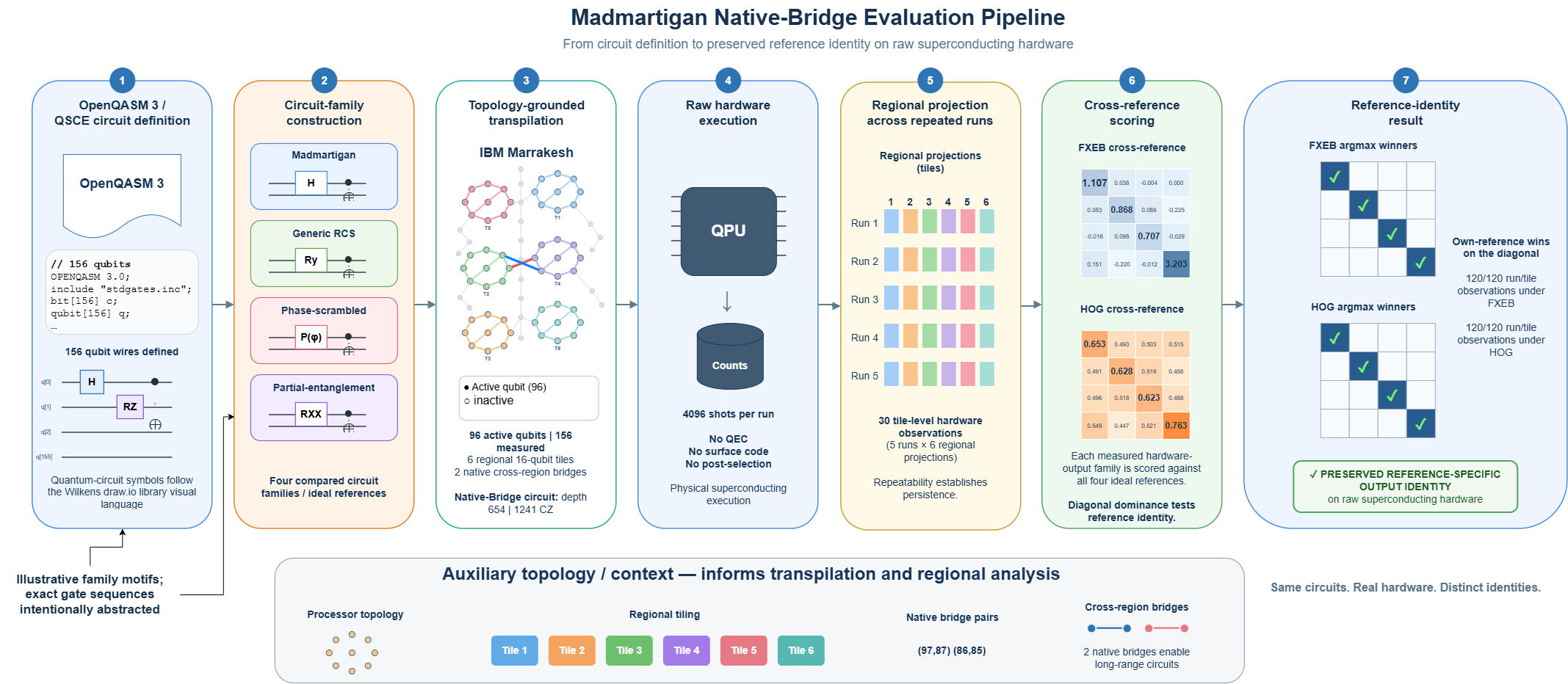
- Image: The diagram shows the full Madmartigan Native-Bridge evaluation pipeline. The workload was mapped onto IBM Marrakesh with six 16-qubit regional tiles connected through two native cross-region bridge pair. (Quantum Midi Posse)
PRESS RELEASE — A study presented at IEEE proposes a way to test whether results from quantum processors remain recognizable and useful as they move into the conventional computing systems that would coordinate future distributed quantum computers.
The research, led by Frank Angelo Drew, of Quantum Midi Posse, combines a 96-active-qubit hardware benchmark with a smaller experiment that translated a measured quantum result into a command sent between two conventional computers.
“For us, the important question is not simply whether a noisy quantum processor produces structure. It is whether the intended reference identity survives execution strongly enough to be recognized, validated and used downstream,” said Drew. “In the Madmartigan results we presented, every hardware-output family scored highest against its own ideal reference, and that identity held across all 120 run-and-tile observations under both FXEB and HOG. That is the systems capability we wanted to put on the table.”

The work addresses a practical question for distributed quantum computing. If multiple quantum processing units, or QPUs, eventually work together, the classical systems managing them will need to determine whether each quantum calculation produced a usable result before allowing the larger workflow to continue.
The study indicates that preserving recognizable output patterns and handing validated results to classical control systems should be treated as basic readiness requirements for distributed quantum computing.
It does not demonstrate a complete distributed quantum computer or a quantum network. Instead, it tests an intermediate capability that may be needed to connect quantum calculations with the classical software responsible for scheduling jobs, checking results and directing subsequent actions.
Testing Whether a Quantum Pattern Survives
The first experiment used a benchmark called Madmartigan Native-Bridge on IBM’s Marrakesh superconducting quantum processor. The circuit used 96 active qubits and included six regions based on the same 16-qubit design, with additional operations connecting the regions.
The benchmark was designed to produce a known pattern of measured results. The study then examined whether that pattern remained visible after the circuit ran on noisy quantum hardware.
The circuit included more than 6,000 quantum gate operations, including 1,241 two-qubit CZ gates. Two-qubit gates help produce the correlations and entanglement required for quantum computing, but they are also an important source of errors on current hardware.
Each hardware execution involved 4,096 repetitions, or shots. The experiment did not use quantum error correction or post-selection, a technique that removes measurements that do not meet selected conditions.
Rather than attempting to reconstruct the complete state of the 96-qubit system, the analysis examined the results from each of the six 16-qubit regions. It compared those measurements with the results expected from an ideal version of the circuit.
Five hardware executions produced 30 regional observations. All 30 showed a positive match with the intended reference pattern, according to the study.
The researchers used two statistical measures to evaluate the results. One tested whether the hardware favored the sequences of zeros and ones that were considered more likely by the ideal model. The other measured how often the processor returned results from the more probable half of the ideal distribution.
The second measure produced an average result of about 65%, compared with 50% for output that showed no preference for the expected high-probability results.
The figure should not be interpreted as a 65% accuracy rate for the complete calculation. It indicates that the intended pattern remained visible in the measured results despite hardware noise and the circuit’s size.
Distinguishing the Intended Result
The study also compared the benchmark with three control circuits. One used a generic random circuit of similar scale, another changed the phase structure of the original circuit and a third removed part of its entanglement pattern.
Each control produced its own organized output. However, the controls did not closely match the reference pattern used for the main experiment.
When each circuit was compared with its corresponding ideal model, it scored highest against its own reference. This suggests the method could distinguish the intended circuit output from other structured results rather than merely detecting nonrandom activity.
In practical terms, the test resembles identifying a song heard through a noisy radio. Detecting a rhythm would not be enough. The listener would need to recognize enough of the melody to determine which song was playing.
A distributed quantum system could use a similar check to decide whether one part of a larger calculation completed successfully. Depending on the result, the system could accept the output, rerun the calculation or prevent the result from moving to the next stage.
Using a Quantum Result as a Command
A second experiment tested whether a measured quantum output could initiate an action on a conventional network.
The experiment used a 16-qubit circuit with an internal send-route-receive structure. The eight most common results measured on the IBM processor matched the eight leading outcomes predicted before measurement, according to the study.
Software translated the most frequently measured state into a “PING” command. That command then authorized one conventional computer to send a standard data packet to another.
The communication between the computers was classical and used User Datagram Protocol, a common internet communication method. The quantum component supplied the measured result that initiated the transmission.
The receiving computer recorded the IBM backend, the identification number for the quantum job, the dominant measured state and the distribution of the eight leading outcomes. That information created a record connecting the classical action to the quantum hardware execution.
A more advanced version of the process could allow quantum results to trigger scheduling decisions, calculation retries, resource requests or subsequent stages in a hybrid quantum-classical workflow.
Future work will likely address some of the limitations in this preliminary study. For example, future studies would explore ways to connect separate quantum processors, distribute entanglement across a network and transfer quantum information between distant systems.
Both experiments were conducted on IBM Marrakesh. Quantum processor performance can vary between devices and across calibration periods, making independent reproduction and testing on additional hardware necessary.
The proposed next steps include repeating the benchmark under different hardware conditions, testing new circuit settings, auditing the underlying measurement data and incorporating the command mechanism into a distributed quantum workflow simulator.
The study suggests that future distributed quantum systems will need to be evaluated not only by their qubit counts, interconnects and ability to divide calculations, but also by whether their outputs remain recognizable, auditable and usable by the classical computers coordinating them.