Oak Ridge National Lab Promotes Quantum Roadmap, Reveals Projects’ Impacts


Insider Brief
- The Department of Energy‘s Oak Ridge National Laboratory promoted its Quantum Roadmap at the “Quantum on the Quad” event.
- ORNL’s Quantum Roadmap leverages the labs extensive experience in quantum research.
- The document is a culmination of over two decades of research and development in quantum science.
The Department of Energy’s Oak Ridge National Laboratory (ORNL) recently showcased its Quantum Roadmap at the “Quantum on the Quad” event, revealing its path toward quantum research and development. This strategic document is a culmination of over two decades of research and development in quantum science, aligning the lab’s substantial resources and expertise with the Department of Energy’s broader mission, according to a story on ORNL’s website.
The Quantum Roadmap leverages ORNL’s extensive experience in quantum research, including its workforce of more than 30 full-time quantum specialists and the Quantum Science Center. These resources are instrumental in exploring the practical applications of quantum mechanics, a field that promises revolutionary advancements in various sectors, from supercomputing to energy grid security.
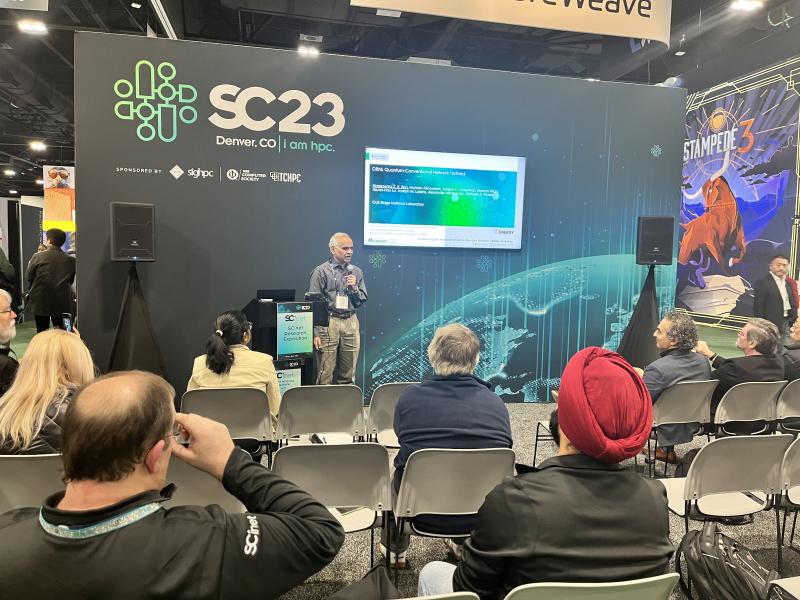
The team discussed three significant funding awards at the event that underscore the lab’s position as a frontrunner in the quantum computing and networking domain.

One project, the Performance Integrated Quantum Scalable Internet (PiQSci), involves a collaboration with the University of Massachusetts-Amherst, University of Arizona, University of Texas at Austin, and Arizona State University. This project aims to develop a scalable quantum internet, enhancing network capacity and security while facilitating faster processing of substantial data volumes. PiQSci, receiving $6 million over three years, will capitalize on ORNL’s existing infrastructure, including its 300-kilometer “dark fiber” testbed—the longest in the national lab complex—supporting high-speed data transfer and dedicated quantum networking channels, according the the ORNL story.
Project lead and ORNL Corporate Fellow Nageswara Rao emphasized that a multidisciplinary approach is a key aspect of the PiQSci project.
“This project team provides the multidisciplinary expertise in theory and experiment needed to design and build the quantum networks enabled by our testbed with powerful quantum-conventional capabilities,” said Rao.
In parallel, ORNL is undertaking the Grid Research, Integration, and Deployment for Quantum (GRID-Q) project, funded with $3.75 million over three years. This initiative, supported by DOE‘s Office of Electricity, Office of Fossil Energy and Carbon Management, and Office of Cybersecurity, Energy Security, and Emergency Response, aims to integrate quantum technologies into the power grid. Envisioned to enhance grid efficiency and security, GRID-Q involves collaborations with four other national labs, three academic institutions, and two industry partners.
Co-project lead and ORNL distinguished research scientist Warren Grice said the project’s goal is to transition quantum technologies from lab settings to practical grid applications, ensuring a resilient and secure power infrastructure.
“We believe that quantum technologies can help make the power grid more efficient and secure, and the GRID-Q project seeks to help move those technologies from the laboratory to the real world,” said Gricr.
Suman Debnath, also a co-lead, added that the project could help power grid experts comprehend and integrate quantum technologies.
Additionally, the AQUEDUCT (Assessment of Quantum Utility EvaluateD Under Current Technologies) project, backed by $1 million over four years, is set to develop benchmarks for quantum computing utility. With partners including the University of Tennessee, Knoxville, MITRE, Virginia Tech, and the University of Southern California, AQUEDUCT aims to bridge hardware noise characterization with application-level performance in quantum computing.
Kathleen Hamilton, project lead and ORNL staff member, noted that AQUEDUCT seeks to provide predictive metrics for assessing quantum computers’ utility in addressing contemporary and future computational challenges.
“The AQUEDUCT project addresses two rapidly developing areas of quantum computing: characterizing hardware noise at the component level and connecting the impact of this noise to application-level performance,” said Hamilton. “By bridging these twin research efforts, AQUEDUCT aims to develop predictive metrics for assessing the utility of quantum computers for today’s and tomorrow’s computational science challenges.”
Managed by UT-Battelle for DOE’s Office of Science, ORNL continues to spearhead research in the physical sciences. The Office of Science is committed to addressing some of the most pressing challenges of our time. For more information, visit https://energy.gov/science.
If you found this article to be informative, you can explore more current quantum news here, exclusives, interviews, and podcasts.

Keep track of everything going on in the Quantum Technology Market. In one place.

Matt Swayne
With a several-decades long background in journalism and communications, Matt Swayne has worked as a science communicator for an R1 university for more than 12 years, specializing in translating high tech and deep tech for the general audience. He has served as a writer, editor and analyst at The Quantum Insider since its inception. In addition to his service as a science communicator, Matt also develops courses to improve the media and communications skills of scientists and has taught courses.
[email protected]

Stay Ahead of Quantum
Get the latest research, company news, and market intelligence every week.
MENTIONED IN THE ARTICLE

US Department of Energy
The United States Department of Energy is a cabinet-level department of the United States Government concerned with the United States' policies regarding energy and safety in handling nuclear material.
→

Oak Ridge National Laboratory Quantum Computing Institute (ORNL)
The Oak Ridge National Laboratory (ORNL) Quantum Computing Institute is a lab-wide collaboration that promotes the use of theory, computation, and experiment in the research and development of quantum computing for scientific applications of next-generation computer systems. The lab has various partnerships across the quantum ecosystem with major players such as IonQ, the EU Quantum Flagship and GENCI project, Qubitekk, Aliro Quantum, and many more.
→

U.S. Department of Energy (DOE)
The mission of the Department of Energy is to ensure America's security and prosperity by addressing its energy, environmental, and nuclear challenges through transformative science and technology solutions. In September, 2022, Research supported by ASCR demonstrated that classical machine learning algorithms can accurately predict ground state properties and classify quantum phases of matter using data generated from quantum experiments. In November, 2022, Research supported by Q-NEXT revealed that the performance of a sensor network is constrained by the intrinsic noise associated with the quantum states used in the network. In March, 2023, Research funded by DOE SC NP achieved the first experimental observation of entanglement between dissimilar particles, specifically positive and negative pions. In August, 2023, Research funded by DOE SC BER demonstrated strong preservation of entanglement in a two-photon absorption process involving organic molecules, offering a new approach for developing quantum light-based spectroscopy and microscopy.
→

University of Tennessee
The University of Tennessee, located in Knoxville, Tennessee, United States, is a public land-grant research university. It was established in 1794, two years prior to Tennessee becoming the 16th state. The university serves as the main campus of the University of Tennessee system.
→

National Security Engineering Center (MITRE)
NSEC delivers research, engineering, and analytical solutions to the Department of Defense and the Intelligence Community. Since 1958, NSEC has contributed transformational innovations to essential systems such as the Semi-Automated Ground Environment (SAGE), the nation’s first air-defense system. These include Joint STARS, the Air Force/Army airborne ground surveillance, battle management, command and control aircraft, and Intelink, the first secure intranet used by the Intelligence Community. A team of physicists led by MITRE’s Gerry Gilbert, a theoretical physicist and quantum expert, are working on a quantum moonshot: a mission to build a scalable universal quantum computer.
→

University of Southern California
The University of Southern California is a private research university located in Los Angeles, California. Established in 1880 by Robert Maclay Widney, it holds the distinction of being California's oldest private research university.
→