


Insider Brief
- Oak Ridge National Laboratory researchers developed LuGo, a quantum algorithm that reduced quantum gate requirements by more than 95% in a fluid-flow modeling problem.
- LuGo performs more calculations on classical computers before encoding data into quantum circuits, cutting the required gate count from 2 million to 91,000.
- Researchers validated the algorithm through classical simulations and evaluated it on quantum processors, with potential future applications in microfluidics, groundwater flow and porous media flow.
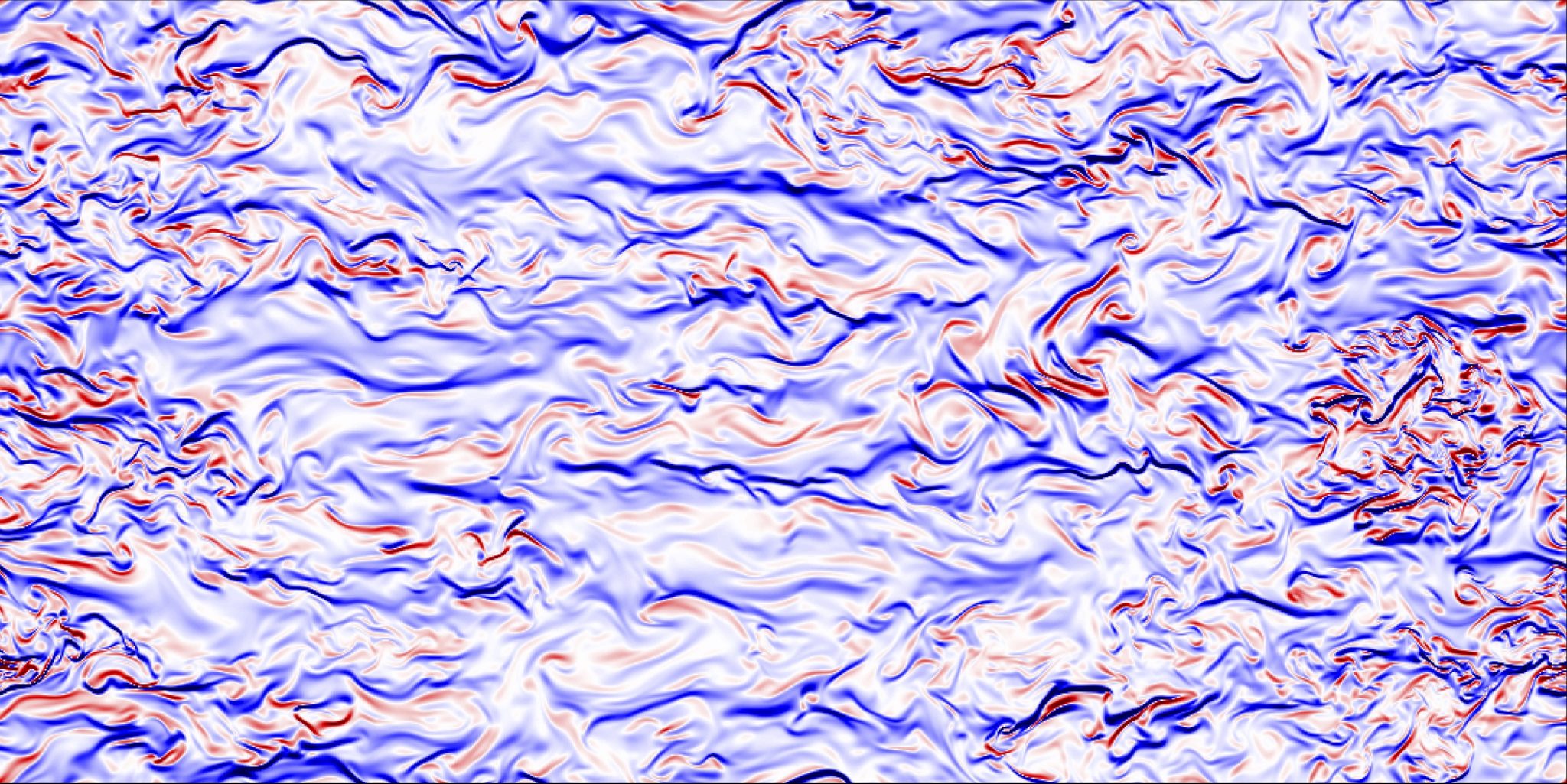
- Image: A 2023 simulation on Oak Ridge National Laboratory’s Summit supercomputer used trillions of grid points to model turbulence in ocean water. LuGo, a quantum algorithm developed by ORNL researchers, could open new possibilities for such quantum studies of turbulence. (Miles Couchman)
PRESS RELEASE — Researchers at the Department of Energy’s Oak Ridge National Laboratory used the world’s fastest supercomputer for open science to develop a quantum algorithm that could lead to more advanced models in fluid dynamics and other scientific fields.
The results of the study, supported by the Oak Ridge Leadership Computing Facility’s Frontier supercomputer and Quantum Computing User Program (QCUP), highlight new opportunities to explore quantum computing’s emerging potential to fuel scientific discovery. The findings could ultimately support applications in such real-world problems as microfluidics, groundwater flow and porous media flow as scientists work to develop more accurate, “fault-tolerant” quantum computers with lower error rates.
The innovation received a 2026 R&D 100 Award from science and technology media group R&D World, one of a record 22 of the annual awards for ORNL.

“We wanted to find a smarter approach to dealing with a major computational bottleneck in quantum modeling of fluid dynamics,” said Chao Lu, an ORNL postdoctoral researcher who led the study presented at the 2025 IEEE International Conference on Quantum Computing and Engineering. “Now we’re interested to see what kind of acceleration it can enable for other applications.”
Speeding up simulations
The team’s findings build on those of a previous ORNL study examining potential quantum approaches to solve the Hele-Shaw flow equation — a scenario of two flat, parallel plates extremely close to each other and the flow of liquids and gases between them — using the Harrow-Hassidim-Lloyd (HHL) algorithm, a quantum algorithm for solving a set of linear equations.
Modeling fluid flow plays an essential role across industrial design in fields from aerodynamics to oil refining. The unsteady flow of air, other gases and liquids over machinery parts can lead to turbulence that holds back performance.
Traditional approaches to modeling flow rely on complex sets of approximated equations that can fail to account for finer details. Simulating flow captures more of the physics but can require huge amounts of computing time. A recent 3D simulation of oceanographic flow using ORNL’s Summit supercomputer, for example, required modeling trillions of grid points.
The binary bits used in classical computing simulations allow only one possible value to be assigned per bit. Quantum computing, which relies on quantum bits, or qubits, to store information, allows combinations of values to be encoded on a single bit. That dynamic enables a wider range of possible values that could open new avenues to solving complex problems such as predicting fluid flow.
Making the most of that advantage requires holding down the relatively high error rate caused by the delicate nature of qubits. Researchers have tested various solutions, but the industry hasn’t settled on a standard protocol. The final medium for encoding qubits also remains a moving target, with various systems employing neutral atoms, trapped ions, superconductors and other materials.
The current generation of quantum computers, known as noisy intermediate-scale quantum, relies mostly on running small-scale problems to be calculated on a limited number of qubits.
Clearing the chokepoint
The team’s quantum approaches to the Hele-Shaw problem hit a roadblock: converting the equation to quantum form, known as quantum phase estimation (QPE), consumed more than 90 percent of the computational effort. The primary bottleneck lay in the required number of logic gates, the basic building blocks of quantum circuits.
“We needed 2 million gates to perform the necessary calculations,” said Murali Gopalakrishnan Meena, an ORNL computational scientist and co-author of the study. “These gates are like switches between functions or like intersections on a busy highway. Just as more intersections mean more traffic, more gates mean more potential for error, or noise. That’s especially true in quantum computing, because the volatile nature of qubits causes them to degrade quickly and introduces a high degree of noise already.”
The team obtained allocations of time on Frontier, the OLCF’s 1.4-exaflop flagship supercomputer capable of up to 1.4 quintillion calculations per second, and Perlmutter, the National Energy Research Scientific Computing Center’s 113-petaflop supercomputer, capable of more than 1 quadrillion calculations per second.
“For these kinds of calculations, we needed machines with lightning speeds,” Gopalakrishnan Meena said.
The team used those resources to develop LuGo, a QPE algorithm that streamlines the process and cuts computational demand. The team validated the algorithm by conducting classical simulations of the quantum circuits.
The team also obtained allocations of time on Quantinuum’s H-1 quantum computer, IBM’s Marrakesh and Sherbrooke quantum computers and IQM’s Garnet and Sirius quantum computers via QCUP, part of the DOE’s Quantum User Expansion for Science and Technology Initiative, which awards time on cloud-based commercial quantum processors around the country to support research projects. The IBM and IQM computers rely on superconducting qubits, while Quantinuum’s H-1 relies on trapped ions.
The team used those machines to evaluate the algorithm’s quantum capabilities.
LuGo delays quantum conversion by performing more initial calculations, known as preprocessing, on the classical side before encoding the data as quantum circuits.
“With LuGo, we reduced the computational effort tremendously and observed better overall performance,” Lu said.
LuGo enabled the team to cut the number of quantum gates from 2 million to 91,000 – a reduction of more than 95 percent in computational demand. The improvement required just one of Frontier’s nearly 10,000 nodes.
“What LuGo does is extend the HHL solution’s capability to new levels of detail in much less time,” said Kalyan Gottiparthi, an ORNL computational scientist and co-author of the study. “As quantum computing grows as a field and as we move toward a fault-tolerant generation of quantum computers, we expect we’ll find more of these kinds of approaches that allow us to leverage established classical solutions in new ways adapted for a quantum advantage.”
This research was supported by the DOE Office of Science’s Advanced Scientific Computing Research program. The OLCF and NERSC are ASCR-funded Office of Science user facilities.
Related publication: Chao Lu, Marc Illa, Muralikrishnan Gopalakrishnan Meena, and Kalyan Gottiparthi. “LuGo: An enhanced quantum phase estimation implementation.” Future Generation Computer Systems 178:
108270 (2026). DOI: https://doi-org.ornl.idm.oclc.org/10.1016/j.future.2025.108270
UT-Battelle manages ORNL for DOE’s Office of Science, the single largest supporter of basic research in the physical sciences in the United States. DOE’s Office of Science is working to address some of the most pressing challenges of our time. For more information, visit https://energy.gov/science.