One Broken Symmetry Opens a Path to Universal Quantum Control


Insider Brief
- Researchers developed a theory of universal control in globally driven quantum systems and demonstrated an effective three-atom interaction in a Rydberg-atom experiment.
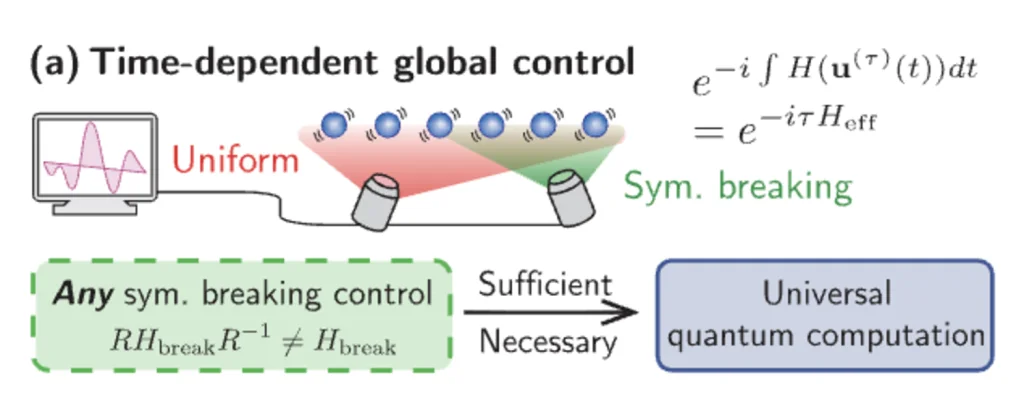
- For a one-dimensional qubit chain with uniform nearest-neighbor interactions and global rotations, adding a controllable field or interaction that breaks mirror symmetry enables universal quantum control.
- Optimized global pulses produced a three-atom ZXZ interaction in an eight-atom chain, with measurements showing signatures of topological edge modes.
PRESS RELEASE — A new theory identifies what globally driven quantum systems need to become fully controllable. In a Rydberg-atom experiment, optimized pulses also create an interaction involving three atoms at once.
The study by Hong-Ye Hu and colleagues is forthcoming in Nature Physics. The linked manuscript is the authors’ preprint.
Many quantum simulators use a small number of laser fields that act on every atom at once. This shared control can make large systems easier to operate, but it raises a basic question: can a device controlled globally perform a full range of quantum operations, or is it limited to the interactions built into its hardware?

For a one-dimensional chain of qubits, the researchers prove a precise rule. With uniform interactions between neighboring qubits and global rotations, the remaining obstacle is mirror symmetry: atoms on opposite sides of the chain are indistinguishable. Add a controllable interaction or field that breaks that symmetry, and universal quantum control becomes possible. The team also extends related results to fermionic and bosonic systems.
To turn the theory into a lab-ready method, the team developed direct quantum optimal control, which searches for pulse sequences while accounting for practical limits on the lasers and for atomic motion. In a Rydberg-atom array, optimized global pulses produced the dynamics of an effective ZXZ interaction: one coupling shared by three neighboring atoms, beyond the device’s native pair interactions. The target also required working outside the usual Rydberg blockade regime, where strong interactions normally suppress nearby excitations and make control easier.
In a chain of eight atoms, measurements showed that the end atoms retained distinctive signals and correlations as the rest of the chain evolved—a signature of topological edge modes. Numerical results in the paper also suggest that random global pulses can spread quantum information quickly, with characteristic measurement statistics emerging on a timescale that grows only logarithmically with the number of atoms.
Together, the results connect a mathematical answer to a practical control method: global fields can support far richer quantum dynamics than the hardware’s built-in interactions alone would suggest.

Keep track of everything going on in the Quantum Technology Market. In one place.

Matt Swayne
With a several-decades long background in journalism and communications, Matt Swayne has worked as a science communicator for an R1 university for more than 12 years, specializing in translating high tech and deep tech for the general audience. He has served as a writer, editor and analyst at The Quantum Insider since its inception. In addition to his service as a science communicator, Matt also develops courses to improve the media and communications skills of scientists and has taught courses.
[email protected]

Stay Ahead of Quantum
Get the latest research, company news, and market intelligence every week.
MENTIONED IN THE ARTICLE