


Insider Brief
- OpenAI said GPT-5.6 Sol, working through Codex, autonomously completed routine measurements on an MIT six-qubit superconducting chip, reducing the need for constant researcher supervision.
- The AI agent selected experimental settings, operated laboratory hardware, analyzed data and calibrated qubit frequencies, control pulses and information-retention times.
- The agent performed well with clear signals but sometimes required expert guidance when results were weak, noisy or physically ambiguous.
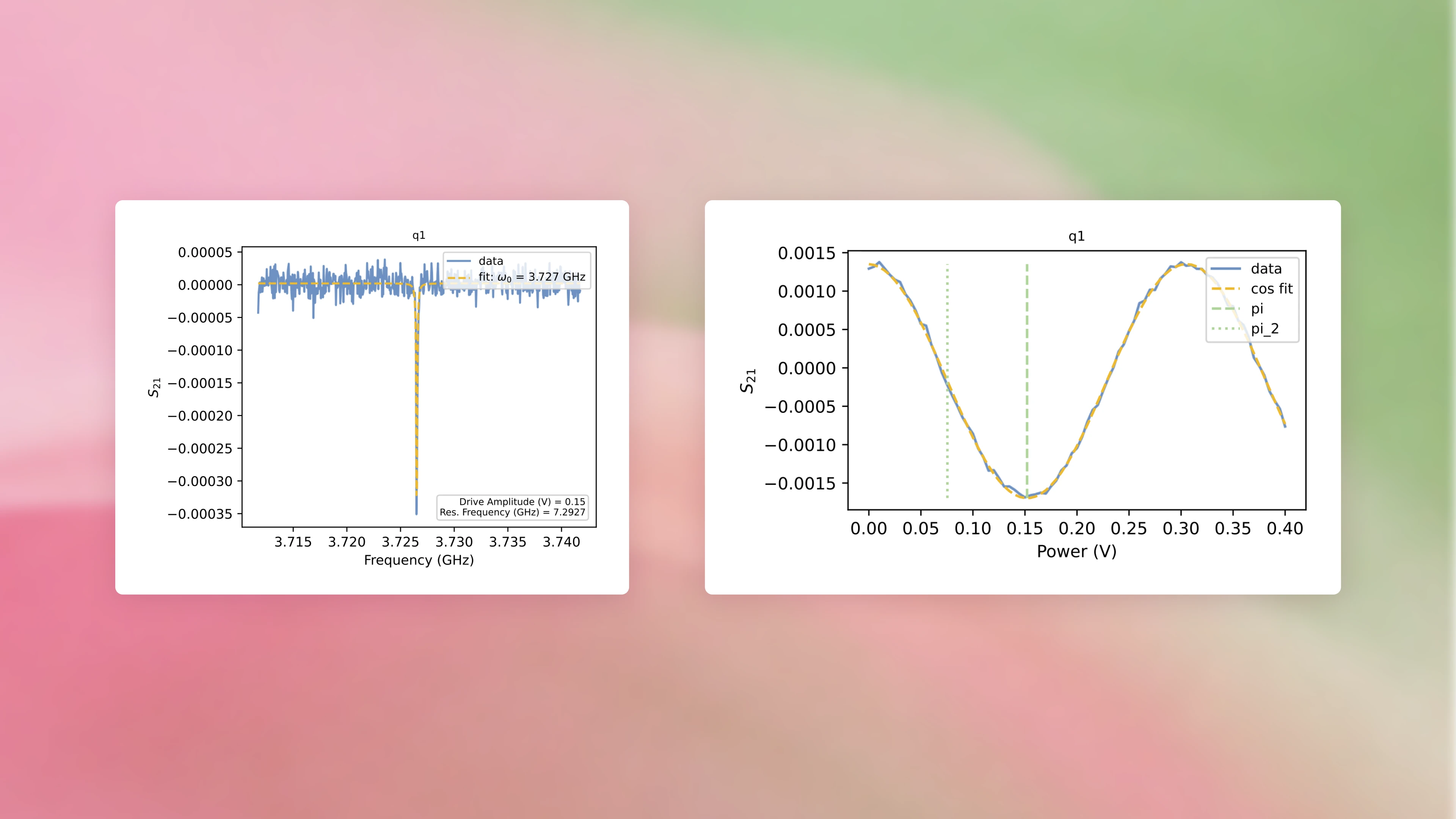
- Image: A set of calibration measurements for one qubit, completed autonomously by GPT‑5.6 Sol. (EQuS group)
Artificial intelligence agents can independently run many routine quantum-computing experiments, potentially reducing days of hands-on laboratory work while leaving scientists responsible for difficult measurements and unexpected results, according to an OpenAI blog post.
In the post, the company described an experiment in which Beatriz Yankelevich, a graduate student in the Massachusetts Institute of Technology’s (MIT) Engineering Quantum Systems Group, used GPT-5.6 Sol through Codex to characterize a six-qubit superconducting chip. The AI system selected measurement settings, operated laboratory hardware, analyzed data and used the results to determine what to do next.
When experimental signals were clear, the agent completed a standard series of measurements with little intervention from a researcher, OpenAI said. The system identified the qubits’ operating frequencies, calibrated the signals needed to control and read them, and measured how long the devices could retain quantum information.

The AI had more difficulty when signals were weak or obscured by noise. It sometimes took longer to select useful measurement settings and occasionally required help from an experienced researcher. The results suggest AI agents can take over structured and repetitive portions of quantum research, but they are not yet reliable substitutes for scientists when physical systems behave in uncertain or unfamiliar ways.
The work offers a practical example of how AI could affect scientific research beyond drafting text, searching scientific literature or writing computer code. By connecting the agent directly to laboratory software, the MIT researchers allowed it to act on a physical experiment, evaluate the response and adjust its approach.
OpenAI said the MIT group now regularly uses agents to conduct routine measurements on its standard chips. That can free researchers to spend more time interpreting results, designing new experiments and deciding which scientific questions to pursue.
“I’ve built infrastructure to guide agents through several parts of my work—measurement, theory, and chip design—and now it’s really starting to pay off,” Yankelevich said, according to the post. “I can have multiple agents working on different problems at once, and I spend most of my time on higher-level work—interpreting results, devising experiments, planning next steps for the agents, reading, and writing.”
A Time-Consuming Calibration Process
Quantum computers process information using quantum bits, or qubits. Unlike conventional bits, which represent either a zero or a one, qubits can use properties of quantum mechanics to represent and manipulate information in more complex ways.
The technology could eventually help scientists simulate molecules and materials that are difficult for conventional computers to model. Such capabilities could support research in areas including chemistry, medicine and materials science. Today’s quantum processors, however, remain sensitive machines that require extensive calibration before researchers can use them reliably.
The MIT group studies systems that use superconducting qubits, which are devices are built on chips using electrical circuits and are cooled to temperatures close to absolute zero in specialized systems known as dilution refrigerators. Cooling reduces thermal disturbances that could disrupt the fragile quantum information stored by the qubits.
Superconducting qubits perform operations quickly and can be controlled with microwave signals. They can also be produced using manufacturing techniques related to those used in the semiconductor industry. Once a chip has been fabricated, packaged and cooled, researchers generally interact with it through software rather than by physically adjusting the device.
That software-based control made the experiments a suitable test for an AI agent. Codex was connected to the laboratory software used to coordinate measurements, allowing the agent to send instructions to the chip, process returned signals and choose subsequent steps.
The task still involved more than running a fixed script. Before scientists can use a superconducting chip, they must conduct a sequence of measurements whose results depend on one another. An incorrect value early in the process can affect later tests and prevent researchers from properly controlling the qubits.
Each chip may require hundreds or thousands of preliminary measurements. Preparing, calibrating and running more complex qubit experiments can take months. Even characterizing one of the MIT group’s standard chips can occupy a researcher for several days, according to OpenAI.
Giving the Agent Laboratory Skills
Yankelevich tested the AI system on an uncalibrated six-qubit chip of a type the MIT group commonly uses to evaluate its fabrication process.
She provided Codex with specialized instructions, described as skills, explaining how to conduct and assess individual experiments. Those instructions gave the agent a framework for operating the equipment and evaluating whether a measurement had produced a useful result.
Using the skills and the chip’s intended design specifications, GPT-5.6 Sol selected experimental parameters and operated the hardware. It then analyzed the resulting data and decided whether to refine the measurement or save the result for the next stage.
The agent first had to identify the qubits’ transition frequencies. Superconducting qubits are sometimes described as artificial atoms because they can occupy only specific energy levels. Researchers use microwave pulses to move a qubit between these levels and to probe its quantum state.
Finding the relevant frequency allows scientists to address and control a qubit accurately. Researchers must then calibrate the microwave pulses used to operate the device and the procedures used to read its state.
The system also measured how long a qubit retained quantum information. That duration is an important indicator of device performance because qubits gradually lose their quantum properties through interactions with their surroundings. Researchers need to complete operations before that information deteriorates.
According to OpenAI, the agent handled this standard sequence with little human assistance when the returning signals were easy to distinguish. Its performance weakened as the data became less clear.
Quantum devices can drift over time, meaning their measured properties may change and previously selected settings may no longer work as expected. Hardware defects, environmental disturbances and other physical effects can also produce inconsistent or misleading signals.
Experienced researchers can often recognize these conditions and adjust an experiment based on their understanding of the device. The AI agent was less capable of interpreting such ambiguity, showing that successful laboratory automation depends on more than following a sequence of software commands.
AI as a Laboratory Assistant
The immediate benefit is not necessarily that an AI agent can calibrate a chip faster than an experienced scientist. OpenAI acknowledged that researchers may still identify the best settings more quickly than current models.
The advantage instead comes from reducing the amount of time researchers must spend watching routine experiments. An agent can continue making incremental progress without constant supervision, allowing a scientist to work on analysis, experimental design or other projects.
Laboratory research frequently involves long periods of data collection and equipment monitoring. Automating those periods could allow research groups to test more chips or conduct additional measurements without a increasing staff time.
Routine chip characterization is well suited to the approach because it follows a relatively defined process. Researchers know which properties need to be measured, how the experiments depend on one another and what a plausible result should look like.
Novel research presents a harder problem because there may be no established procedure. Unusual data could also represent either an experimental error or an important physical effect. In those cases, Yankelevich gives Codex agents narrower goals and retains greater control over scientific decisions, according to OpenAI.
The agents can still support new experiments by writing, modifying and testing software for hardware control, data analysis and simulation. Direct access to the laboratory lets them revise code and immediately test it against measurements from a physical device.
The experiment also points to a broader model for AI-assisted science. Rather than operating as a general-purpose system with unrestricted control, an agent can be given a defined set of tools, laboratory instructions and boundaries. Scientists can assign routine tasks while stepping in when results fall outside expected ranges.
Important questions remain about reliability, oversight and whether the approach will transfer to larger or less familiar systems. The demonstration involved a standard six-qubit chip and workflows already understood by the MIT group. It did not establish that an agent could independently diagnose new hardware problems or interpret results from an unexplored experiment.
You can read the technical case study here.


.png)