University of Cambridge Joins UK Quantum Commercialisation Initiative


Insider Brief
- The University of Cambridge has joined the UK Quantum SuperConnector, a five-university initiative designed to help commercialise quantum research and support the growth of quantum businesses across the UK.
- Cambridge’s contribution will draw on the Maxwell Centre’s commercialisation expertise, with Dr Aga Iwasiewicz-Wabnig serving as Co-Director alongside Imperial Business School’s Professor Ramana Nanda.
- The programme will connect researchers with entrepreneurs, investors and industry partners through commercialisation training, a dedicated quantum accelerator track and a UK-wide digital ecosystem platform.
PRESS RELEASE — A consortium of five of the UK’s top universities, including the University of Cambridge, has announced the launch of the UK Quantum SuperConnector, an initiative designed to bridge the gap between quantum research and commercial success.
The initiative will create a UK-wide community of entrepreneurs, investors, industry adopters and policymakers that will strengthen the vibrant quantum ecosystem across the UK.
The programme will help researchers across the country to accelerate the adoption of quantum technologies, attract investment and enable growth.

The five universities – Cambridge, Imperial College London, and the Universities of Bristol, Glasgow and Oxford – all have deep strengths in quantum research and commercialisation.
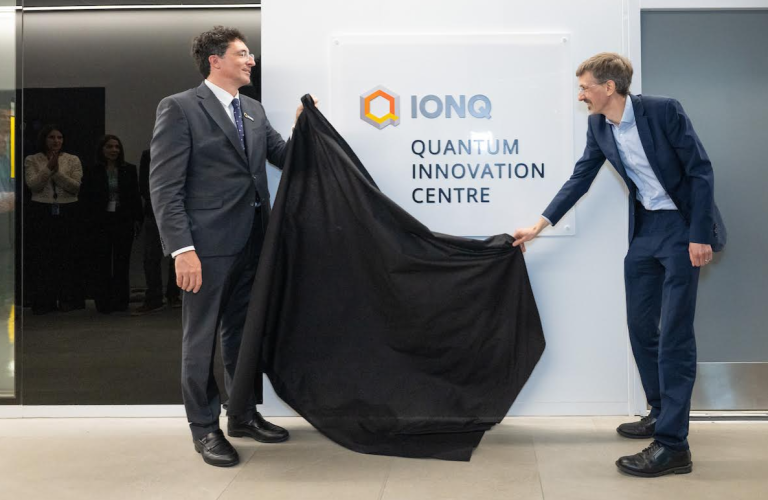
Cambridge’s contribution will draw on its track record in translating quantum research into commercial success through both startups and industrial collaboration, including Nu Quantum, Riverlane, and the University’s partnership with IonQ to establish the IonQ Quantum Innovation Centre, which was launched in October 2026 and will be the home of the most powerful quantum computer in the UK when it is installed next year.
Professor Ramana Nanda from Imperial Business School will serve as Director of the Quantum SuperConnector. Dr Aga Iwasiewicz-Wabnig, Director of the University of Cambridge’s Maxwell Centre, will serve as Co-Director.
“The UK’s long-standing strategic investment in quantum research, including through its National Quantum Technologies Programme (NQTP), already generates world-class science,” said Iwasiewicz-Wabnig. “We must now build up a matched capability to commercialise and deploy emerging quantum-enabled technologies, wherever in the UK the right ideas originate.”
“The UK Quantum SuperConnector will draw on the decade of expertise of the Maxwell Centre in taking research towards impact,” said Professor Mete Atatüre, Head of Cambridge’s Cavendish Laboratory. “We will also explore connections with the recently-launched IonQ Quantum Innovation Centre, enabling UK quantum innovators to supercharge their progress towards commercial deployment.”
By connecting regional strengths in quantum research, entrepreneurship and industry, the SuperConnector will help build stronger innovation clusters across the country and support the growth of globally significant companies in every region of the UK.
The SuperConnector will support the Government’s mission to re-industrialise the UK as an innovation-led, research-driven economy, and harness the UK’s exceptional higher education assets in support of this ambition.
A central aim of UK Quantum SuperConnector is to support the development of the skilled workforce required for commercial deployment of quantum applications in critical sectors including healthcare, finance, aerospace and defence.
The SuperConnector will focus on building the commercial skills and networks needed to translate quantum research into valuable commercial assets, including new quantum and quantum-enabled ventures, licensing opportunities, partnerships and collaborative R&D.
In Cambridge, this will include the creation of a dedicated quantum track within the Maxwell Centre’s impulse for tech innovators accelerator, capitalising on its convening and network strengths, as well as the launch of a UK-wide digital ecosystem platform.
“The UK has a unique opportunity to turn its world-leading quantum research into globally competitive companies that will create jobs and drive economic growth,” said Nanda. “The UK Quantum SuperConnector will help unlock that potential by accelerating the journey from breakthrough science to real-world impact, helping to create the next generation of entrepreneurs and world-leading quantum companies across the UK.”
The UK Quantum SuperConnector team are inviting the UK quantum community and beyond to get involved via their Expression of Interest form – including researchers, founders, investors, deep-tech companies, end-users and organisations in the sectors that quantum technologies could transform.

Keep track of everything going on in the Quantum Technology Market. In one place.
Topics

Mohib Ur Rehman
Covering quantum and emerging technologies, Mohib explores the intersection of technology, security, and society. His work also frequently examines surveillance infrastructure and the institutions shaping the digital world. In addition to his work at The Quantum Insider, he co-runs SK NEXUS, an independent technology publication that helps readers understand the technologies shaping their lives.

Stay Ahead of Quantum
Get the latest research, company news, and market intelligence every week.
MENTIONED IN THE ARTICLE

University of Cambridge
"Cambridge is active in space and satellite-related research: its “Space” research topic page references contributions to exoplanet detection, galaxy evolution via the James Webb Space Telescope (JWST) and instrumentation for space missions. It participates in advanced materials and manufacturing for space: e.g., collaboration on ultra-lightweight solar cells for space applications (with the UK Space Agency) involving Cambridge researchers. The university also engages in space-environment, planetary science, instrumentation research such as graphene protection for lunar dust."
→

Nu Quantum
Nu Quantum develops Entanglement Fabric and Quantum Networking Units to interconnect discrete processing cores. Founded in 2018 as a Cambridge University spinout, the company's hardware enables secure quantum networks suitable for aerospace, aviation, and satellite telecommunications, facilitating distributed quantum computing.
→

Riverlane
Riverlane is developing the Error Correction Stack that unlocks useful quantum computing
→

IonQ
IonQ is a developer in trapped ion quantum computing founded in 2015 that actively applies its technology to the aerospace and defense sectors. The company empowers satellite-based quantum networks and quantum enabled drones to improve positioning, navigation, and timing resilience in GPS denied environments, and collaborates with industry leaders like Airbus to optimize aircraft loading.
→