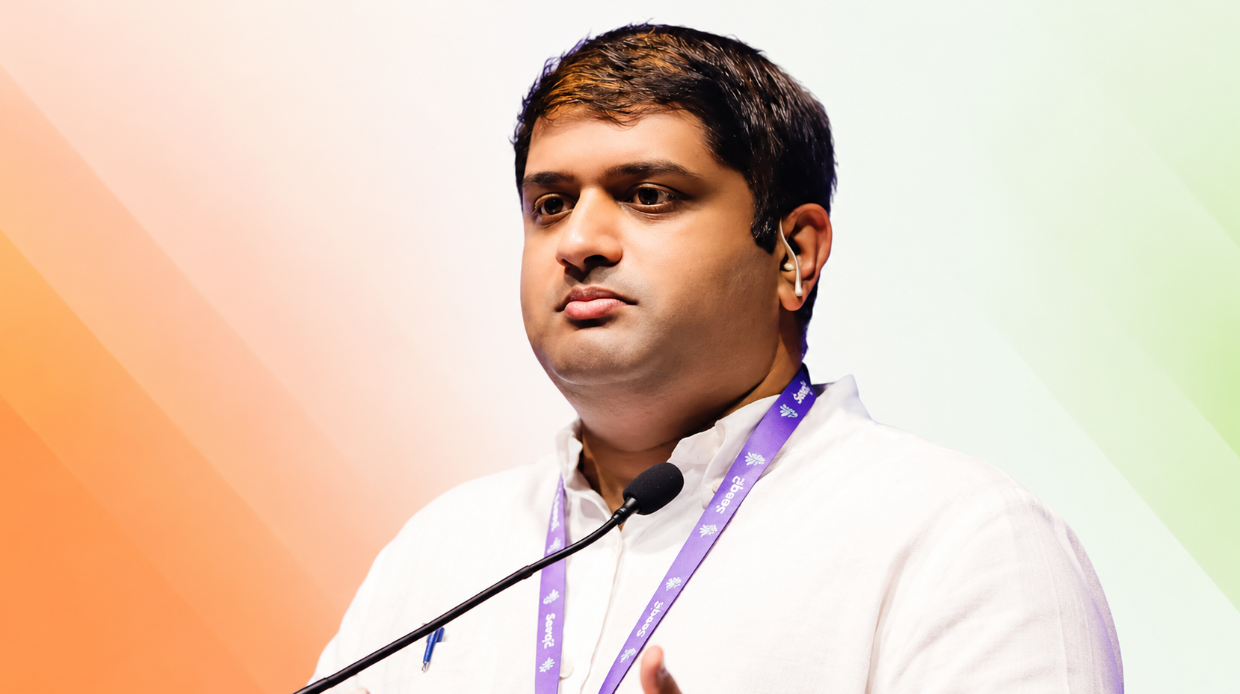


Guest Post By George Varghese, Head of Investment, 0G Labs
We’re witnessing one of the largest infrastructure investment cycles in modern technology, and I believe we’re still early in understanding its economic potential. AI has already changed how companies think about computing, with enormous investment flowing into GPUs, data centres, energy infrastructure and models. As AI expands across industries, computational demand has room to grow.
Quantum computing could add another dimension to that growth. Hardware and error-correction progress is accelerating research, and I see enormous potential in combining quantum capabilities with today’s AI systems. The opportunity extends across hardware, software and connecting infrastructure.
The investment case for AI infrastructure remains strong. Enterprises are incorporating AI into core processes, while reasoning models, multimodal systems and autonomous agents are widening the range of applications worth deploying.

Each advance brings new requirements for computing, networking, storage and power. More efficient models can lower the cost of individual tasks, making additional applications commercially viable and potentially expanding overall demand. I expect sustained investment across computing.
Still, investors need to understand the economics of individual assets. A data centre can operate for decades while the chips inside it undergo several replacement cycles. Changes in hardware performance, software efficiency and utilisation affect returns, even when aggregate demand continues growing.
That is why I pay close attention to infrastructure that can accommodate changing computational requirements without excessive reinvestment.
I’m particularly optimistic about quantum computing’s potential in fields where computational complexity currently limits progress. Molecular simulation, materials science and certain optimization problems are promising areas, although the practical advantages will depend on the particular task and the maturity of the hardware.
Years before a quantum computer simulates anything useful about a protein, a smaller one will break elliptic-curve signatures. Traffic captured today gets decrypted whenever that machine arrives, so the exposure on what we fund this year is already accruing. Almost nobody is ready. The Government Accountability Office (GAO), the audit arm of Congress, looked at 24 federal agencies this month and found not one had fully implemented the basics.
Chains are worse off than most enterprises, because a blockchain doesn’t merely use cryptography, it commits to it, permanently, in a ledger nobody can quietly patch over a weekend.
So there’s a question I now ask before writing a cheque: can this thing change its cryptography later? Does the team know where its cryptography actually lives – not in principle, in a bill of materials. Can it swap a signature scheme without a hard fork or an address migration. What would that cost, in engineering months and in gas. Most teams can’t get past the first question.
We put 0G through a post-quantum audit rather than wait for a deadline to force it, and 0G is now a post-quantum Layer 1.
The same logic justifies our investment into American Fortress’s seed round last year. Most proposed fixes to the quantum problem ask the world to move: new address formats, new wallets, a migration event across every chain holding value, coordinated by nobody in particular. That is not a plan, it’s a hope. American Fortress is attempting the harder version – quantum-resistant transaction signing that leaves existing addresses where they are, plus a backward-compatible Bitcoin soft fork designed to freeze dormant vulnerable wallets before an attacker can reach them. They’re also building a privacy layer underneath it, which is how we ended up co-building Send-to-Name payments for people and AI agents on 0G.
AI already helps researchers analyse large datasets, identify patterns and generate hypotheses. Quantum processors could eventually contribute specialised simulation capabilities to some of those workflows, especially when modelling quantum systems stretches classical methods.
The commercial implications are substantial. Better simulation could help researchers develop materials with useful properties, improve drug discovery, and refine industrial processes. Value would accrue across the businesses applying these capabilities, as well as the companies providing the computing infrastructure.
Of course, fault tolerance, scalability and operating costs remain difficult challenges. We should expect progress to vary by application and avoid assuming that every promising laboratory result translates into a profitable service.
One area I find especially attractive is the infrastructure connecting different computing architectures.
Enterprises already rely on combinations of CPUs, GPUs and specialised accelerators. If quantum processors become commercially useful for particular workloads, organisations will need ways to integrate them into existing processes without introducing unnecessary cost or complexity.
Consider a company developing new materials. Classical systems might manage data and train AI models, while quantum resources could eventually perform selected simulation tasks. Making that workflow practical would require reliable software orchestration, secure data handling and efficient access to computing capacity.
I see a substantial opportunity for companies that make these environments easier to operate. Interoperability affects switching costs, resource utilisation and the ability to adopt new technology when it becomes economically attractive.
At 0G Labs, our work on decentralised AI infrastructure has strengthened my interest in how computing resources can be accessed and coordinated across providers. Open, distributed approaches could connect heterogeneous resources, provided they meet enterprise expectations for performance, security, and reliability.
Quantum hardware may remain concentrated in specialist facilities because of its physical requirements. The surrounding software and access layers could support a wider range of providers and commercial models.
Investors financing advanced computing infrastructure are making decisions whose consequences will extend beyond the current generation of AI models.
I would examine utilisation, energy costs, hardware replacement schedules and the expense of incorporating new architectures. I’d also ask whether a business can generate attractive returns with existing technology while retaining the ability to adopt new capabilities when customers have a reason to pay for them.
Quantum offers several distinct investment opportunities. Hardware developers face demanding scientific and engineering milestones. Software companies must demonstrate that their tools solve practical integration problems. Infrastructure providers need to show that access to specialised resources can be delivered reliably and at competitive prices.
These businesses deserve different valuations and risk assumptions. Their prospects will depend as much on commercial execution as on technological progress.
I expect AI to remain a powerful driver of infrastructure demand, and I’m optimistic that quantum computing will eventually expand the range of problems we can address. Together, they could create opportunities across scientific research, financial services, and industrial technology, with benefits extending well beyond the computing sector itself.
For investors, the task is to identify companies with credible economics today and the capacity to participate in future advances. The infrastructure built during this AI investment cycle could support successive generations of innovation if we make sensible decisions about flexibility, access and capital efficiency. I believe the economic value of computation has considerable room to grow and companies that make advanced computing practical, accessible, and commercially viable will be well placed to capture it.
This post presents the views of the author only. It does not reflect the views or opinion of The Quantum Insider or it’s editorial staff.