When Not If: Coinbase Chief Sees Quantum, Not AI as The Biggest Threat to Crypto



Insider Brief
- Coinbase CEO Brian Armstrong said quantum computing poses a greater long-term threat to cryptocurrency security than AI and called for preparations against future attacks.
- Coinbase is upgrading its custody infrastructure, while Armstrong urged blockchain networks to adopt quantum-resistant security.
- Google researchers modeled a future quantum attack that could recover a private key in about nine minutes under specific assumptions, following advance preparation.
- Image: Photo by PiggyBank on Unsplash
An argument is forming that artificial intelligence may be a bigger threat right now than the ominous introduction of future cryptographically relevant quantum computers.
Coinbase Global Inc. CEO Brian Armstrong weighed in during an earnings call and add his own two cents. He said quantum computing poses a more serious long-term threat to cryptocurrency security than artificial intelligence, as the company begins upgrading its systems to withstand future quantum attacks.
Speaking Thursday during Coinbase’s third-quarter earnings call, Armstrong said the exchange has started work on protecting its custody infrastructure, which safeguards customers’ digital assets. He said the blockchains underlying those assets must also adopt security measures designed to resist quantum computers.

Armstrong distinguished between AI finding new ways to defeat existing cryptography and quantum computers performing calculations that could undermine it. He expressed little concern about AI breaking the elliptic-curve cryptography used to authorize transactions across major cryptocurrency networks, according to the call transcript published by Yahoo Finance.
“There’s been something like, you know, a 40-year track record actually of people attempting new algorithms to try to make this, you know, easier to break, and they’ve basically made zero progress,” he added.
Armstrong said that Quantum computing is a “different story” altogether.
“Quantum, you know, it requires a new type of computer to be built and actually to do it at scale, not just like a theoretical one with a couple of qubits,” Armstrong said. “And so I think that’s more of a matter of when, not if.”
Preparing the Networks
Armstrong said the industry needs to focus on upgrading the blockchains themselves to be quantum resistant.
Post-quantum security uses mathematical methods designed to withstand attacks from both conventional and quantum computers. For Coinbase, preparation involves work on its own custody systems alongside participation in broader discussions about blockchain upgrades, the CEO said.
Coinbase announced an independent advisory board on quantum computing and blockchain in January. The company said the group would assess scientific developments and provide guidance to the industry on preparing for future security risks, including threats that could remain years away.
Most modern blockchains, including Bitcoin and Ethereum, rely on elliptic-curve cryptography, according to Coinbase. These systems allow users to prove they are authorized to move funds without disclosing the secret information used to approve a transaction.
A public key lets others verify a digital signature. A private key authorizes spending. The security risk arises if an attacker can use an exposed public key to calculate its corresponding private key and then authorize transactions without the owner’s permission.
What the Nine-Minute Estimate Means
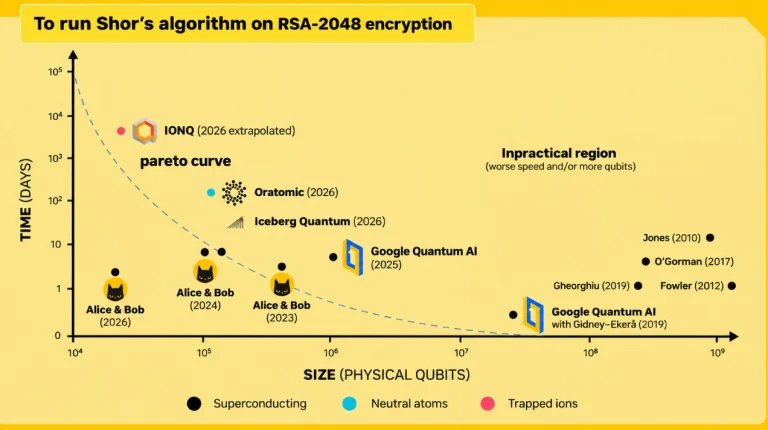
Google researchers have examined how a future quantum computer could carry out such an attack. Their research estimates that, under specified hardware assumptions, a sufficiently capable machine could recover a private key in about nine minutes after learning the public key, if it had already completed part of the calculation.
That estimate describes a modeled capability of a future machine, rather than a demonstrated attack on Bitcoin. The advance preparation is central to the timing: the researchers describe a quantum computer waiting in a prepared state until a target public key becomes available.
Google has urged cryptocurrency networks to transition to post-quantum cryptography. Its researchers describe that transition as a way to preserve blockchain security as quantum hardware develops.
Armstrong said he hopes the Bitcoin community will begin converging on a path forward over the next couple of quarters. He called for preparations to begin ahead of the threat, even though he does not expect a quantum attack imminently.

Keep track of everything going on in the Quantum Technology Market. In one place.
Topics

Matt Swayne
With a several-decades long background in journalism and communications, Matt Swayne has worked as a science communicator for an R1 university for more than 12 years, specializing in translating high tech and deep tech for the general audience. He has served as a writer, editor and analyst at The Quantum Insider since its inception. In addition to his service as a science communicator, Matt also develops courses to improve the media and communications skills of scientists and has taught courses.
[email protected]

Stay Ahead of Quantum
Get the latest research, company news, and market intelligence every week.