ParityQC Launches Parity Twine Optimizer for Quantum Optimization


Insider Brief
- ParityQC has launched the Parity Twine Optimizer as a product through the IBM Qiskit Functions Catalog, offering a 30-day free trial to IBM Quantum Network members.
- The optimizer uses ParityQC’s Parity Twine Compilation technology to reduce gate count, circuit depth and two-qubit gate overhead for quantum optimization problems.
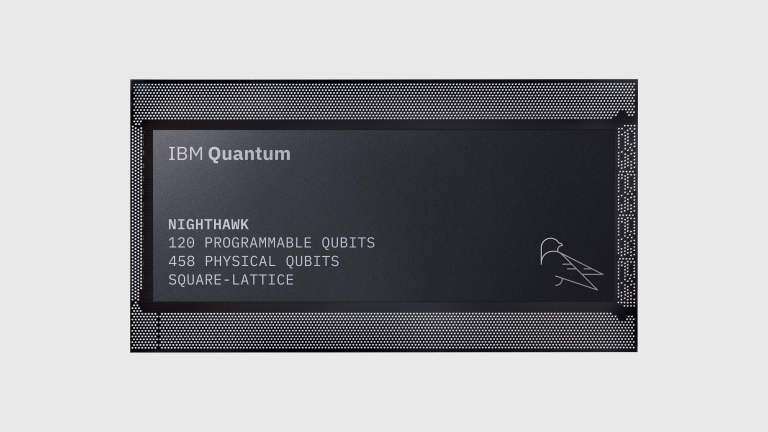
- The hardware-independent compiler supports different QPU topologies, including IBM Heron’s heavy-hex and IBM Nighthawk’s square-lattice architectures, with the aim of running larger optimization problems on current quantum hardware.
PRESS RELEASE — ParityQC, the Quantum Architecture Company, today launched the Parity Twine Optimizer, making its compiler technology, which led to record-setting performance in executing the Quantum Fourier Transform, available as a product. Built on the ParityQC Architecture, it delivers uniquely efficient compilation and is now available via the IBM Qiskit Function, including a free trial upon request, giving developers and enterprises an easy way to put a clear technological head toward solving complex optimization problems.
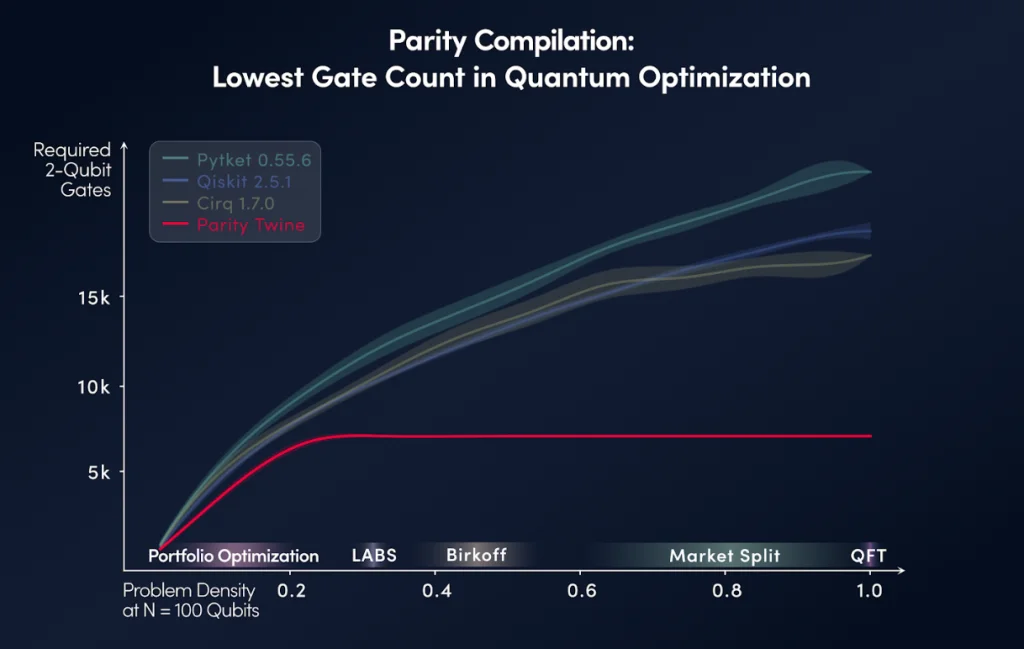
The Parity Twine Optimizer makes efficient compilation a reality: ParityQC‘s Parity Twine Compilation has shown in published results that it delivers a significant reduction of gate count and depth in quantum optimization. It supports running larger and denser problems on real hardware today. It reduces the two-qubit gate overhead of compiling industry-relevant optimization problems, making larger and denser instances to be executed on today’s quantum hardware. The advantage is
rooted in the structure of the Parity encoding itself rather than case-by-case tuning, so it holds across problem types and stays consistent as problems grow larger and more connected.

The Parity Twine Optimizer is available now in the IBM Qiskit Functions Catalog, offered to IBM Quantum Network members through a 30-day free trial. It meets users where they already work: anyone in the IBM Quantum Network can bring
record-efficient compilation into their own optimization problems and test it on IBM’s quantum hardware, without changing their setup or committing upfront. Its underlying compiler is hardware independent and available through ParityOS, ParityQC‘s enabling software, and the technology will become accessible through further access routes in the future.
“By offering the Parity Twine Optimizer as an IBM Qiskit Function, we are providing the quantum community with access to a tool with what we currently show to be the most efficient quantum compiler available for larger and more connected problems to run on real hardware,” said Magdalena Hauser and Wolfgang Lechner, co-CEOs of ParityQC.
“Efficiency is paramount for useful results on today’s quantum computers. With ParityQC’s Parity Twine Optimizer now available in the IBM Qiskit Functions Catalog, our clients in the IBM Quantum Network have a new, powerful tool capable of scaling alongside the complex optimization problems they’re exploring,” said Scott Crowder, Vice President, IBM Quantum Adoption and Business Development.
Key features ofthe Parity Twine Compilation include: Compile your circuits with maximum efficiency and minimal overhead in two-qubit gates. Eliminate the need for costly SWAP operations with the unique Parity Twine technology and leverage the full potential of quantum hardware today.
- Run larger problems on real hardware: Minimizes circuit depth and two-qubit gate overhead, so larger optimization problems run efficiently on today’s quantum processors.
- Higher performance, lower compilation overhead: Built on the state-of-the art Parity Twine compilation, it reduces gate count and circuit depth while preserving algorithm quality, for faster execution and lower error accumulation.
- Adaptive and hardware independent: Supports arbitrary problem graph connectivity and adapts to your target hardware topology, including both heavy-hex (such as IBM Heron) and square-lattice (such as IBM Nighthawk) IBM Quantum QPUs, generating connectivity-aware circuits tuned to the problem graph density.
- Efficient end-to-end optimization: Solves full optimization workflows seamlessly with minimal, predictable QPU usage as you scale.

Keep track of everything going on in the Quantum Technology Market. In one place.
Topics

Mohib Ur Rehman
Covering quantum and emerging technologies, Mohib explores the intersection of technology, security, and society. His work also frequently examines surveillance infrastructure and the institutions shaping the digital world. In addition to his work at The Quantum Insider, he co-runs SK NEXUS, an independent technology publication that helps readers understand the technologies shaping their lives.

Stay Ahead of Quantum
Get the latest research, company news, and market intelligence every week.
MENTIONED IN THE ARTICLE

ParityQC
Parity quantum computing architecture delivers the instruction set and layout for quantum chips, digital or analog.
→

IBM
IBM is an iconic technology pioneer founded in 1911 as the Computing-Tabulating-Recording Company and officially renamed International Business Machines Corporation in 1924. Beyond foundational computing, IBM possesses a deep legacy in aerospace and defense from building the guidance computers and Instrument Unit for NASA's historic Apollo missions to partnering with Airbus on CIMON, the first AI assistant on the ISS.
→
More in Industry News