NSF Awards Yale-Led Center $37.5M for Quantum Error Correction Research


Insider Brief
- Yale will lead a $37.5 million NSF Quantum Leap Challenge Institute focused on developing practical approaches to quantum error correction and fault-tolerant quantum computing.
- The five-year NSF PRACTIQAL center will bring together physicists, engineers, computer scientists and chemists to address challenges across quantum hardware, control electronics, error-correction codes and algorithms.
- The research will focus on making error correction more efficient and scalable, including through the development of specialized erasure qubits that can identify when and where errors occur.
Press release – A Yale-led multidisciplinary team of researchers has been awarded a $37.5 million grant from the U.S. National Science Foundation (NSF) for a center aimed at designing practical and self-correcting quantum computers from top to bottom and pointing the way forward for industry to build reliable machines.
The grant is one of eight that NSF has awarded for large-scale interdisciplinary research centers known as Quantum Leap Challenge Institutes that address major challenges at the frontiers of quantum information science and technology.
Quantum computing holds the promise of solving a range of problems that are nearly impossible for classical computers. Potential applications in materials science, drug design, and more could enhance quality of life and drive economic growth. One of the main challenges, though, is that quantum machines are much more prone to error than classical machines. That’s because qubits— the units of information in quantum computing — are very fragile. In comparison, the ones and zeros of conventional computers are incredibly robust, but quantum states can easily be affected by noise and other factors in their environment.

To be reliable and practical, quantum computers must be able to detect and correct errors in these machines faster than they occur.
“Today, error correction is the main scientific and engineering challenge for making quantum computing useful,” said Professor Robert Schoelkopf, director of the center. “With this project, we want to understand the science and engineering that makes the computers better and easier to build. We’ll come up with new ideas at all levels of the stack to make error correction and fault-tolerant machines much more achievable, efficient, and practical.”
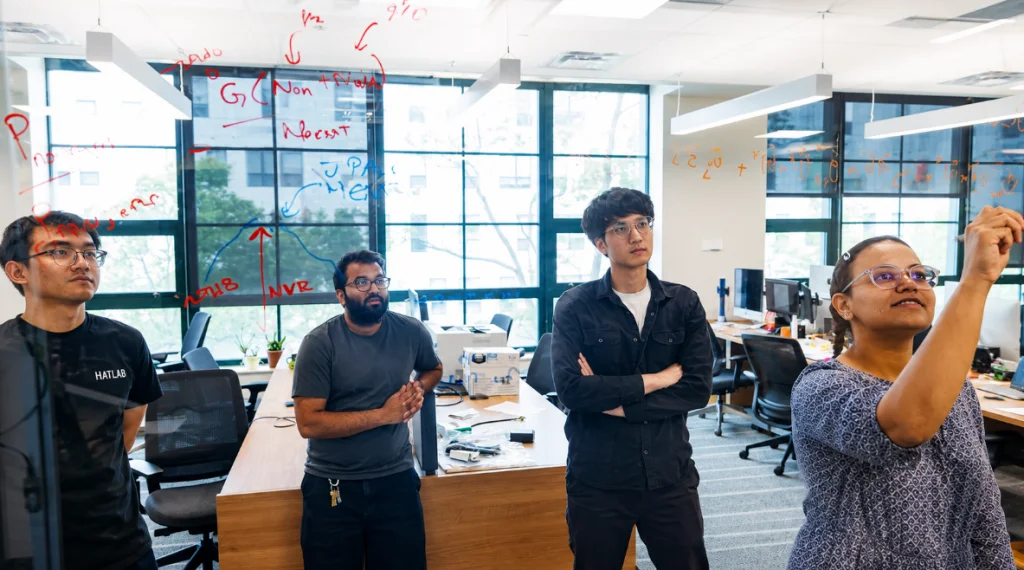
To that end, the research team will launch a new effort titled the NSF Quantum Leap Challenge Institute for Physics and Engineering of Practical Quantum Error Correction (NSF PRACTIQAL), a center that brings together computer scientists, chemists, physicists, and engineers from numerous universities. NSF PRACTIQAL is focused on making advances at every level of the quantum computer, from the physical qubits and control electronics to the way algorithms are run. The center is designed to foster a community of scientists and engineers from a wide range of disciplines who can contribute to a comprehensive understanding of the hardware and software needed to realize large-scale, error-corrected quantum computing.
“Part of the reason we have not just physicists, but engineers and computer scientists, is so we can understand the physics of the devices and the kind of errors that occur, and then optimize the codes and the algorithms to work with that,” said Schoelkopf, the Sterling Professor of Applied Physics.
NSF PRACTIQAL will primarily focus on two challenges in quantum computing. One is identifying key issues that have hindered the scaling of error-corrected machines and finding ways to make quantum error correction more practical and efficient. Second, the researchers will explore the uses of specially designed qubits known as “erasure qubits.” Pioneered by members of the PRACTIQAL team, these qubits act as flags that signal exactly where and when an error has occurred.
Researchers in the field typically work on one specific component of quantum computing. While this component could work perfectly on its own, though, it might not work well as part of a larger system made from components developed in other labs. By applying their individual specialties in a coordinated fashion, the PRACTIQAL team aims to develop a quantum computing system in which the whole machine is optimized. For instance, the hardware and software will be designed to run the same types of code so that the machines run more efficiently and be less prone to errors.
Michael Hatridge, co-director of PRACTIQAL, noted that much of the work in this area has been done on very small machines optimized for error correction. The PRACTIQAL group aims to shorten the route to large-scale, error corrected quantum computers.
“Because we’re academics, we’re not going to build a giant system, but we’ll prove our ideas and build a pathway towards how you could build a much bigger system,” said Hatridge, associate professor of applied physics. “That’s why we have industrial partners. We also have an external advisory board helping us not just do isolated experiments, but to stay relevant to the broader community.”
By the end of the ambitious five-year project, the researchers expect to have developed a path toward building practical error-correcting computers on an industrial scale.
“We’re looking forward to it,” Hatridge said. “PRACTIQAL is big, it’s complicated, and it has a lot of moving parts, but we’re very excited to do it.”
In addition to Schoelkopf and Hatridge, Yale faculty involved in NSF PRACTIQAL include Yongshan Ding and Lin Zhong of the Department of Computer Science and Aleksander Kubica and Shruti Puri of the Department of Applied Physics, all at Yale Engineering, as well as Steven Girvin and Konrad Lehnert of the Department of Physics and Victor Batista of the Department of Chemistry.

Keep track of everything going on in the Quantum Technology Market. In one place.

Mohib Ur Rehman
Covering quantum and emerging technologies, Mohib explores the intersection of technology, security, and society. His work also frequently examines surveillance infrastructure and the institutions shaping the digital world. In addition to his work at The Quantum Insider, he co-runs SK NEXUS, an independent technology publication that helps readers understand the technologies shaping their lives.

Stay Ahead of Quantum
Get the latest research, company news, and market intelligence every week.
MENTIONED IN THE ARTICLE

Yale University
Yale University is a private research university in New Haven, Connecticut that was founded in 1701. It is the third-oldest institution of higher education in the United States and one of the nine colonial colleges chartered before the American Revolution.
→
National Science Foundation
The National Science Foundation, situated in Alexandria, Virginia, is a governmental entity. This organization administers the America's Seed Fund SBIR/STTR Program, which aids startups and small businesses by providing grants and seed funding. In Aug, 2022, NSF organized a workshop on Quantum Advantage and Next Steps at the University of Chicago. In Oct, 2022, NSF hosted a virtual workshop on Software-Hardware Co-Design for Quantum Computing, aiming to foster collaboration and build a shared technological ecosystem for both quantum and classical technologies. In Mar, 2023, An NSF Research Coordination Network award facilitated weekly collaboration among scientists from various countries, leading to the inclusion of Quantum Biology as a topic in the Gordon Research Conferences. In Jun, 2023, NSF announced new awards for MRSECs, with several focusing on quantum control of materials and materials for quantum information processing. In Jul, 2023, NSF released the solicitation (NSF 23-604) for the first phase of the NQVL, marking a significant step in advancing quantum research and development.
→