NSF Extends Quantum Sensing Program With Five-Year $37.5M Award

Insider Brief
- The U.S. National Science Foundation has renewed the Quantum Leap Challenge Institute for Quantum Sensing for Biophysics and Bioengineering with $37.5 million over five years to advance quantum sensing for biological research.
- Led by the University of Chicago, NSF QuBBE will develop quantum nanoprobes, protein-based quantum sensors, entanglement-based sensing methods and in vivo measurement techniques.
- The renewed program will also expand quantum education and workforce initiatives through partnerships with Chicago State University and the University of Illinois Chicago.
Press release – The U.S. National Science Foundation has renewed the Quantum Leap Challenge Institute for Quantum Sensing for Biophysics and Bioengineering (NSF QuBBE) with a $37.5 million, five-year investment to advance quantum sensing technologies that can reveal biological processes difficult or impossible to observe with conventional tools.
The renewal will move NSF QuBBE into its next phase: advancing quantum sensing from proof-of-principle measurements toward robust tools for investigating biological systems. Led by the University of Chicago in partnership with Chicago State University, the University of Illinois Chicago, Harvard University and other collaborators, NSF QuBBE brings together quantum scientists, engineers, chemists, biologists, and physicians.
At UChicago, the effort spans the UChicago Pritzker School of Molecular Engineering, Physical Sciences Division, Biological Sciences Division and UChicago Medicine.

“For more than four decades, NSF has been laying the foundational groundwork of research and discovery that is powering today’s modern quantum computing, sensing and communication,” said Brian Stone, performing the duties of the NSF director. “It’s time for focused activities to leverage that base of knowledge to drive us even farther forward to the benefit of all Americans. The NSF Quantum Leap Challenge Institutes are a next step for us in understanding the quantum world we live in.”
Greg Engel, director of NSF QuBBE, noted that “Quantum sensing has reached a point where it can begin to address real biological questions. The next challenge is to make these tools reliable, adaptable, and useful in the complex environments where biology actually happens. This renewal allows us to take that step.” Engel is also chair of the Department of Chemistry and professor at the UChicago Pritzker School of Molecular Engineering (UChicago PME).
“The NSF Quantum Leap Challenge Institutes are a next step for us in understanding the quantum world we live in.” — said, Brian Stone, performing the duties of the NSF director.
From Quantum Experiments to Biological Tools
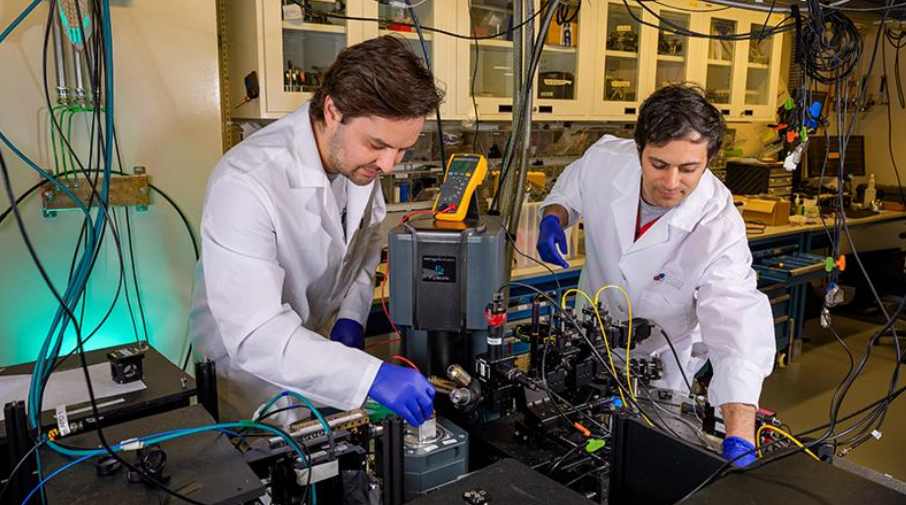
Quantum sensors use properties of quantum systems to make extraordinarily precise measurements. In biology, they could provide new ways to observe molecular and nanoscopic cellular processes that are difficult to access using conventional techniques.
During its first phase, NSF QuBBE supported advances across quantum sensing and biology, including genetically encodable qubits, nanodiamond sensors capable of detecting cellular activity, advances in high-field nanoscale nuclear magnetic resonance, and novel approaches to using entanglement for biosensing.
Among those advances, research led by UChicago PME Associate Professor Peter Maurer and Liew Family Professor David Awschalom, both NSF QuBBE co-principal investigators, along with their collaborators, demonstrated that fluorescent proteins can function as spin qubits, opening the possibility of quantum sensors that can be genetically expressed directly within cells.
“In the first phase of QuBBE, we used diamond and molecular quantum sensors to probe biological processes, but a key challenge was placing these sensors exactly where they are needed in living systems. This motivated us to develop protein qubits – genetically encodable quantum sensors that are roughly ten times smaller than diamond sensors and can potentially be targeted with precision inside cells. Phase two gives us the opportunity to turn these discoveries into tools for biology,” said Maurer.
The scientific convergence fostered through NSF QuBBE has also helped catalyze new efforts to move quantum sensing toward biomedical applications, including the formation of the Berggren Center for Quantum Biology and Medicine, housed at the UChicago Pritzker School of Molecular Engineering in collaboration with UChicago Medicine and the Biological Sciences Division. The Center is advancing the development and adoption of quantum technologies for medicine and training physicians and physician-scientists to work at the intersection of quantum science and healthcare.
In the coming years, NSF QuBBE will drive advances in four interconnected research areas: developing novel quantum nanoprobes for biological sensing; exploring entanglement and squeezed sensing; advancing in vivo measurement with quantum sensors; and accelerating the adoption of quantum sensing across biology and medicine.
Researchers will pursue approaches ranging from improving nitrogen-vacancy centers in diamond to developing protein-based quantum sensors that can operate within biological systems, while investigating how entanglement, advanced imaging, theory, and computation could enable new ways of measuring biological activity.
“The opportunity in this next phase is to integrate the quantum sensor and the biological question from the beginning,” said Allison Squires, deputy director and co-principal investigator of NSF QuBBE and Neubauer Family Assistant Professor at the UChicago Pritzker School of Molecular Engineering. “Rather than developing a technology in isolation and then looking for an application, we can design these tools for implementation in the complex biological environments where we ultimately want them to work.”
Building Chicago’s Quantum Workforce
NSF QuBBE’s workforce programs bring together the University of Chicago, Chicago State University (CSU), and the University of Illinois Chicago (UIC) to create pathways into quantum science and technology.
During NSF QuBBE’s first phase, the Institute partnered with CSU to establish the Quantum Institute, including Q-Cert, a one-year post-baccalaureate Quantum Science Certification program. In its next phase, NSF QuBBE plans to expand that model, including the launch of a quantum master’s program at CSU and further integration of undergraduate, master’s, and Ph.D. training.
The work will complement CSU’s new Quantum Education, Science and Technology Center, CQuEST, which is the university’s center for innovation in quantum science and microelectronics, connecting education, research and workforce development as Chicago’s quantum ecosystem grows.
“Building the future of quantum science requires us to build pathways for students to see themselves as part of it,” said Valerie Goss, NSF QuBBE co-principal investigator and workforce development lead at Chicago State University. “Through our partnership with NSF QuBBE, we are creating opportunities for students to gain the knowledge, research experience and connections they need to participate in this rapidly developing field.”
NSF QuBBE will also expand its Quantum Academy, led by UIC Associate Professor Minjung Ryu, which engages Chicago-area high school students and teachers in quantum science through hands-on learning, research experiences, and teacher professional development. During the second phase, Quantum Academy will develop innovative curricular materials and provide professional development for educators, equipping them to deliver high-quality learning experiences to students in Chicago-area schools.
“Quantum sensing has reached a point where it can begin to address real biological questions. The next challenge is to make these tools reliable, adaptable, and useful in the complex environments where biology actually happens. This renewal allows us to take that step.” said, Greg Engel, director of NSF QuBBE.
Establishing Quantum Sensing for Biology as a Field
NSF QuBBE will work to make quantum sensing technologies more accessible to researchers in biology and medicine, expanding infrastructure and user capabilities while bringing biologists, physicians, and other potential users directly into the development and testing of new technologies.
“NSF’s Quantum Leap Challenge Institutes were created to ask ambitious questions that require an interdisciplinary lens,” Engel said. “NSF QuBBE is built around one of those questions: can quantum measurement change what we are able to see, understand, and ultimately control in biology and medicine? This renewal gives us the opportunity to create an impactful body of work that provides an answer to that important question.”
The five-year cooperative agreement begins Sept. 1, 2026, and runs through Aug. 31, 2031.
Engel is also co-director of the Berggren Center for Quantum Biology and Medicine and a professor in the James Franck Institute and Institute for Biophysical Dynamics at the University of Chicago.
NSF QuBBE includes investigators from the University of Chicago, Chicago State University, the University of Illinois Chicago, and Harvard University, with expertise spanning quantum information science, biological imaging, molecular and cellular biophysics, protein engineering, materials science, biomedical research, education, and workforce development.

Keep track of everything going on in the Quantum Technology Market. In one place.
Topics
Mohib Ur Rehman
Covering quantum and emerging technologies, Mohib explores the intersection of technology, security, and society. His work also frequently examines surveillance infrastructure and the institutions shaping the digital world. In addition to his work at The Quantum Insider, he co-runs SK NEXUS, an independent technology publication that helps readers understand the technologies shaping their lives.
Stay Ahead of Quantum
Get the latest research, company news, and market intelligence every week.
MENTIONED IN THE ARTICLE