Quantum Biology Review Suggests Protein Networks And Quantum Sensing Open New Paths For Biology


Insider Brief
- A Howard University-led review examines how quantum effects in protein networks could influence biological processes and advance quantum sensing in cells.
- Studies surveyed include collective light emission in protein fibers at room temperature and protein movements that support quantum tunneling in enzyme reactions.
- Quantum sensors have been used to map cancer-related proteins and measure heat transport within cells, while researchers seek stronger connections between laboratory findings and biological functions.
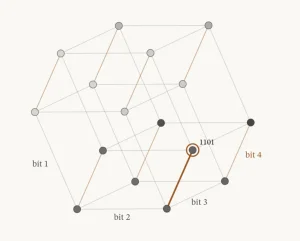
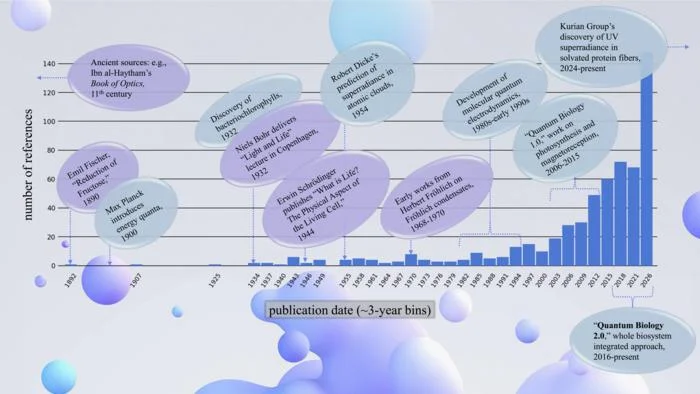
- The histogram charts the distribution by publication date of nearly 600 references covered in the Quantum Biology 2.0 review article in Protein Science. (Quantum Biology Laboratory: Margaret Christ and Philip Kurian)
One of the hot-button topics in quantum science — and I have the emails to prove it — is whether quantum effects exist in the body, which traditionally has been thought to be too warm and too wet to nurture notoriously sensitive quantum phenomena.
Now, a new review led by Howard University researchers suggests that quantum effects in protein networks could help explain how living systems move energy and process information, while opening paths to more sensitive biological measurements.
The article in Protein Science brings together experimental, computational and theoretical research on how proteins interact with light, support chemical reactions and respond to their surroundings. The researchers indicate that quantum biology is expanding beyond its familiar focus on photosynthesis and animals’ magnetic navigation to examine a wider range of cellular structures and processes.

One example is evidence that organized protein fibers can absorb and emit light collectively at room temperature. Other work connects protein movements to quantum tunneling in enzymes and uses quantum sensors to measure conditions inside cells. Together, these studies suggest new ways to investigate biology and design instruments inspired by it, according to the review.
The researchers, all affiliated with Howard University’s Quantum Biology Laboratory, describe this broader research agenda as Quantum Biology 2.0. Their goal is to connect findings across disciplines and move toward understanding quantum effects within whole biological systems.
“Our group’s discovery of superradiance in solvated protein fibers in thermal equilibrium opens a new window on the role of quantum processes across the web of life,” Philip Kurian, QBL Principal Investigator and Founding Director, said in a university news release. “This review thus provides the necessary vision for a renewed research program geared toward the understanding of biologically oriented scientists, who are interested in how quantum processes play a role in enzyme catalysis, evolutionary behavior, and sub-neuronal brain mapping across living systems interacting with the electromagnetic field, even at the ultraweak or single-photon level.”
The review surveys developments over roughly the past decade, with historical context and explanations of the underlying physics. It organizes the literature into eight main topics, ranging from collective light emission and protein vibrations to magnetic sensing and quantum technologies. The team reported that they generated or analyzed no new datasets for the article.
Protein Networks and Light
Much of the review centers on proteins containing ordered arrangements of tryptophan, an amino acid that absorbs ultraviolet light. When these molecules sit in suitable arrangements, their interactions with light can become collective: An absorbed excitation can be shared across several molecules.
One result is superradiance, in which molecules emit light more rapidly than they would acting independently. The review highlights a 2024 experiment reporting room-temperature superradiance in microtubules suspended in solution.
Microtubules are hollow protein structures that help organize cells, support their shape and move materials within them. They also help separate chromosomes during cell division. Their repeating structure positions tryptophan molecules in organized networks, creating conditions for collective optical behavior, according to the researchers.
The finding gives researchers a way to explore how the shape and arrangement of a biological structure influence its response to light. The review extends that discussion to other protein fibers, ultraviolet-sensitive proteins and viruses.
The scientists also examine how energy absorbed from light can interact with protein vibrations. Those interactions may help organize motions across proteins and affect how molecules find their partners in crowded cells. The proposed connection between coordinated vibrations and longer-range molecular interactions remains an active area of theoretical and experimental research, according to the review.
Research on photosynthesis provides a guide to interpreting such effects. Light-absorbing molecules can share energy, but surrounding water, heat and molecular motion limit how far that sharing extends and how long it lasts.
The review emphasizes that biological performance depends on the balance between collective behavior and energy loss. Longer-lasting quantum coherence — a coordinated relationship among quantum states — does not automatically produce a more efficient biological system. In some circumstances, interactions with the surroundings help direct energy where it needs to go.
Protein Motion Helps Chemical Reactions
Another line of research examines quantum tunneling, a process that allows particles to cross an energy barrier they could not cross under the rules of classical physics.
For enzymes, which speed up chemical reactions, tunneling can help explain the movement of hydrogen during the breaking and formation of bonds. The review describes evidence that the protein surrounding an enzyme’s reaction site helps establish the conditions needed for this movement.
It highlights a 2023 study of soybean lipoxygenase, an enzyme used to investigate hydrogen transfer. Researchers combined protein mutations, mass spectrometry and measurements of how fluorescent probes responded over time and at different temperatures.
The results linked motions in a surface region of the protein to the chemical reaction occurring deeper inside it. According to the review, these coordinated movements help bring the hydrogen donor and receiver close enough together for tunneling and align the energies needed for the reaction.
The work points to an active role for the wider protein structure. Understanding an enzyme’s behavior may require tracking how energy and motion travel through it, as well as examining the small region where the reaction occurs.
New Tools for Studying Cells
The review also describes a growing set of quantum technologies for investigating biology.
Among them are tiny diamonds containing defects that act as sensitive probes. By monitoring changes in their light emission, researchers can detect local magnetic fields and temperature changes, as well as obtain information about nearby chemical conditions. The review describes applications in cells and biological samples at ordinary temperatures and pressures.
Such measurements could help scientists study processes that are difficult to resolve with larger instruments, including variations within individual cells. Such measurements have practical applications in cancer research and cell biology. The review describes studies using diamond quantum sensors to map cancer-related proteins in human tumor samples and measure how heat moves through individual cells, giving researchers a closer view of conditions that broader measurements can miss.
Another approach uses entangled photons, particles of light with linked quantum properties. The researchers describe research using these relationships to improve imaging and spectroscopy, the study of how matter absorbs and emits light. One aim is to obtain useful information with less illumination, reducing damage to delicate samples.
While quantum biology often seeks to find how quantum mechanics influences biology, the researchers also suggest biological structures could inform quantum technology design. The review discusses theoretical work showing how changes in a spiral arrangement of light-emitting molecules can alter the speed at which collective states release energy. Such control could be useful in future approaches to storing and transferring quantum information.
Testing Effects in Living Systems
A major challenge is connecting observations in isolated proteins or laboratory preparations to their functions inside living organisms.
The researchers say much of the field has relied on measurements outside intact living systems. Moving into cells adds complexity, while the act of measuring can disturb the effects researchers want to observe. Better tools must separate faint signals from background noise without disrupting the biological setting.
The review’s discussion of extremely weak light emitted during metabolism illustrates the problem. These emissions have been investigated as possible indicators of disease, but some cited studies used small samples. The team writes that there will be the need for randomized, controlled trials to validate diagnostic applications.
Interpretation presents another hurdle. In photosynthesis research, oscillating signals measured with rapid laser techniques do not, by themselves, establish how energy moves or whether a quantum effect improves biological performance, the review explains. Researchers must account for the measurement conditions, timescales and assumptions in their models.
The researchers also acknowledge a limitation of their own approach of covering such a broad field reduces the depth available for individual topics. Their selection reflects both the wider literature and the research perspective developed by their laboratory.
Future work will require closer collaboration among protein scientists, physicists, chemists and engineers, they write. Priorities include more precise measurements, better models of proteins interacting with their surroundings and experiments that connect molecular effects to cellular behavior.
Dr. Judith Klinman, professor emerita of chemistry and biochemistry and biophysics at UC Berkeley who was not involved in the work, said the work makes quantum biology relevant to the protein science communities.
“It is quite challenging to convey sufficient depth while integrating the wide range of topics required to understand the nature of quantum effects in proteins and living systems,” Klinman said in the release. “The Kurian Group has highlighted a compelling research agenda in quantum biology for the next decade and beyond.”

Keep track of everything going on in the Quantum Technology Market. In one place.

Matt Swayne
With a several-decades long background in journalism and communications, Matt Swayne has worked as a science communicator for an R1 university for more than 12 years, specializing in translating high tech and deep tech for the general audience. He has served as a writer, editor and analyst at The Quantum Insider since its inception. In addition to his service as a science communicator, Matt also develops courses to improve the media and communications skills of scientists and has taught courses.
[email protected]

Stay Ahead of Quantum
Get the latest research, company news, and market intelligence every week.