

Insider Brief
- Argonne National Laboratory is launching a three-year, $1 million project to develop diamond-based quantum sensors for high-precision electromagnetic field measurements in high-energy physics experiments.
- The project will use nitrogen-vacancy (NV) centers in diamond to develop sensors and magnetic-field mapping systems that can operate in high-field and radiation-rich environments.
- Researchers will develop and test sensor prototypes before working toward field-ready systems that can integrate with future particle physics experiments.
Press release – A new Argonne project is bringing together experts in quantum information science and high energy physics to build diamond-based quantum sensors capable of measuring electromagnetic fields with unprecedented precision.
Understanding how the universe’s smallest building blocks interact requires a precise understanding of how electromagnetic forces affect matter.
Whether scientists are measuring the momentum of bits of matter emerging from a particle collision or tracking subtle changes in the motion of particles stored in a magnetic ring, they need to understand the surrounding electromagnetic fields and how those fields change over space and time. Even tiny uncertainties can limit the precision of an experiment.

A new three-year, $1 million project at the U.S. Department of Energy’s (DOE) Argonne National Laboratory addresses that challenge by combining two of the laboratory’s strengths: quantum information science and particle physics.
“This is another front for the likely quantum revolution … Five or 10 years ago, this was kind of science fiction. But now we tend to think that these are practical paths to making the devices useful for other scientists and ourselves.” — Nazar Delegan, Argonne scientist
The project will develop a new generation of quantum sensors based on diamond materials. These sensors are expected to help researchers map electromagnetic fields with unprecedented accuracy while integrating seamlessly with the next generation of accelerators, which is crucial to experiments in particle physics, also known as high energy physics.
“The main idea is that we have these experiments in high energy physics, and we’re looking for something that could help many of them,” said Argonne physicist and project lead Peter Winter. “One commonality across many of these experiments is that they have magnetic fields that they need for various purposes. And they often have strict requirements for mapping this magnetic field with high precision.”
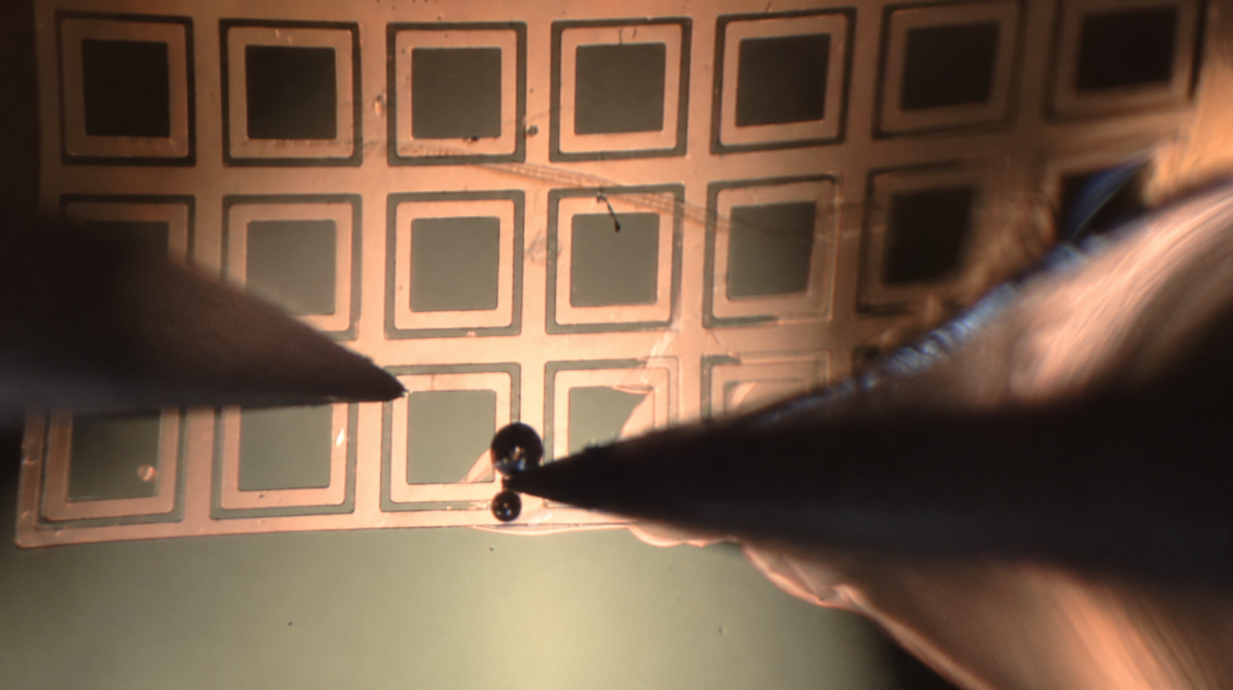
The effort centers on tiny defects in diamond known as nitrogen-vacancy centers, or NV centers. Created when a nitrogen atom sits next to a missing carbon atom in the diamond crystal, these defects behave like a tiny, trapped magnet with distinct energy states. Their energy states shift in response to magnetic and electric fields. Researchers use light and microwaves to read out information from them, allowing the sensors to measure electromagnetic fields with extraordinary sensitivity.
Argonne and its collaborators have spent years advancing NV centers in diamond. Now researchers are adapting it to meet the needs of high energy physics.
“What’s ideal here is that we’ve developed this technologically integratable platform where for the first time we can actually put in these quantum sensors into existing microelectronic systems,” said Argonne scientist Nazar Delegan, project co-lead. “We have something of a wide range of flexibility from an engineering and science perspective.”
That flexibility is important because different high energy physics experiments have different requirements. Some must operate in areas exposed to intense radiation. Others require exceptionally precise measurements. Still others have limited space for instrumentation.
The project researchers will pursue several goals, including building prototypes of ultrahigh-precision NV quantum sensors and large-area magnetic-field mapping systems. They’ll also lay the groundwork for sensor arrays designed for rapidly changing electromagnetic environments.
The first order of business will be to tailor the diamond materials to the needs of high energy physics experiments. Scientists will then test the sensors in laboratory and operational environments, including high-magnetic-field and radiation-rich settings. The final phase will focus on developing field-ready prototypes that can be integrated into future experiments.
The project highlights the power of cross-disciplinary research. Advances in quantum information science and particle physics have typically progressed along separate paths. Today, technologies originally developed for quantum information applications are finding everyday uses in areas such as medicine and national security. High energy physics is increasingly benefiting from these advances as well.
Diamond-based quantum sensors are naturally resistant to radiation, making them attractive for demanding environments. Their compact size could reduce the amount of cabling and instrumentation required in experiments, while their ability to measure multiple quantities simultaneously could provide scientists with a more complete picture of experimental conditions.
The work also creates opportunities for students and early-career researchers. Because the project spans quantum information science, materials science, engineering and particle physics, participants will gain experience working across conventional disciplinary boundaries — an increasingly valuable skill in modern science.
“One of the things I’m excited about is bringing on board a junior scientist who will adopt both fields and start to act almost like an ambassador for the two, and seeing that development is obviously rewarding,” Delegan said.
Ultimately, the researchers hope the technology will be versatile enough to serve many different experiments.
“We’re looking for a pretty diverse platform that could enable this field mapping under various circumstances,” Winter said.
The project is also a first step in making the technology more widely available for use beyond discovery science.
“This is another front for the likely quantum revolution,” Delegan said. “These technologies are now advanced enough that we can think about the practical applications, maybe leading to some commercial development. Five or 10 years ago, this was kind of science fiction. But now we tend to think that these are practical paths to making the devices useful for other scientists and ourselves.”
If successful, the project could help scientists make more precise measurements, reduce uncertainties and open new possibilities for exploring the fundamental nature of the universe — all by harnessing the quantum properties of tiny defects inside a diamond.
This research will receive funding from the DOE’s Office of High Energy Physics under its Quantum Information Science program.
Argonne National Laboratory seeks solutions to pressing national problems in science and technology by conducting leading-edge basic and applied research in virtually every scientific discipline. Argonne is managed by UChicago Argonne, LLC for the U.S. Department of Energy’s Office of Science.
The U.S. Department of Energy’s Office of Science is the single largest supporter of basic research in the physical sciences in the United States and is working to address some of the most pressing challenges of our time. For more information, visit https://energy.gov/science.