Google Researchers Use AI And Mathematical Proofs to Cut Quantum Computing Requirements


Insider Brief
- Google researchers used AI agents and computer-checked mathematical proofs to design quantum programs requiring fewer computing resources for scientific calculations.
- The team reduced combined qubit-and-gate requirements by roughly elevenfold for a fusion simulation, eightfold for photochemistry and 2.5-fold for a drug-metabolism model.
- The scientific programs still exceed the capabilities projected for early fault-tolerant quantum computers, requiring further reductions in computing requirements.
Quantum computing could one day help artificial intelligence tackle more demanding calculations. Now, Google researchers have shown how AI can return the favor, using teams of agents to design quantum programs that need fewer computing resources.
In a study, Google researchers used artificial intelligence and computer-checked mathematical proofs to design quantum programs that require substantially fewer computing resources, potentially bringing demanding chemistry and fusion calculations closer to practical use.
The team, led by researchers at Google DeepMind and Google Quantum AI, reported roughly elevenfold lower resource costs for a fusion-related simulation, eightfold lower costs for a photochemistry calculation and a 2.5-fold reduction for a model relevant to drug metabolism. This doesn’t exactly make quantum computers useful but brings them a step closer to tackling scientific problems that are beyond their reach today.

The study, posted on the preprint server arXiv, describes a system in which AI agents propose programs and prove that they perform a specified calculation within a stated resource budget.
The approach addresses a problem facing quantum algorithm development. Researchers want to design calculations too large for conventional computers to simulate, while the quantum machines needed to run them are still being developed. Mathematical proofs offer a way to check those programs before suitable hardware exists.
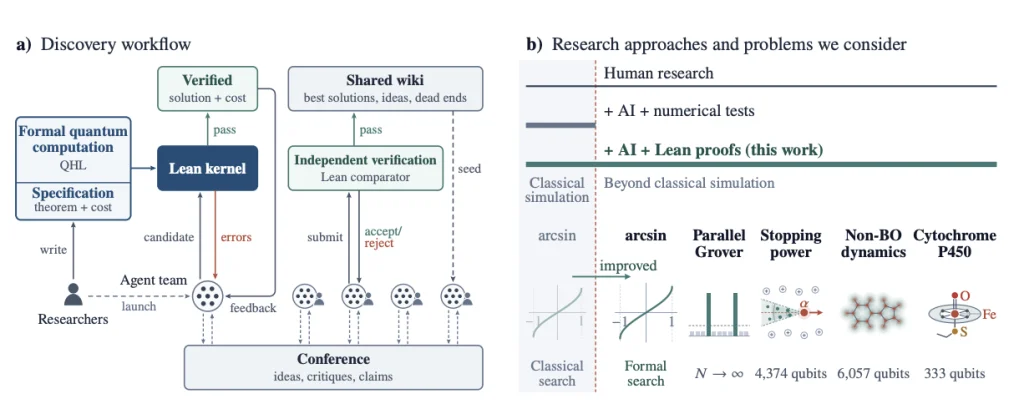
According to the study, teams of AI agents improved five types of quantum programs, ranging from basic arithmetic and search routines to scientific simulations involving hundreds or thousands of quantum bits, or qubits.
For the arithmetic and scientific calculations, the researchers measured cost by multiplying the number of logical qubits by the number of T gates, operations that are expensive to implement on error-corrected quantum computers. Logical qubits store information using error correction to protect it from faults in the underlying hardware.
The measure accounts for both how many qubits a program needs and how many computing steps it must perform. The reported savings reflect improvements in that combined measure.
The researchers said such algorithm improvements are needed alongside advances in hardware. Many proposed scientific applications require billions to quadrillions of logical operations, compared with roughly a million operations projected for early fault-tolerant processors, according to the paper.
Proofs Guide the Search
The team built a quantum programming library in Lean, a system that checks mathematical proofs. Researchers used it to specify what each program had to accomplish, how accurate its answer had to be and how its resource use would be counted.
AI agents then searched for programs that met those requirements. Each proposed solution had to include proofs of both correctness and cost. When a proof failed, the agents could use the resulting error messages to revise their work.
This expands the range of programs that AI can help develop, according to the researchers. Testing candidate programs through conventional simulation restricts the search to calculations that a classical computer can handle. A proof can establish that a program satisfies its requirements without reproducing its full quantum behavior in a simulation.
A separate checking system confirmed that each proposed solution met the researchers’ original requirements. That check was designed to prevent agents from obtaining an apparent improvement by changing the task, weakening a theorem or introducing unsupported assumptions.
Human researchers chose the problems, prepared the specifications and interpreted the results. Different researchers organized their agents in different ways, from a single agent repeatedly revising a solution to teams dividing work among subroutines.
Teams shared successful programs, partial proofs and failed approaches through a common wiki. They also exchanged proposals and criticism in scheduled virtual conferences.
The study traced how those exchanges contributed to improvements. In the photochemistry calculation, one team proposed an idea during a conference and another refined and proved it, producing the largest single reduction in the program’s development sequence: 34%.
The researchers said assigning credit was sometimes difficult because a final proof could combine ideas from several teams and communication channels.
Savings Across Scientific Applications
The largest improvement among the three scientific applications involved a calculation relevant to inertial-confinement fusion, which compresses hydrogen fuel to trigger fusion reactions. Fusion energy is an important research area today because scientists expect fusion energy — once achieved — to be a source of clean, inexpensive energy.
Sustaining fusion reactions, however, depends partly on whether energetic alpha particles deposit enough energy back into the fuel. The simulation examines stopping power, the rate at which the fuel absorbs energy from a passing particle.
The researchers considered one alpha particle and 218 electrons moving among 216 fixed protons. Their improved program required 4,374 logical qubits, down from 5,650 in the baseline, and reduced the combined qubit-and-gate cost by a factor of 10.9.
A central change altered how the program represented particle interactions. The new approach used a grid of positions and exploited the Pauli exclusion principle, which limits how electrons can occupy the same quantum state. According to the study, this reduced the number of repeated computational steps needed to represent the interactions.
The program also retained a calculation of total electron momentum between steps, reducing how often it had to compute that information again.
For photochemistry, the team studied a molecular model containing 187 electrons and 47 nuclei. Light-driven chemical reactions can require scientists to track electrons and nuclei together because their movements affect one another on similar timescales.
That makes the calculations relevant to processes such as solar energy conversion and light-activated chemistry, according to the paper.
The task required a program to represent one femtosecond, or one quadrillionth of a second, of molecular evolution within a specified error. The agents reduced its combined resource cost by a factor of 8.08 compared with a baseline incorporating improvements from earlier research.
Among the changes, the program copied particle coordinates into temporary qubits and cleared those copies through measurement, lowering the work needed to handle interacting particles. Other changes simplified calculations of electrical forces and the representation of nuclear charges.
The drug-metabolism example focused on Compound I, a short-lived reactive form of cytochrome P450 enzymes. These enzymes help break down medicines, and understanding their reactions can help researchers assess drug clearance and potentially harmful byproducts, according to the study.
The team considered a model with 63 electrons in 58 orbitals, mathematical descriptions of the states electrons can occupy. The program had to estimate energies for the lowest-energy state and nearby states within a specified accuracy.
The improved solution reduced combined resource cost by a factor of 2.49 against an updated baseline. Much of the saving came from changing how the program stored and retrieved information needed to rotate electronic orbitals during the calculation.
The researchers also reported a more than 290-fold resource reduction for computing arcsine, a mathematical function used in preparing quantum states. That result combined an initial search using classically testable circuits with further improvements checked through formal proofs.
For parallel quantum search, the agents reduced the expected number of query rounds by up to a factor of 1.41. Those gains were measured against published quantum search methods under the study’s specified conditions.
Further Reductions Needed
The scientific programs still require substantially more resources than projected for the first fault-tolerant quantum computers, the researchers said. Reaching those machines will require further improvements of several orders of magnitude.
The specifications also shape what the agents can discover. For the photochemistry task, the researchers required correctness for every input state, including states that would not describe a physically valid arrangement of the particles. That requirement matched the baseline but constrained optimization.
For the P450 calculation, the team fixed the mathematical representation of the molecular problem. Doing so excluded improvements that might come from changing that representation.
The researchers identified hardware constraints as another area for future work. Their formal specifications could be extended to include error-correcting codes, the movement of information between qubits and physical chip layouts.
Different machines may also need different cost measures. Early devices could place a greater premium on conserving qubits, while architectures that execute many T gates simultaneously could benefit from minimizing the number of sequential operation layers.
The team said it plans to release its Lean library, problem specifications and verified solutions as open-source resources. The longer-term aim is to let researchers and AI agents accumulate algorithm improvements while hardware developers build the machines needed to execute them.

Keep track of everything going on in the Quantum Technology Market. In one place.

Matt Swayne
With a several-decades long background in journalism and communications, Matt Swayne has worked as a science communicator for an R1 university for more than 12 years, specializing in translating high tech and deep tech for the general audience. He has served as a writer, editor and analyst at The Quantum Insider since its inception. In addition to his service as a science communicator, Matt also develops courses to improve the media and communications skills of scientists and has taught courses.
[email protected]

Stay Ahead of Quantum
Get the latest research, company news, and market intelligence every week.
MENTIONED IN THE ARTICLE

Google Quantum AI lab
Google aims to build quantum processors and develop novel quantum algorithms to dramatically accelerate computational tasks for machine learning.
→

Google DeepMind [Acquired by Google]
Google DeepMind, now a subsidiary of Google, is an artificial intelligence research laboratory founded in the UK in 2010 and acquired by Google in 2014. It is known for breakthroughs like AlphaGo and AlphaZero. DeepMind focuses on AI safety, responsible AI development, and inclusive AI through various projects and models like Gemini and Gemma.
→