


Insider Brief
- Silicon’s path from beach sand to quantum processor traces an unbroken arc from 1950s transistor doping to purified spin qubits.
- Two 1998 proposals, Loss-DiVincenzo’s quantum-dot qubit and Kane’s phosphorus-donor qubit, wagered that silicon’s manufacturing base could build quantum hardware industrially.
- Diraq, imec, and Silicon Quantum Computing now match trapped-ion fidelity benchmarks, though physical qubit counts still lag behind competing platforms.
Humanity’s ability to make things has dictated its progress over the ages. From the Stone Age to the Bronze and the Iron Age, we have leaped from one material to the next, each letting us do what we couldn’t before. Over time, these leaps have grown ever more sophisticated in discovery, process, and production.
The defining material of the modern age, like its predecessors, can be found everywhere: sand. But sand alone is inert. Push it through a process more exacting than any age before it and out comes something no prior age’s material could offer: a substrate pure enough to think with, silicon.
Two Silicon Threads
Today, the semiconductor industry produces more transistors each day than there are cells in the human body. From our smartphones to data centers, practically every technology we come across runs on silicon chips manufactured using processes refined over several decades.
The first silicon transistor was developed in 1954. By the 1980s and 90s, the semiconductor industry had become extremely good at controlling electrons in silicon and related materials. At this point, no one was thinking about quantum computing; demand for shrinking transistors drove the industry’s growth.

But two particular developments from this era turned out to be crucial for quantum computing:
- Heterostructures and 2D electron gases, where researchers confined electrons into a 2D sheet at the interface between two semiconductor layers. The techniques used to trap and manipulate electrons in these ultra-clean, ultra-cold environments became the foundation for quantum dots.
- Single-electron transistors, where researchers built devices sensitive enough to control the movement of individual electrons. While originally pursued for ultra-low-power classical logic, this demonstrated that we could isolate and manipulate one single electron in a solid-state device. This capability is the literal prerequisite for a spin qubit.
From Theory to Proof
The pivot from “the ability to isolate single electrons” to “computing with them” came from two landmark proposals in 1998:
- Physicists Daniel Loss and David DiVincenzo proposed using a trapped electron’s spin as a qubit. Here, neighboring dots coupled together performed two-qubit gates.
- Bruce Kane, a postdoctoral researcher at Australia’s University of New South Wales UNSW, proposed implanting phosphorus atoms into silicon. His proposal suggested using the spin of the donor electron (or the phosphorus nucleus itself) as the qubit. This scheme borrowed directly from silicon fabrication techniques.
These arguments sharpened in the years to follow. Moore’s law-driven miniaturization would eventually push transistors down to just a few tens of atoms wide. At this scale, quantum physics takes over, preventing transistors from performing reliably, and thus limiting the prospects for future progress in conventional computing. In turn, this reinforced the case for exploring silicon beyond Moore’s Law. Theory outpaced experiment by well over a decade, however: the first working spin qubit was demonstrated in 2005, not in silicon but in gallium arsenide, proving the Loss-Divincenzo concept experimentally.
Silicon took longer as isolating and reading out a single electron spin in silicon required fabrication precision that the field did not yet have at the time. In 2010, the first single-shot readout of an electron spin in silicon was proven true. Later, in 2012, the first electron spin qubit in silicon were demonstrated. A 2013 follow-up extended control to the donor’s nuclear spin as well. These were proof-of-concept devices, not yet competitive in performance. Still, they marked the moment when silicon spin qubits moved from a theoretical proposal to a physical, measurable reality.
The Case for Silicon
The focus on silicon largely stemmed from its material properties.
Noise is one of the biggest obstacles for effective quantum information processing. Various sources of qubit noise, from charge instabilities to thermal fluctuations, can cause qubits to change state and lead to computational errors. Silicon’s crystal lattice offers a relatively noise-free environment where spins can retain their quantum nature but getting there took work. Before purification, natural silicon carried its own noise problem, and other fabrication challenges that kept it lagging behind other platforms:
- Natural silicon contains about 4.7% silicon-29, which has a nonzero nuclear spin. This creates a fluctuating local magnetic field that scrambles electron spin coherence. This nuclear spin noise is akin to trying to keep a compass needle steady in a room full of tiny, randomly oriented magnets. This was a genuine physics problem, not just an engineering inconvenience.
- Building gate structures small and clean enough to reliably trap and control single electrons required unprecedented nanofabrication precision.
- Detecting a single spin’s state, rather than a large ensemble’s, required extremely sensitive charge-sensing techniques that took years to mature.
Luckily, the 2010s witnessed a turning point. By removing silicon-29 through isotope and separation and crystal growth, researchers eliminated the inherent materials dominant noise source. For silicon spin qubits, this meant orders of magnitude jump in coherence times.
Parallel advances in electron-beam lithography and gate-stack engineering enabled cleaner, more reproducible quantum dots and precisely placed donor atoms. By the mid-2010s, Delft (QuTech), UNSW, and others demonstrated increasingly competitive single- and two-qubit spin gates silicon spin-gate fidelities.
The biggest attraction of silicon-based quantum processors is that they leverage the entire existing semiconductor manufacturing infrastructure. These processors use the same technology that the microchip industry has handled for many years: the same fabs, the same lithography, and the materials science that already built billions of transistors. As a result, manufacturers can expect to benefit from previous multibillion-dollar infrastructure investments, keeping production costs low.
Using silicon as the basis for a quantum computer means that all the clever engineering and processing that went into developing modern classical microelectronics can be adapted to build quantum devices.
Silicon’s Position Today
Silicon’s advantage is not that it performs best in isolation but that it inherits a manufacturing base that other materials would find difficult to match. A flurry of recent developments has proven that this point isn’t just theoretical:
- Diraq’s “hot qubit” results have pushed the envelope further, holding 98.92% two-qubit fidelity at 1 Kelvin. This is ten times warmer than the near-absolute-zero temperatures superconducting qubits demand, stripping away one of the field’s costliest engineering burdens.
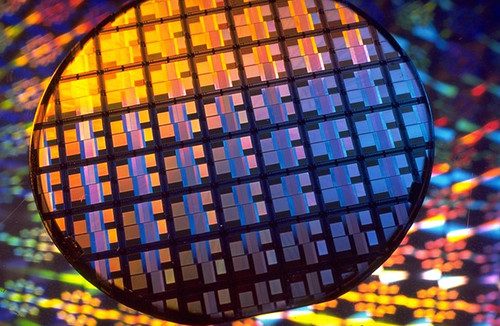
- In September 2025, Diraq and imec demonstrated that randomly selected devices from a standard 300mm industrial wafer. Built with imec’s existing spin-qubit process flow, their device hit over 99% two-qubit fidelity.
- Intel’s Tunnel Falls chip showed a major fab could process silicon qubits at genuine volume. By early 2026, a Nature Reviews assessment found no fundamental incompatibility between standard CMOS fabrication and spin-qubit requirements.
Stacked against other modalities, silicon’s position is one of trajectory rather than dominance:
- Trapped ions still hold the fidelity crown outright. Quantinuum and IonQ sit at 99.97–99.99% two-qubit fidelity with the best physical-to-logical qubit efficiency in the field (as little as 2:1).
- Superconducting platforms lead on raw qubit count. IBM’s Condor alone fields over a thousand physical qubits. This is at a much steeper 105:1 overhead to produce a single logical qubit. IBM has shifted its focus toward modular, error-corrected systems utilizing processors like Heron.
- Neutral atoms have emerged as the modality gaining the most institutional momentum. This has prompted Google to launch its own program alongside its existing investment in QuEra. The focus here is on strength of scaling headroom rather than fidelity.
Against this playing field, silicon spin qubits have narrowly matched the fidelity leaders. Silicon Quantum Computing’s 99.99% ties IonQ’s record, while still trailing badly in physical qubit count, with barely a dozen qubits demonstrated at scale compared with thousands elsewhere.
The Unwritten Chapter
The journey from sand to spin qubit could be viewed as a decades-spanning story of transistor-driven materials refinement. The quantum jump truly emerged once physicists figured out how to treat a single trapped electron as a qubit rather than just a charge carrier.
Today, what silicon offers for quantum computing is not a performance lead but the shortest plausible distance between laboratory result and factory output. Qubits roughly a thousand times smaller than a superconducting transmon, fabricated on tooling that the semiconductor industry already owns and operates at a trillion-dollar scale, is not a claim any competing modality can make on the same terms.
But the distance still to travel is real and specific. Physical qubit counts remain in the dozens, not the thousands fielded by superconducting and neutral-atom platforms. A January 2026 benchmarking study found fidelity still degrades as circuit depth and qubit count rise together, meaning today’s best single- and two-qubit numbers aren’t yet holding at any meaningful scale. The first logical-qubit operations in silicon only arrived in early 2026, years behind trapped-ion and neutral-atom equivalents, and error correction is only barely underway.
Beyond the qubits themselves, the surrounding architecture has various contentious bottlenecks:
- Routing control and readout signals to thousands of qubits without overwhelming a dilution refrigerator’s wiring budget.
- Integrating cryogenic control electronics directly alongside the qubits, and proving that the uniformity seen in a handful of wafer samples holds across full production runs at yield.
None of these are physics problems in the way isotopic purification or single-electron control once were. Rather, they are engineering and manufacturing problems, which is exactly the kind of problem silicon’s inherited industry has spent seventy years getting good at.
Looking ahead, silicon’s quantum chapter is repeating its own history one more time: an abundant, unglamorous starting point, run through a process more exacting than anything that came before it, in pursuit of a capability no prior material could offer, with the outcome, this time, still unwritten.