
Insider Brief
- The 2026 City Quantum & AI Summit will take place on Oct. 7 at London’s Mansion House, bringing together leaders from government, defense, industry, academia and finance to examine how quantum computing and artificial intelligence are reshaping critical sectors under the theme “Connections in Chaos.”
- The agenda features discussions on defense, cybersecurity, life sciences, space, finance and the convergence of quantum computing and AI, with speakers from organizations including NATO, Multiverse Computing, Cleveland Clinic, GSK, NVIDIA, Oxford Quantum Circuits, Google DeepMind and the London Stock Exchange.
- Organizers say the summit is designed to strengthen collaboration across industries and allied nations as governments and businesses increase investment in quantum technologies and AI to address economic competitiveness, scientific innovation and national security challenges.
Building on its 6-year tradition where visionary science meets real-world solutions, the 2026 The City Quantum & AI Summit will bring together military leaders, technology executives, researchers, investors and policymakers to examine how quantum computing and artificial intelligence are changing national security, health care, finance and other critical industries.
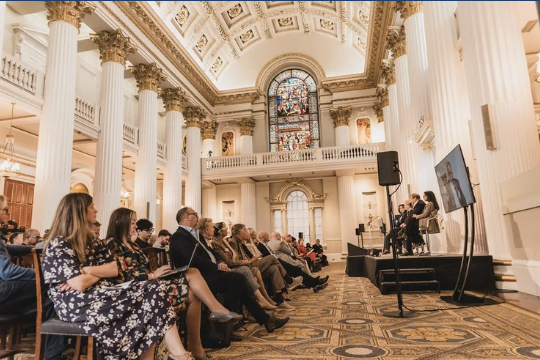
The one-day conference will take place Oct. 7 in London at the palatial Mansion House under the theme “Connections in Chaos.” Organizers say the program reflects a growing need for governments, businesses and researchers to work more closely together as emerging technologies become increasingly important to economic competitiveness and national security.
”We are always pleased to sponsor The City Quantum & AI Summit. It allows us to showcase our latest user cases in data centres and defence at board level, while its quantum and AI themes feed directly into our unique quantum-inspired AI products,” says Enrique Lizaso, co-founder and CEO of Multiverse Computing, one of Europe’s largest scale ups, currently about to close its €500m round.

“Connections in Chaos” also reflects the value of human relationships in a digital age. Organizers say the conference is intended to connect people from industries that increasingly face common challenges but have traditionally operated independently. Those connections extend across disciplines, from defense and pharmaceuticals to finance and space, as well as across allied nations through the summit’s longstanding collaboration with NATO.
The conference comes at a time when governments around the world are increasing investments in quantum technologies and artificial intelligence. AI is already transforming software development, scientific research and business operations. Quantum computing remains an emerging technology, but governments and industry are investing heavily because of its potential to solve certain scientific and industrial problems that are beyond the practical reach of today’s conventional computers.
The summit will open with remarks from Alderman and future Lord Mayor Bronek Masojada, followed by Karina Robinson, CEO of Redcliffe Advisory and founder of The City Quantum & AI Summit.
Defense Opens the Program
The conference will begin with a discussion on defense and security. Organizers say they intentionally chose defense as the opening topic because geopolitical tensions have increased the importance of cooperation among governments, established defense companies and emerging technology firms.
The session will be chaired by Admiral Sir Tony Radakin, former chief of the Defence Staff. Participants include Enrique Lizaso, co-founder and CEO of Multiverse Computing; Tony Lowe, CEO of Delta.g; Simon Harwood, strategy and technology director at Leonardo UK; and a representative from defense technology company Helsing.
According to the organizers, the panel is designed to bring together leaders who have experienced military conflict alongside executives developing next-generation technologies. They argue that protecting democratic societies will require closer cooperation among governments, defense contractors and technology companies as AI and quantum technologies become more capable.
The defense focus will continue with a keynote address by Jean-Charles Ellerman Kingombe, NATO assistant secretary general, on cyber defense in the quantum and AI era.
Quantum computing has become a strategic priority for NATO and many of its member nations. While practical quantum computers remain under development, governments are preparing for the technology’s long-term impact on cybersecurity because future quantum systems could eventually break many of today’s encryption methods. At the same time, AI is becoming an increasingly important tool for intelligence analysis, logistics, cybersecurity and military planning.
From Medicine to Financial Markets
The remainder of the conference highlights industries where quantum computing and AI are expected to have a growing influence.
A life sciences panel will feature Dr. Lara Jehi, chief research information officer at Cleveland Clinic; James McCafferty, chief information officer at the Wellcome Sanger Institute; and Anthony Rowe, vice president of Onyx Research at GSK.
The discussion will explore how AI is already helping researchers analyze medical data and accelerate biomedical research. Speakers are also expected to examine how future quantum computers could improve molecular simulations and drug discovery by modeling chemical interactions that remain difficult for conventional computers.
The conference will also turn to the space sector during a discussion held in association with the Farnborough International Airshow. Ashley Fieglein Johnson, president and chief financial officer of Planet; Will Whitehorn, chair of Seraphim Space Investment Trust; and Phil Cooper, commercial lead for aerospace, satellite and defense at Amazon Web Services, will discuss how AI, cloud computing and satellite technologies are reshaping the industry.
Another panel will examine financing innovation. Emily Turner, CEO of HSBC Innovation Bank UK, and Dame Julia Hoggett, chief executive of the London Stock Exchange, are among the scheduled participants. The discussion will focus on how financial institutions and capital markets can support companies developing quantum and AI technologies as they move from research into commercial deployment.
Connecting Quantum and AI
One of the conference’s featured sessions will bring together Gerald Mullally, CEO of Oxford Quantum Circuits, and Nic Harrigan, quantum manager at Nvidia, for a discussion titled “Entangled Exchange.”
The conversation will examine how quantum computing and artificial intelligence are becoming complementary technologies rather than competing ones.
AI is already helping researchers design, calibrate and operate quantum computers. At the same time, many researchers believe future quantum computers could eventually speed up some AI workloads and solve optimization and simulation problems that challenge today’s computing systems.
The session reinforces the Summit’s view that the greatest advances are likely to come from connecting technologies rather than treating them as separate fields.
The program also includes a special appearance by Sir Peter Knight, widely regarded as one of the founders of the United Kingdom’s quantum research program, and Tom Adeyoola, the executive chair of Innovate UK.
The summit will conclude with a discussion on the broader implications of increasingly powerful computing systems. Roman Orús, a member of the United Nations Independent Scientific Panel on AI and a co-founder of Multiverse Computing, and Thore Graepel, distinguished research scientist at Google DeepMind, will discuss what organizers describe as one of the defining questions facing society as quantum computing and AI continue to advance.



![Google DeepMind [Acquired by Google]](https://s3.us-east-2.amazonaws.com/tqd.s3.bucket/images/9833ddd7-a034-449d-b355-05b9ea6843db.jpeg)