Guest Post – Ireland’s Quantum Play: Nimble Market with an Outsized Position


Guest Post by Meric Kucukbas
Industry has yet to encounter quantum computing in any meaningful way, and even fewer professionals could clearly define it. Yet Ireland is increasingly positioning itself as a country helping to define what comes next.
For starters, back in the 19th century, Dublin-born physicist William Rowan Hamilton forged the mathematical foundation for what later became quantum mechanics.
But more relevant to today, there is a concentration of multinational technology firms, universities are teaching quantum computing, a financial services sector that has begun preparing for a post-quantum transition, let alone the present, and Ireland’s national strategy oriented around quantum computing. For any company looking to expand into quantum computing, they don’t need to look further than Ireland.

A National Strategy Built Around Quantum Computing
Ireland recognized early that the country needed to move decisively to position itself as a European quantum leader, and indeed, the country quickly melded government strategy, academic research, and private-sector investment.
Ireland’s quantum policy framework was forged in Quantum 2030, a national strategy launched in 2023. The document’s vision was ambitious: by 2030, Ireland is to be an internationally competitive hub in quantum technologies through research, talent, collaboration, and innovation.
Arguably, four years early, Ireland is already there.
The national strategy is structured around four pillars, fundamental and applied research, science and engineering talent, national and international collaboration, and innovation and entrepreneurship, with a fifth, cross-cutting pillar focused on building public awareness and the benefits of quantum technologies.
It’s a strategy that Ireland has followed with other competitive technological industries to great success. Nine of the top 10 American technology companies have operations in Ireland. Of the top 10 global software companies, eight are in Ireland.
Three of the largest software providers are in Ireland. The biggest American tech firms, such as Google, Meta and Amazon, have significant European headquarters in Ireland. The information and communications technology industry in Ireland employs over 100,000 people.
All of which is to say that Ireland doesn’t need to recruit partners to help build a quantum computing universe. The customers, payments networks, banks, fintechs, security software firms are already operating in Ireland, and many have begun investing in post-quantum readiness.
From Laboratory to Deployable System
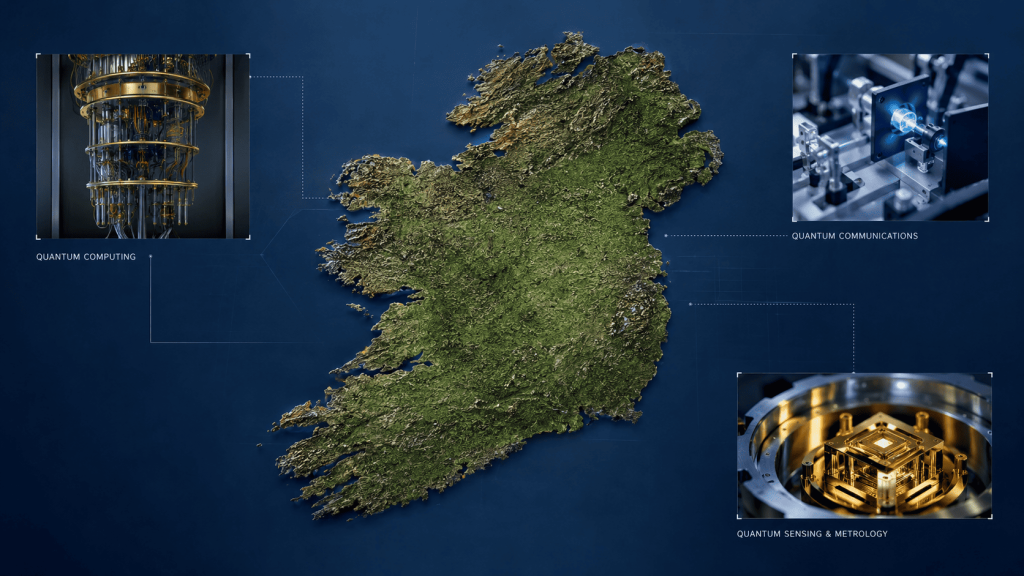
Ireland’s been creating a framework that will allow quantum computing to thrive. For instance, the IrelandQCI (Ireland Quantum Communication Infrastructure) project incorporates integrating innovative and secure quantum devices and systems into conventional communication infrastructures.
Meanwhile, technology specialists in six universities are pooling their expertise and resources to add an extra security layer to Ireland’s communications infrastructure and the data it transmits.
In 2020, the Quantum Computing in Ireland initiative was created to unite quantum computer researchers and lay the foundations for a quantum ecosystem in Ireland. The project brought together partners from academia and enterprises to collaborate on quantum computing.
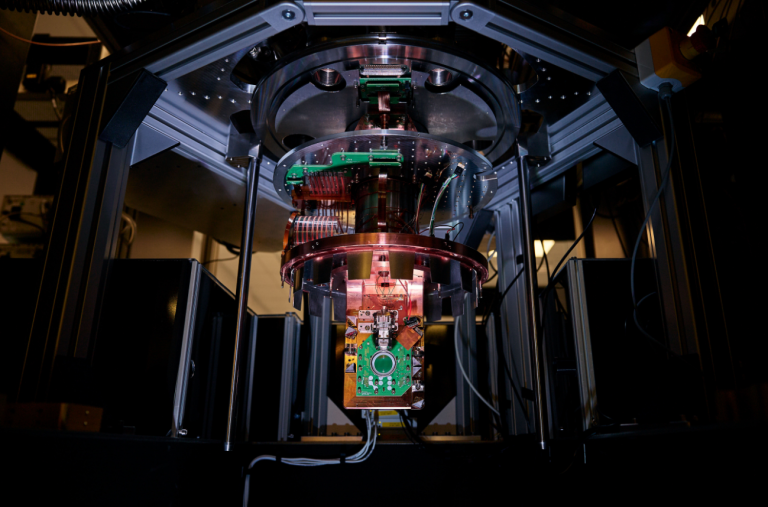
It’s early in the history of quantum computing, but there is evidence that Ireland’s quantum position is working: the country is already seeing companies moving away from research to viability in the marketplace. One recent example is Equal1, headquartered in Dublin, which has developed Bell-1, a quantum computing system designed for direct deployment in high-performance computing environments.
Unlike most quantum systems, which require dedicated cryogenic facilities and purpose-built rooms, Bell-1 is a compact, rack-mounted system engineered to operate alongside classical computing hardware in standard data-center environments.
The Next Tech Race: Can Ireland Win in Quantum?
Ireland is confident that it can. Public investment in national quantum programs reached close to €30 billion as of early 2022, with the United States, China, Germany, France, and the United Kingdom leading on absolute funding, according to the World Economic Forum. Starting in 2018, the EU’s Quantum Technologies Flagship committed to spend €1 billion over ten years. China has elevated quantum to a priority on par with semiconductors in its most recent five-year plan.
Ireland recognizes that it may have a smaller footprint than its larger competitors, but it sees itself as a quantum computing specialist, a nimble startup, if you will, that can absolutely compete against the bigger behemoths.
The argument for getting into quantum computing early is not that fault-tolerant quantum computers will arrive next quarter. Obviously, they will not. But decisions need to be made today instead of tomorrow, choices that involve everything from cryptographic migration timelines, talent pipelines and vendor lock-in to standards alignment.
Late movers will pay a premium for delaying too long. Right now, companies and countries are playing a game of quantum computing that looks like musical chairs: you don’t want to be a late mover, standing without a chair, while your competitors have a seat at the table.
Post-quantum cryptographic migration is already a serious time commitment, years, for any organization with serious data-security obligations. Quantum-enhanced optimization, simulation, and sensing will reach commercial usefulness gradually, over time, with financial services, pharmaceuticals, materials, and logistics likely to feel the impact earliest. But that can only happen if organizations truly invest in what it means to be quantum ready.
There’s more to it than buying access to a quantum computer. Readiness starts far earlier, with companies familiarizing themselves with data structures, workflows, numerical literacy and cryptography hygiene. The countries and companies that have positioned themselves inside the relevant supply chains, talent pools, and partnerships will be the ones that profit from their investments and the ones that don’t, won’t.
It’s simple: A country that does not develop its own quantum capability does not avoid quantum technology, it becomes a customer of someone else’s, with the strategic and financial dependencies that implies.
For sectors as critical as secure communications, payments infrastructure, and defense systems, that dependency is not a posture most governments will accept once the implications become clear. The pressure to build sovereign capability is one of the reasons national quantum strategies have proliferated so quickly across Europe and beyond.
What this Means For Companies Watching the Space
For executives operating in technology-adjacent sectors, the relevant question is no longer whether quantum will affect their business, but when, in what form, and with which partners. Moreover, the partners you choose to work with as businesses assess, deploy and launch, matters. Companies may want to work with organizations that have a lived experience with not only successful quantum-adjacent initiatives, but also stalled and failed ones.
Right now, every corporation’s leadership team should be swiftly developing a working understanding of quantum’s likely impact on a given sector, an inventory of cryptographic exposure, and an active relationship with at least one quantum capability provider. The companies that defer those decisions will defer them at higher cost and on terms shaped by competitors who did not. In short, companies that aren’t prepared for quantum computing aren’t prepared for the future.
For businesses considering where to build their quantum computer capabilities, it’s hard to make the case that Ireland isn’t that place. The talent pipeline is already being trained at Trinity, UCD, Maynooth, the University of Galway, and Munster Technological University. The big-tech anchors are already here, and like it or not, a new dawn is upon us. Ever the early riser, Ireland is more than ready.
About the author
Méric Kucukbas is a technology and research specialist at IDA Ireland with deep expertise in quantum computing, artificial intelligence, and emerging technologies. With a background in theoretical and computational physics, he works closely with multinational companies, academic institutions, and industry stakeholders to support the growth of Ireland’s quantum technology ecosystem and advanced R&D landscape. Kucukbas has been actively involved in industry initiatives surrounding quantum innovation, including collaborations with Quantum Ireland and World Quantum Day programming focused on commercial applications, research advancement, and workforce development in quantum technologies.

Keep track of everything going on in the Quantum Technology Market. In one place.
Topics

Resonance
The Quantum Insider is the leading online resource dedicated exclusively to Quantum Computing. You can contact us at [email protected].
Stay Ahead of Quantum
Get the latest research, company news, and market intelligence every week.
MENTIONED IN THE ARTICLE

Meta
Meta is a technology company that enables people to connect, discover communities, and grow their businesses.
→

Amazon
Amazon is a multinational technology company founded in 1994, headquartered in Seattle, Washington. The company focuses on e-commerce, cloud computing, digital streaming, and artificial intelligence. Through its Climate Pledge Fund, established in 2020 with an initial $2 billion investment, Amazon invests in companies developing sustainability-focused technologies and services to help achieve net-zero carbon emissions by 2040.
→
More in Policy & National