Quantinuum Expands IPO as Valuation Climbs Above $14 Billion


Insider Brief
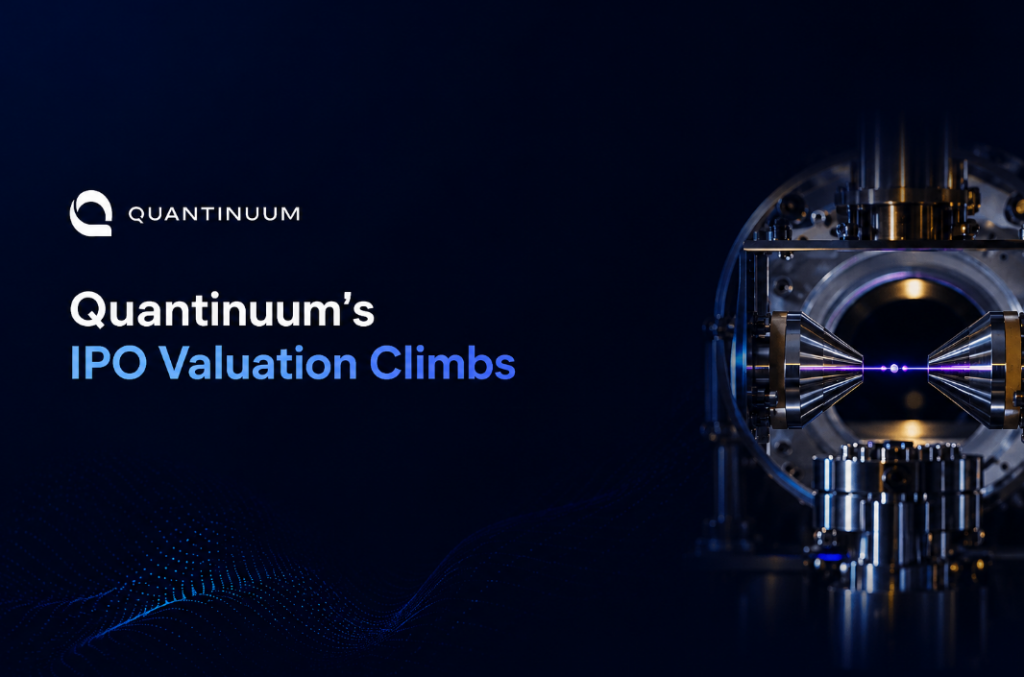
- Quantinuum has reportedly increased the size and pricing of its IPO, raising its potential valuation to approximately $14.3 billion.
- According to Barron’s, the company plans to offer 26.5 million shares at $53 to $55 each, potentially raising up to $1.46 billion ahead of its expected Nasdaq debut under the ticker symbol “QNT.”
- The higher valuation reflects growing investor interest in quantum computing and follows a tentative $100 million Commerce Department funding agreement to support development of Quantinuum’s trapped-ion quantum systems.
Quantinuum is increasing the size of its initial public offering as investor demand continues to build ahead of what could become the largest public-market debut in the history of the quantum computing sector.
According to Barron’s, Quantinuum now plans to offer 26.5 million shares priced between $53 and $55 each, up from an earlier plan to sell roughly 21 million shares at $45 to $50 per share. At the top of the revised range, the company could raise as much as $1.46 billion and achieve a market capitalization of approximately $14.3 billion.
The company is expected to begin trading on the Nasdaq Global Market under the ticker symbol “QNT” later this week, according to Barron’s.

The revised terms represent a sharp increase from the company’s initial filing in May, when Quantinuum sought to raise up to approximately $1.05 billion at a valuation of roughly $12.7 billion.
Full-Stack Quantum IPO
The offering is poised to become the largest public listings ever completed by a dedicated full-stack quantum computing company.
According to Barron’s, Quantinuum’s expected valuation would make it the second-most valuable publicly traded quantum company behind IonQ, which currently carries a market value of roughly $27 billion. Like Quantinuum, IonQ also focuses on the trapped ion approach to quantum computing, D-Wave Quantum follows with a valuation near $11 billion.
The company’s projected value also exceeds those of several prominent private-sector quantum competitors. Barron’s reported that Xanadu Quantum Technologies was valued at approximately $4.8 billion on Monday, while Infleqtion carried a valuation of roughly $3.5 billion. Horizon Quantum remained below the $1 billion mark.
The IPO is another sign that investors are placing larger bets on companies pursuing quantum computing, despite the technology remaining in its early commercial stages.
Unlike many of the quantum firms that reached public markets through special purpose acquisition companies, or SPACs, Quantinuum is pursuing a traditional initial public offering. Traditional IPOs typically involve more extensive regulatory review and are often viewed as a more demanding route to public markets.
Federal Support Raises Profile
Interest in Quantinuum has also been boosted by recent federal support for the quantum sector.
Barron’s reported that Quantinuum was among a limited number of companies selected for funding under a tentative agreement with the U.S. Commerce Department. Under the proposed arrangement, the company could receive $100 million to advance development of its trapped-ion quantum computing systems.
The announcement helped draw renewed attention to the company and the broader quantum industry.
The financial news service also reported that IBM continues to benefit from federal quantum investments. IBM is expected to receive approximately $1 billion from the Commerce Department to establish a standalone quantum foundry known as Anderon.
The government commitments reflect growing interest among policymakers in maintaining U.S. leadership in quantum technologies, which are viewed as strategically important for computing, communications, cybersecurity and national security.
A Growing Quantum Contender
Quantinuum was created in 2021 through the merger of Honeywell Quantum Solutions and Cambridge Quantum. The combination brought together Honeywell’s trapped-ion quantum hardware business and Cambridge Quantum’s software and algorithms expertise.
Since then, the company has emerged as one of the largest standalone quantum computing firms in the world.
According to company filings, Quantinuum reported $30.9 million in revenue during 2025, up from $23 million the previous year. The company also generated $79.3 million in bookings, a measure of signed contracts that may translate into future revenue. At the same time, Quantinuum reported a net loss of $192.6 million as it continued investing heavily in research, engineering and operations.
As a full-stack company, Quantinuum develops both quantum computing hardware and software. Its systems are based on trapped-ion technology, which uses electrically charged atoms controlled by electromagnetic fields to perform calculations. The approach is widely regarded as one of the leading architectures in the race to build large-scale quantum computers.
Quantinuum also generates revenue from cybersecurity products, software platforms and professional services. The company counts organizations including Airbus, BMW Group, JPMorganChase and Amgen among its customers and collaborators, according to regulatory filings.
What Comes Next
According to the original filing, Honeywell will continue to hold a substantial ownership position following the IPO. It is expected to retain about 49.1% of Quantinuum’s voting power after the offering and Cambridge Quantum will hold around 32.5%. The prospectus also confirmed that founder Ilyas Khan is the largest individual shareholder of the company with a personal stake worth over $2 billion at the initial offering price.
The industrial conglomerate has continued to support the business since creating Quantinuum through the 2021 merger.
For investors, The IPO will provide another large-scale opportunity to gain exposure to the quantum computing sector, which has seen a surge in public-market interest during the past year.
The company’s debut will also serve as a closely watched test of investor appetite for quantum computing firms at increasingly higher valuations. While enthusiasm around the technology has grown, companies across the sector continue to face significant technical and commercial challenges as they work toward building systems capable of solving practical problems at scale. For Quantinuum, the expanded offering suggests investors are willing to place a premium on companies viewed as leaders in the race to commercialize quantum computing.

Keep track of everything going on in the Quantum Technology Market. In one place.
Topics

Matt Swayne
With a several-decades long background in journalism and communications, Matt Swayne has worked as a science communicator for an R1 university for more than 12 years, specializing in translating high tech and deep tech for the general audience. He has served as a writer, editor and analyst at The Quantum Insider since its inception. In addition to his service as a science communicator, Matt also develops courses to improve the media and communications skills of scientists and has taught courses.
[email protected]

Stay Ahead of Quantum
Get the latest research, company news, and market intelligence every week.
MENTIONED IN THE ARTICLE

Quantinuum
Quantinuum builds full-stack quantum computing solutions for practical deployment. Leveraging proprietary enhancements to trapped-ion QCCD architecture, the company has launched multiple commercial hardware generations that deliver leading two-qubit gate fidelity and industry-topping accuracy.
→

IonQ
IonQ is a developer in trapped ion quantum computing founded in 2015 that actively applies its technology to the aerospace and defense sectors. The company empowers satellite-based quantum networks and quantum enabled drones to improve positioning, navigation, and timing resilience in GPS denied environments, and collaborates with industry leaders like Airbus to optimize aircraft loading.
→

D-Wave Quantum
D-Wave Quantum is a pioneering dual-platform quantum computing company that partners with aerospace organizations to solve complex logistical, defense, and satellite challenges. Founded in 1999, the company’s quantum annealing technology is utilized by industry leaders like Lockheed Martin to optimize aircraft networks, improve manufacturing efficiencies, and support critical national security initiatives.
→

Xanadu
Xanadu is a Canadian photonic quantum computing company founded in 2016 that is building fault tolerant systems utilizing light. The company collaborates with defense and hardware partners like AMD and Lockheed Martin to accelerate computational fluid dynamics simulations and train an aerospace engineering workforce.
→

Infleqtion
Infleqtion, founded in 2007 at the University of Colorado Boulder, specializes in neutral atom quantum technology for the aerospace and defense sectors. The company is heavily involved in orbital infrastructure, notably supplying atomic clocks and contributing quantum sensors to NASA's Cold Atom Lab and the Quantum Gravity Gradiometer Pathfinder mission to enhance space navigation, timing, and Earth observation capabilities.
→

Horizon Quantum Computing
Horizon Quantum Computing is developing tools to simplify and expedite the process of developing quantum software applications. In November, they announced launching their European office in Ireland.
→
IBM
IBM is an iconic technology pioneer founded in 1911 as the Computing-Tabulating-Recording Company and officially renamed International Business Machines Corporation in 1924. Beyond foundational computing, IBM possesses a deep legacy in aerospace and defense from building the guidance computers and Instrument Unit for NASA's historic Apollo missions to partnering with Airbus on CIMON, the first AI assistant on the ISS.
→

Anderon
Anderon is a quantum foundry initiative from IBM, focused on advancing large-scale quantum wafer fabrication in the United States. Leveraging decades of semiconductor research and quantum computing expertise, Anderon aims to catalyze domestic quantum manufacturing capabilities. The division specializes in 300mm wafer processes, advanced packaging, and scalable quantum hardware production, supporting applications across computing, sensing, and communications. By establishing a robust supply of quantum wafers, Anderon seeks to anchor a national quantum ecosystem and drive U.S. economic growth in the quantum industry.
→