

Insider Brief
- IonQ opened a new quantum computing R&D and semiconductor testing facility in Boulder, Colorado to expand its trapped-ion quantum hardware development.
- The 22,000-square-foot facility will support semiconductor ion trap chip design, testing, and future quantum computer development.
- Colorado state and local agencies supported the expansion through tax incentives tied to job creation and investment targets.
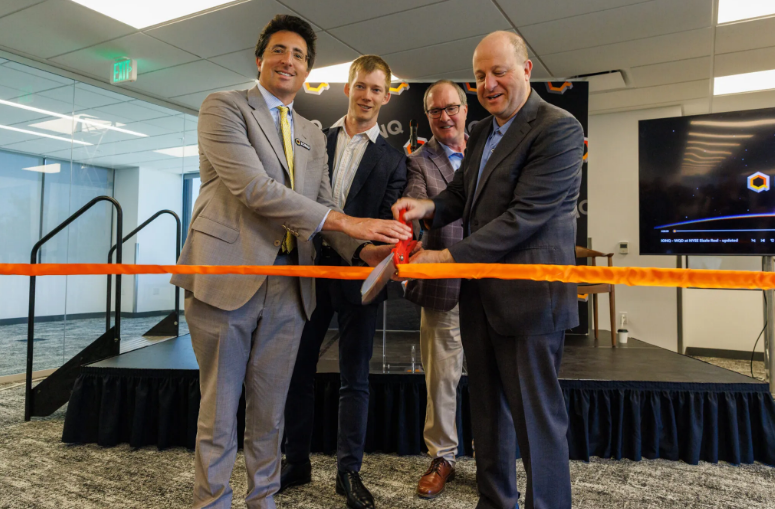
PRESS RELEASE — Today, Governor Polis and the Global Business Development Division of the Colorado Office of Economic Development and International Trade (OEDIT) celebrated IonQ’s (NYSE: IONQ) new laboratory suite in Boulder, Colorado. The suite will house state-of-the-art Quantum Computing R&D and semiconductor chip testing facilities that will develop new technologies, create good paying jobs, and strengthen Colorado’s leading quantum sector.
“Colorado is a quantum hub, and we are only growing. The selection of Boulder as IonQ’s North American expansion, is proof of Colorado’s strong and growing quantum economy, and will bring more high-paying skilled jobs to the region, and attract more businesses to Colorado,” said Governor Polis.
The company employs a pioneering approach to building trapped-ion quantum computers using electronics instead of lasers, enabling mass manufacturability via the standard semiconductor supply chain. The new facility, which is projected to have its first quantum computer fully installed by the third quarter of this year, will enable IonQ to design, test, and iterate new generations of its semiconductor ion trap chips. With the work in Boulder, IonQ expects to innovate and increase the technological sophistication and performance of its trapped-ion chips and of the quantum computers they power as the company scales.

“Quantum is Now!” said company Chairman and CEO Niccolo de Masi in advance of the official ribbon-cutting ceremony. “IonQ is delivering, today, on the promise of using our advanced quantum technologies to solve the world’s most complex problems, aiding communities and businesses in everything from improving lives with faster pharmaceutical development, to enhancing reliability of infrastructure and optimizing manufacturing processes. IonQ is proud to partner with Governor Polis, the Colorado Office of Economic Development & International Trade, and the city of Boulder to continue to drive Colorado’s reputation as a leader in quantum innovation. We’re deeply appreciative of the support Colorado has demonstrated in helping bring our new R&D labs here, and excited to tap into its highly skilled workforce as we continue to grow.”
In Boulder, IonQ expects to create dozens of net new jobs in the high-paying deep tech space. The positions will include quantum scientists, system engineers, and operations managers. The 22,000 square feet of new laboratories will occupy two floors in Boulder 38, a 9.3-acre Class A research and innovation campus developed by Breakthrough Properties and located at the intersection of 38th Street and Arapahoe (1685 38th Street).
“The world is at a quantum inflection point, and Colorado companies are leading the way developing and commercializing these transformative new technologies. We are thrilled that IonQ is part of this movement, strengthening our state’s quantum ecosystem while pushing the boundaries of what’s possible and creating good-paying jobs for Coloradans,” said Eve Lieberman, OEDIT Executive Director.
To support the company’s expansion in Colorado, the Colorado Economic Development Commission approved a performance-based Job Growth Incentive Tax Credit for the company over an eight-year period. The EDC also approved IonQ for Colorado Refundable Tax Credits and the company will earn additional credits through the Boulder CHIPS Zone, established by the EDC in November 2025. These incentives are contingent upon IonQ, referred to as Project Electron and Project Neon throughout the OEDIT review process, meeting net new job creation and salary requirements.
“IonQ’s decision to locate this facility in Boulder reflects the city’s commitment to building the infrastructure and innovation ecosystem needed to support emerging industries like quantum technology,” said City of Boulder Mayor Aaron Brockett. “Through city and state incentives and initiatives like the CHIPS Zone Program, we are continuing to build on the conditions that make Boulder an ideal place for innovative companies to thrive. This milestone also highlights the strength of Boulder’s collaborative ecosystem, where universities, government, industry and economic development partners work together to advance our community as a global hub for innovation.”