

Insider Brief:
- Australia is transitioning quantum from long-term research into an industrial capability, supported by sustained public investment, a growing workforce, and an expanding ecosystem of companies and institutions.
- Companies across sensing, communications, and computing are already advancing real-world applications, demonstrating a shift from laboratory breakthroughs to deployable systems.
- The annual Quantum Australia Conference takes place in Adelaide from 29 to 30 April.
For 25 years, Australia has built one of the world’s deepest reservoirs of quantum talent. The stakes are rising as quantum moves beyond the lab. Increasingly quantum is emerging as an export industry, a sovereign capability platform, and a source of measurable productivity gains across defense, energy, mining, healthcare, finance, and more. This structural shift reflects over USD$1.6 billion in sustained public investment that has positioned Australia with the world’s fifth largest quantum workforce, over 40 companies operating across sensing, communications, and computing, and 26 research institutions with specialized capability.
What determines Australia’s value uptake over the next decade, however, will be the degree of national coordination around commercialization, supply chains, and global engagement according to Petra Andrén, CEO of Quantum Australia: “Australia has led in quantum research for decades,” Andrén says. “The task now is to convert that depth into sovereign capability and a globally competitive industry. That requires deliberate coordination between researchers, startups, industry, investors, and government.”
Quantum Australia was established as the national centre for quantum growth to support delivery of the National Quantum Strategy. Its role is not symbolic. It convenes policymakers, end users, investors, and technologists around defined industrial objectives. That coordination will be visible in Adelaide on 29 to 30 April at the Quantum Australia Conference 2026.

The conference brings together a diverse mix of voices, including end users from financial services, life sciences, resources, energy, and transport, alongside startups, quantum and adjacent technology companies, government and policy leaders, defence stakeholders, and academic experts. It is structured around capability, procurement, and capital mobilisation and how alignment across these factors will determine whether capability scales domestically, or diffuses offshore.
From Laboratory Breakthroughs to Industrial Systems
Encouragingly, the industrial transition is already visible across multiple domains on home shores. In Adelaide, QuantX Labs has developed TEMPO, the next-generation of optical atomic clocks, providing an order of magnitude performance improvement compared to current GNSS clocks. These optical atomic clocks were tested alongside AUKUS partners in Washington D.C. in 2025. Precision timing underpins radar performance, satellite synchronisation, and telecommunications integrity. And SENTIO, an extremely sensitive quantum sensor for subterranean surveillance perfect for detection of covert operations and undersea surveillance.
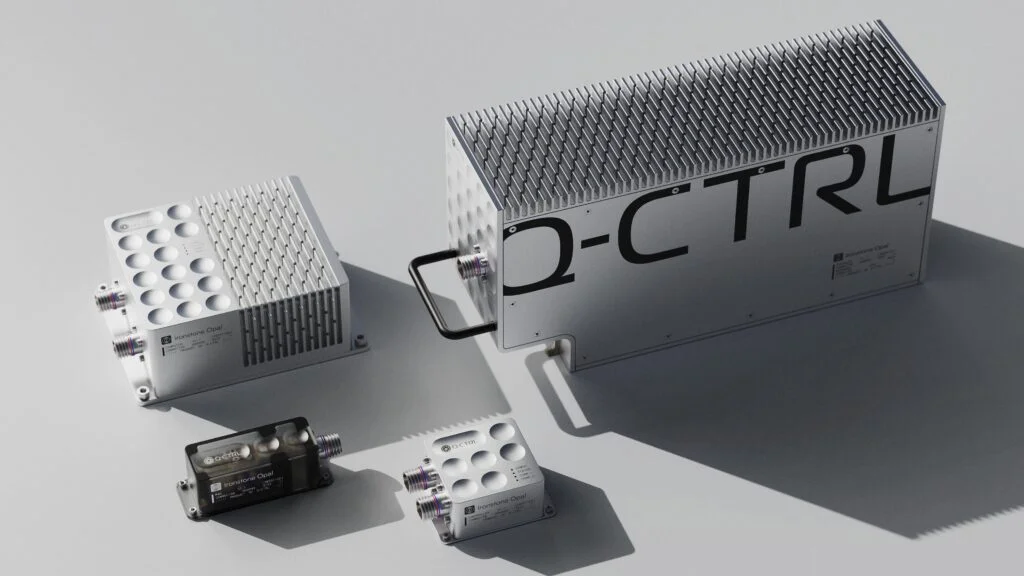
Q-CTRL is a global leader in AI-powered quantum infrastructure software, accelerating progress toward quantum advantage on leading platforms, such as IBM Quantum. Q‑CTRL is also delivering to the global market a complete quantum-assured navigation system, field validated to outperform the best GPS-alternatives, in partnership with AUKUS governments and industry leaders, including Airbus and Lockheed Martin.
In Sydney, DeteQt is commercialising diamond on chip magnetometers capable of operating in GPS denied environments, with applications spanning navigation, mineral exploration, and medical imaging. A broad range of opportunities exist for “magnetic intelligence” with high-sensitivity, chip-scale quantum sensors.
At the computing frontier, both Diraq and Silicon Quantum Computing are advancing silicon-based quantum processors, building upon trillions of dollars in research and development from the semiconductor industry. Founded in Sydney, Diraq is a global contender in the race to deliver utility scale quantum computing. The company is developing utility-scale quantum computers using silicon technology compatible with existing semiconductor manufacturing, enabling the potential to scale to millions of qubits on a single chip. Diraq’s quantum computers are designed to be scalable, powerful, and readily deployable, for example, in conventional data centres.
Meanwhile, Silicon Quantum Computing (SQC) is advancing commercial scale silicon quantum processors using its proprietary PAQMan™ manufacturing process. The company can design, produce and test new quantum chips in under a week, demonstrating the speed and precision needed to scale quantum hardware.
Integration with established manufacturing pathways reflects an understanding that scalability will determine global competitiveness, and we are already seeing this understanding from the Australian government.
In February 2026, Diraq secured a USD$14 million equity investment from the National Reconstruction Fund Corporation – an investment that signals quantum has shifted from research priority to industrial policy. The capital will support Diraq’s goal of delivering a system capable of genuine quantum advantage by 2029.
Emergence Quantum, on the other hand, reflects ecosystem maturation. Founded by former leaders of Microsoft’s quantum hardware program, it addresses control systems and integration bottlenecks across platforms because, as sectors scale, enabling layers will become as critical as core hardware.
And, finally, university commercialisation is also entering a more deliberate phase. The University of Queensland and its commercialisation arm UniQuest recently launched Cortisonic following a collaboration with Lockheed Martin. Cortisonic is developing Sonic Processing Units, a new class of AI processors that leverage acoustic waves for computation to achieve ultra-low-power edge inference.
Lockheed Martin’s sustained involvement demonstrates both the global credibility of Australian research and the export potential of university originated intellectual property when commercialisation pathways are structured with industrial partners from inception.
Collectively, these examples illustrate a sector transitioning from discovery to deployment. They also demonstrate breadth, with capability being cultivated across sensing, communications, and computing rather than concentrating on a single technological pathway.
Coordination as National Advantage
The National Quantum Strategy, released in 2023, formalised the ambition to position Australia as a global quantum leader by 2030. It aligned research funding, industry development and regulatory settings, reinforced by capital mechanisms including USD$700 million allocated to critical technologies through the National Reconstruction Fund. Yet strategy alone does not create industry. Structured collaboration does.
Andrén describes Quantum Australia’s operating model as a community of practice, bringing together end user industries, technology developers, investors, and policymakers around defined challenges: “When defense, mining, energy, and finance engage with quantum companies early, adoption pathways accelerate,” she says. “That shortens the distance between scientific achievement and economic impact.”
Without coordination, Andrén says, research excellence can fragment and talent can drift offshore, resulting in value then accruing in other nations.
Industrial capture requires alignment between capital, procurement, and commercialization according to Malcolm Roberts, Director – Technology at the Australian Trade and Investment Commission, who believes quantum now sits squarely within Australia’s trade and investment strategy: “Quantum combines frontier science with tangible commercial pathways,” Malcolm says. “Our role is to connect Australia’s most credible quantum companies with global customers and integrators, positioning them for real commercial uptake in international markets.”
Austrade’s presence in the United States, United Kingdom, and Asia Pacific markets provides structured access to defence primes, advanced manufacturers and institutional capital. In a sector shaped increasingly by geopolitical sensitivity, trusted intermediaries strengthen confidence.
This global connectivity is already yielding results through companies like Q-CTRL, whose software enables users to run utility-scale algorithms across diverse platforms, empowering enterprises, developers, and researchers to get the most out of quantum hardware. At the same time, its quantum education platform is helping organizations prepare the workforce and close the skills gap as quantum technology adoption scales.
An Industrial Nation in Formation
Quantum remains inherently international with its cross-border applications, mobile talent, and supply chains that span jurisdictions. Strategic competition, however, is intensifying as governments seek sovereign capability and competitive advantage in technologies underpinning defense systems, communications infrastructure, and advanced manufacturing.
Australia’s response has been characterised by continuity, according to Andrén. “Long-term research investment built credibility. Policy settings are aligning capital, procurement, and trade to convert that credibility into durable industry,” she said.
“Whether this alignment sustains momentum will depend on disciplined collaboration across institutions that have historically operated independently. So for policymakers, technologists, and industry leaders, participation is not peripheral. It is formative.”
The Quantum Australia Conference offers a concentrated view of this type of coordinated ecosystem operating across research, industry, and policy and will take place in Adelaide, South Australia on 29-30 April 2026. Book your tickets now.
For all inquiries about how the Australian Trade and Investment Commission can assist with connections to this ecosystem, please contact Timothy.Grey@austrade.gov.au