


Insider Brief
- New research from Quantinuum and Hiverge shows that large language model–driven systems can automatically generate quantum chemistry algorithms that match or outperform leading human-designed methods while using far fewer quantum resources.
- Using Hiverge’s Hive platform, researchers evolved a near-term quantum algorithm from minimal input, achieving chemical precision for benchmark molecules and reducing circuit depth and gate counts by one to two orders of magnitude compared with standard approaches.
- The results suggest automated, noise-aware algorithm discovery could ease a major bottleneck in quantum software development and shift the field toward machine-assisted design as hardware and problem complexity scale.
Large language models are beginning to generate quantum algorithms that match and, in some cases, surpass human-engineered methods, according to a blog post about new research from Quantinuum and Hiverge. The preliminary findings suggest this could lead to a shift in how quantum software may be developed.
The work directly addresses a long-standing obstacle in quantum computing. Even as hardware improves, the algorithms needed to run real chemistry and materials problems remain difficult and expensive to design. Access to high-fidelity quantum processors is limited, so every extra circuit evaluation or unnecessary gate adds to the cost. Variational quantum algorithms, widely used for near-term chemistry simulations, require careful choices about which quantum operators to include, how to optimize their parameters, and how to keep noise from overwhelming the calculation.
All of these steps tend to depend on expert judgment and weeks of trial-and-error, according to the post.

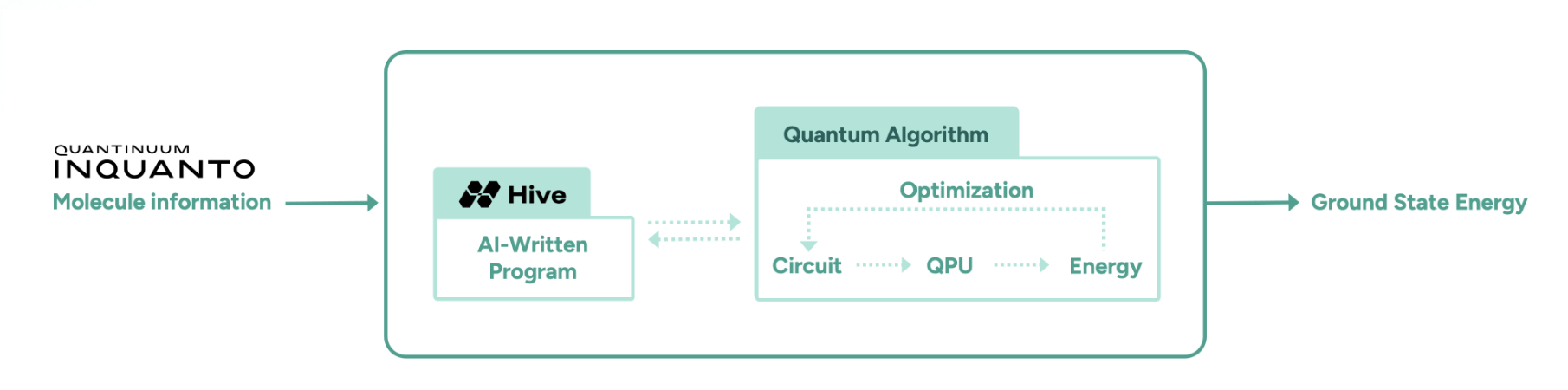
The researchers tested whether an automated system could handle those decisions. Using Hiverge’s platform, known as the Hive, researchers supplied only a simple sketch of a quantum chemistry algorithm and the molecule they wanted to analyze. The Hive is a distributed evolutionary program synthesis system that uses large language models as mutation operators, not as decision-makers. At a high level, the system searches the space of possible quantum algorithms by evolving executable programs, rather than generating a single solution in one pass.
From that minimal input, Hive generated a mature algorithm that runs efficiently on near-term hardware, reaches chemical precision for key molecular systems and reduces quantum resource costs by one to two orders of magnitude compared with leading human-designed methods, according to the post.
“I found it amazing that the Hive converged to a domain-expert level idea,” Quantinuum’s quantum chemistry expert, Dr. David Zsolt Manrique said in the post. “By inspecting the code, we see it has identified the well-known perturbative method, ‘MP2’, as a useful guide; not only for setting the initial circuit parameters, but also for ordering excitations efficiently. Further, it systematically and laboriously fine-tuned those MP2-inspired heuristics over many iterations in a way that would be difficult for a human expert to do by hand. It demonstrated an impressive combination of domain expertise and automated machinery that would be useful in exploring novel quantum chemistry methods.”
This early demonstration also shows that automated discovery could expand the range of problems solvable on current hardware.
Automating a Bottleneck in Quantum Chemistry
The team’s immediate target was an electronic structure problem. computing the ground-state energy of a molecule. Classical computers struggle to handle this calculation once strong quantum effects come into play. They struggle because electrons in molecules can exist in many interacting quantum states at once, which means the number of possibilities a classical computer must track grows exponentially, quickly overwhelming even the most powerful machines.
Quantum processors, in principle, offer a way around the exponential blowup of classical methods. But the algorithms used to prepare and measure these ground states remain fragile. Noisy operations, deep circuits and repeated measurements increase the chance that the calculation fails before converging.
Variational quantum algorithms address some of these issues by combining a quantum circuit with a classical optimizer. But the success of the method depends on how the circuit is built. The usual approach involves selecting a library of chemically meaningful operations and then tuning the circuit step by step until the energy estimate stops improving.
If this sounds monotonous and slow, that’s because it is. The researchers report that this selection strategy is what makes today’s algorithms expensive. Each extra operator and parameter translates into more quantum operations and more measurements.
The Hive attempted to streamline this by evolving a customized version of the algorithm. It treated the codebase as a living program — mutating, combining, and optimizing solutions across many iterations — and scored candidate designs based on how close they came to the exact ground-state energy. The system started from a trivial scaffold and eventually produced a full algorithm, dubbed Hive-ADAPT, that resembles a well-known state-of-the-art method yet consistently outperforms it.
Results from classical simulations show that Hive-ADAPT not only reproduces the correct energy behavior for molecules such as water (H₂O) and beryllium hydride (BeH₂), but also reaches the field’s standard accuracy target for a wider range of molecular shapes than the baseline approach. That target, known as chemical precision, means calculating a molecule’s energy to within about one-thousandth of an atomic energy unit — roughly 1.6×10⁻³ Hartree — which is close enough to reliably predict real chemical behavior. The algorithm also proved adaptable, successfully handling molecular configurations it was not specifically designed to solve.
Quantinuum attributes this performance to the Hive’s ability to combine familiar chemical heuristics with fine-grained code modifications that would be difficult for a researcher to identify manually.
Hardware Constraints Shape the Algorithm
To test whether the AI-generated algorithm holds up under realistic conditions, the researchers incorporated hardware noise into the design process. The Hive was instructed to penalize solutions that used too many two-qubit gates, which remain the largest contributor to errors in near-term systems. The system adapted by assembling circuits that minimized those operations while retaining enough structure to reach a close approximation of the desired energy.
The team implemented one of these circuits for lithium hydride using Quantinuum’s H2 Emulator, a classical model of the company’s trapped-ion processor. With error mitigation applied, the resulting energy differed from the target value by only a few thousandths of a Hartree — roughly the threshold of chemical precision — demonstrating that the method can approach that benchmark under practical constraints.
The team says this type of noise-aware, hardware-specific tailoring will be increasingly important as more organizations run chemistry workloads on quantum devices with varying fidelity levels.
Implications for Quantum Software Development
The study suggests that LLM-driven systems may become a standard tool for designing quantum software, especially as hardware scales and the space of possible algorithms becomes harder to navigate manually.
By operating directly in a programming language such as Python and drawing on libraries like Quantinuum’s InQuanto, the Hive can integrate domain knowledge and produce code that a researcher can inspect, test and modify. The company believes this transparency could help scientists understand how and why new heuristics work, potentially accelerating progress in quantum chemistry.
The approach also lowers the barrier for newcomers. Instead of requiring extensive knowledge of molecular symmetries, operator pools, and optimization strategies, a user can provide a conceptual outline of an algorithm and let the system expand it into a complete implementation. Quantinuum says this could be valuable for organizations that lack large quantum chemistry teams but want to experiment with quantum simulation workflows.
Toward Fully Automated Pipelines
While the proof-of-concept demonstrates that automated discovery can reproduce and improve on today’s techniques, the researchers say questions remain and there is more work ahead. For example, future work will test whether the system can generalize across classes of molecules rather than across bond lengths of a single species.
The team expects the approach to extend beyond chemistry. Other near-term tasks, such as optimization and quantum simulation of materials, may benefit from similar automated design. Quantinuum also points to its recent work on error-corrected quantum phase estimation and says AI-driven strategies could help shape fault-tolerant algorithms by choosing how to combine high-level primitives efficiently.
The broader goal is to build automated pipelines that design, optimize, validate, and benchmark quantum algorithms with minimal human intervention. As quantum hardware becomes more programmable—supported by high-level languages like Quantinuum’s Guppy and reinforced by the rapid growth of LLM-based tools—the researchers anticipate that algorithm design will become a cycle of human steering and machine-driven refinement.
For now, the results indicate that the search for efficient quantum software may shift from manual heuristics to automated exploration. If these methods scale, the next generation of quantum algorithms may emerge not from hand-tuned operator pools, but from code that evolves, adapts, and optimizes itself for the capabilities of the machines that will run it.
Authors include: Quantinuum (alphabetical order): Eric Brunner, Steve Clark, Fabian Finger, Gabriel Greene-Diniz, Pranav Kalidindi, Alexander Koziell-Pipe, David Zsolt Manrique, Konstantinos Meichanetzidis, Frederic Rapp. Hiverge (alphabetical order): Alhussein Fawzi, Hamza Fawzi, Kerry He, Bernardino Romera Paredes, Kante Yin.