


Insider Brief
- Quantum Source unveiled QS-LINK, a proposed interconnect that uses a single rubidium atom as quantum memory to link quantum processors without requiring their photons to arrive simultaneously.
- The design could connect different processor types over standard optical fiber, provided they emit compatible photons.
- Modeling projects roughly 60 times fewer attempts to generate 10,000 entangled pairs per second than conventional linear-optics methods, pending a full end-to-end demonstration.
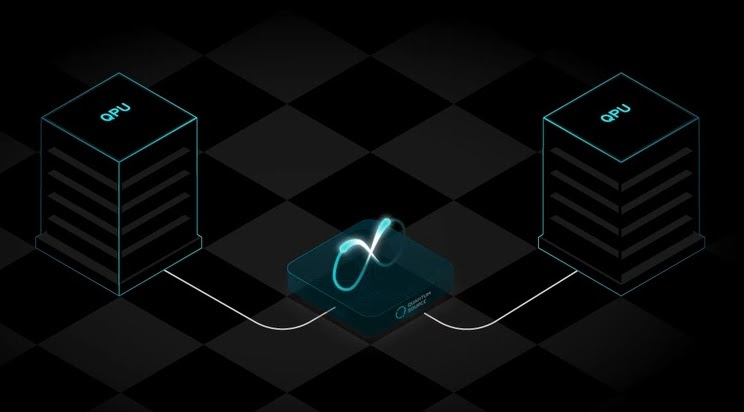
PRESS RELEASE — Quantum Source, developer of compound photon-atom technology that makes photonic quantum computers practical, published the first technical details of its proprietary QS-LINK, an interconnect built to break the bottleneck that keeps quantum computers from scaling beyond a single processor. Using a single rubidium atom as quantum memory, QS-LINK holds the entanglement with a first processor until successfully establishing entanglement with a second one, so processors no longer have to deliver a photon at the same moment, which raises the rate at which they can be linked by orders of magnitude
For all its promise, scale remains the central problem in quantum computing. Fault-tolerant machines will need more qubits than any single quantum processing unit can hold, so they will have to be built from many QPUs linked through shared entanglement. In conventional two-photon schemes, that link only succeeds when photons from both processors arrive in the same attempt, and with each photon delivered about 1% of the time or less, both arriving together happens roughly once in 10,000 tries. QS-LINK removes that requirement with a near-deterministic photon-atom gate that stores the first arrival instead of discarding it. And because the photons interact only with the atom and never with each other, they also never need to be identical, which makes QS-LINK hardware-agnostic.
Any processor that can emit a compatible photon, whether trapped-ion, neutral-atom, superconducting or photonic, can be linked to any other over standard optical fiber. In hardware terms, reaching the roughly 10,000 entangled pairs per second that fault-tolerant architectures call for would take about 190 million attempts per second with linear optics. With QS-LINK it takes about 3.2 million, roughly 60 times fewer and a rate within reach of trapped-ion systems today. Those projections, drawn from analytical modeling and Monte Carlo simulation, assume a photon-atom gate that completes in about 20 nanoseconds at 98.4% efficiency. A full end-to-end demonstration is the next step.

“Every plan for a large-scale quantum computer depends on processors talking to each other, and the current way of doing that is wasteful and often just doesn’t work,” said Oded Melamed, CEO of Quantum Source. “Through our work building a hybrid quantum computer, we realized the same photon-atom gate at its core was the missing piece for connecting everyone else’s.”
The Engine Behind QS-LINK
Quantum Source was founded in 2021 on two decades of quantum optics research at the Weizmann Institute of Science, where chief scientist Prof. Barak Dayan’s group took on the central weakness of photonic quantum computing. Photons make ideal qubits, but they don’t interact with each other, and the linear-optics gates used to entangle them are probabilistic. Quantum Source’s answer was to route photons through a single trapped rubidium atom, which entangles them deterministically and is reused for every operation. That gate is the core of ORIGIN, the engine Quantum Source unveiled in September 2025 to generate the entangled photonic states a fault-tolerant computer runs on. ORIGIN in turn powers QS-ORBIT, the company’s photonic quantum computer.
QS-LINK applies the same gate to a second problem. Where QS-ORBIT uses the atom to generate entangled photonic states for computation, QS-LINK uses it to establish entanglement between processors. A photon reflecting off the atom’s cavity picks up a phase that depends on the atom’s state, and measuring that photon confirms the entanglement landed, which is what lets the atom hold one processor’s half of a link while it waits for the other. In July, Quantum Source and Israel’s Directorate of Defense Research and Development sent entangled photon pairs from that source on demand through more than a kilometer of unstabilized fiber with no measurable loss of fidelity.
“We built the photon-atom gate to give light the one thing it lacks, which is a reliable way to interact,” said Dayan, who also heads the Quantum Optics group at the Weizmann Institute. “The interconnect is where the field has been paying the steepest price for that limitation, and it turned out to be the most natural place to put the gate to work.”
The paper, “Single-atom-based asynchronous photonic interconnect for scalable modular quantum computing,” is available for download.