
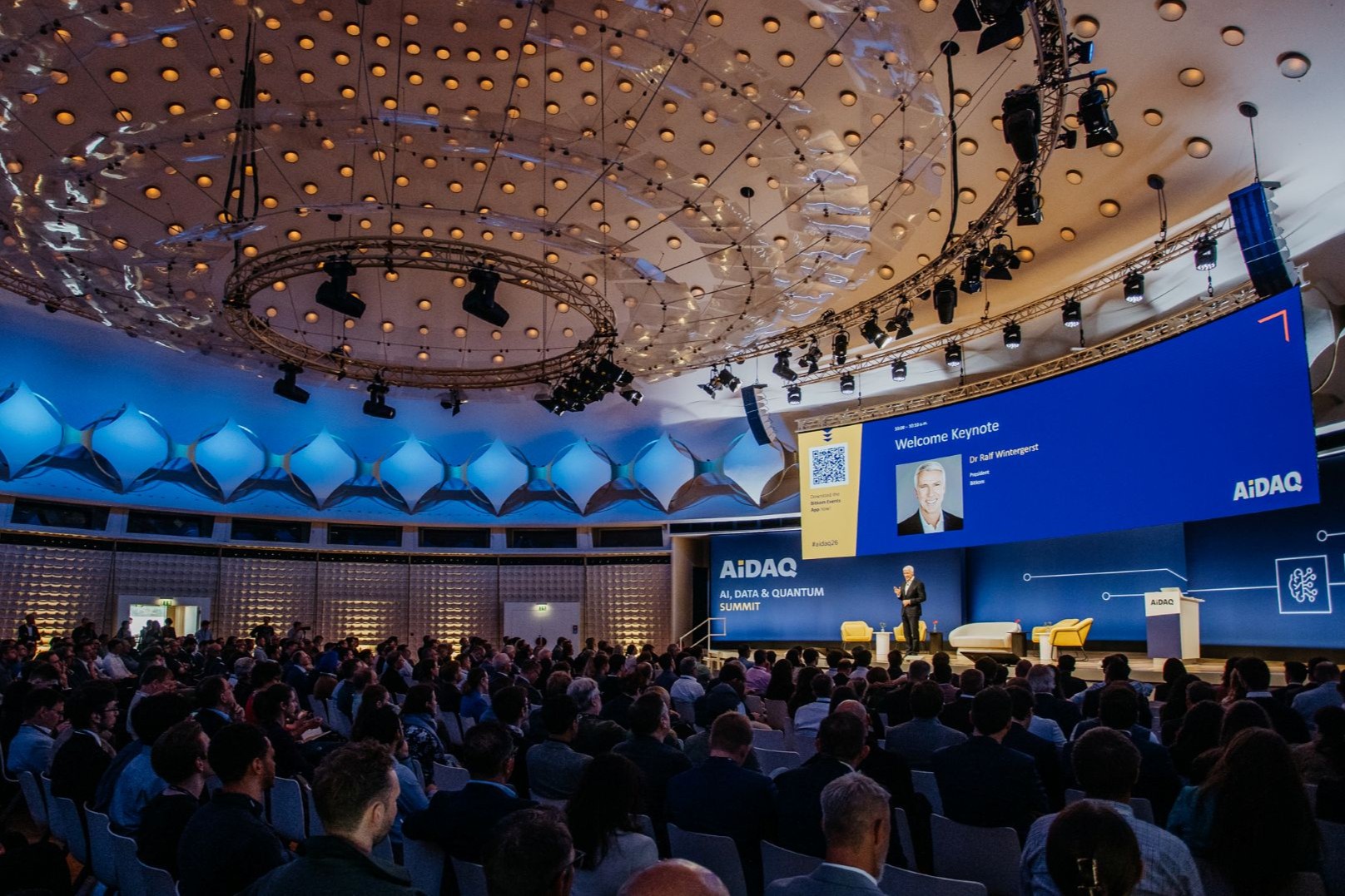

The Quantum Insider joined more than 2,500 participants in Berlin for Bitkom’s AI, Data & Quantum Summit, where AI kept turning up inside quantum.
Berlin became the meeting point for Europe’s AI and quantum communities on 22 and 23 September, when Bitkom’s AI, Data & Quantum Summit (AIDAQ) returned to the bcc Berlin Congress Center. The 2026 edition brought together more than 2,500 participants, 220 speakers and 140 sessions across four stages, workshops, masterclasses and startup pitches, under the patronage of Germany’s Federal Ministry of Research, Technology and Space.
The organisers framed both days around one question: how can technological potential be turned into real economic and societal impact? We were pleasantly surprised that quantum’s answer to that question came up in more sessions, and from more kinds of organisations, than we expected.
AI is already doing work for quantum
The biggest surprise of the summit was how much of the quantum progress on show depended on AI. “AI & Quantum Synergies” was the most common session label on the day-one programme, and the theme kept returning to the stage. NVIDIA’s Dr Kevin Mato spoke on scaling quantum computing with AI supercomputing, in a fault-tolerance block alongside Quantinuum and Leibniz University Hannover, while Leibniz-Rechenzentrum covered telemetry for running quantum systems inside HPC centres.

Security was where the overlap felt most urgent. Bundesdruckerei’s Dr Wadim Wormsbecher presented work on AI swarms that halved the quantum resources needed to break ECDSA, which brings Q-Day closer and leaves post-quantum migration plans less wiggle room. Google’s Dr Thomas Pöppelmann and evolutionQ CEO Dr Michele Mosca followed on post-quantum cryptography and cryptographic resilience.
Germany’s quantum ecosystem showed its depth
German organisations covered the full quantum stack in Berlin. Research came from Forschungszentrum Jülich, DLR and three Fraunhofer institutes; hardware and enabling technology from IQM, eleQtron, planqc, neQxt and kiutra; software and services from Kipu Quantum and d-fine. IQM was a premium partner, and neQxt was one of four startups in the Deep Tech Pitch run by Get Started by Bitkom.
Policymakers want that breadth to hold. Dr Alexandra-Gwyn Paetz, who heads the BMFTR’s department for technological sovereignty and innovation, put a day-one theme plainly: “We want to see a strong ecosystem, not just individual companies.” IQM’s Claudia Nemat and Manousos Markoutsakis spoke on turning technical capability into applications and resilient infrastructure, and Deutsche Telekom’s Lars Neumann described sovereignty on day two as keeping the freedom to choose through competence, architecture and control.
Quantum is reaching every kind of organisation
The use-case sessions showed how wide the quantum user base has become. Deutsche Bundesbank’s innovation team presented its quantum technology work. Lufthansa Industry Solutions and BMW discussed starting a quantum programme inside a large organisation, Airbus and Fraunhofer IKS presented a hybrid quantum-classical aircraft production case, and TRUMPF, E.ON, SAP and DLR covered manufacturing, energy, logistics and climate modelling.
The German government brought its own view, with the Federal Ministry of Defence and the Federal Office for Information Security (BSI) both on the programme. At the early-stage end, QUSMOS and QANAT Technology presented in the Get Started AI & Quantum showcase, and QOODA, Tentris and neQxt pitched alongside yasp, which won the AIDAQ 2026 Deep Tech Pitch.
It wasn’t all sunshine and rainbows – the programme left room for scepticism. A panel on moving from toy problems to industrial value, Accenture’s Mats Falck on why quantum’s first dividend may be classical, and neQxt’s Sascha Heußen with a talk titled “Quantum Computers Are Useless” all tested how far the technology has come.
See you in 2027
AIDAQ returns to the bcc Berlin on 21 and 22 September 2027, after growing from about 2,135 participants in 2025 to more than 2,500 this year. The Quantum Insider will be back to report on how far the AI and quantum work presented in Berlin has moved by then.
Visit aidaq.berlin for the 2026 review and next year’s programme. Learn more about The Quantum Insider at thequantuminsider.com.