

Insider Brief
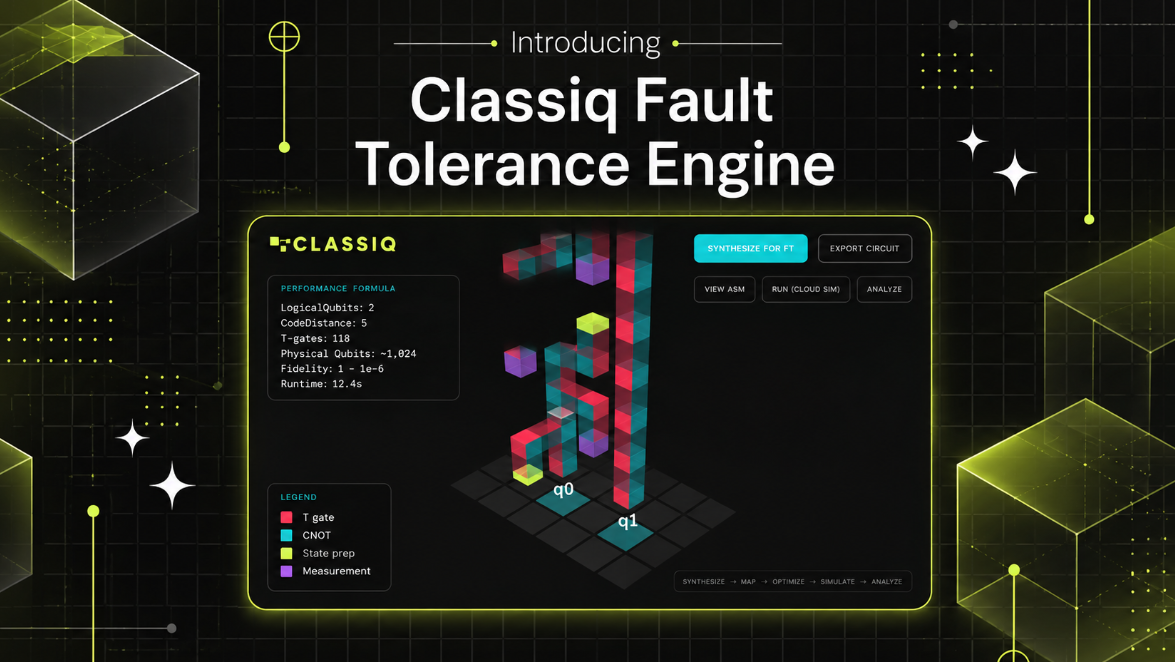
- Classiq introduced its Fault Tolerance Engine to translate optimized logical quantum programs into architecture-aware fault-tolerant execution plans.
- The engine estimates physical qubit requirements, error-correction cycles, code distance, runtime, routing, scheduling, and accumulated error from the execution plan it generates.
- The capability extends Classiq’s existing modeling and synthesis workflow to help users assess the physical feasibility and resource requirements of quantum applications on specific hardware.
PRESS RELEASE — Classiq today announced its Fault Tolerance Engine, a new product capability that translates optimized logical quantum programs into fault-tolerant execution plans, and measures from those same plans the physical resources and reliability required to run the application on a real machine.
Fault-tolerant quantum computing introduces a fundamentally different software challenge. A logical quantum operation cannot simply be passed directly to hardware. It may need to be implemented across many physical qubits, protected through repeated quantum error-correction cycles, and coordinated with layout, routing, scheduling, classical feedback and specialized resources.
Classiq’s Fault Tolerance Engine performs that translation. It carries the logical quantum program built in Classiq’s high-level modeling and synthesis environment through to a concrete fault-tolerant implementation: how the protected qubits are laid out, how their interactions are routed, and the schedule that runs them.

The engine can produce an architecture-aware execution plan and resource estimates covering factors including physical qubit requirements, error-correction cycles, code distance, runtime, routing, scheduling, and accumulated error. It can also account for particularly expensive fault-tolerant operations, including T gates and the magic-state resources commonly required to implement them. Because these figures are measured from the plan the engine actually produced, rather than calculated from formulas, they describe the implementation a machine would run.
This allows users to move beyond asking whether an algorithm is logically correct or whether a circuit can be optimized. They can begin asking whether a target application is physically implementable on a specific machine, based on that machine’s measured noise characteristics, which resources dominate its cost, and what would need to be improved to make the application practical.
“Fault tolerance changes the question quantum software has to answer,” said Nir Minerbi, co-founder and CEO of Classiq. “It is no longer enough to create an efficient logical circuit. You need to understand what that program becomes when every logical operation has to be protected, routed, scheduled and realized using physical hardware. Our Fault Tolerance Engine extends the Classiq approach into that layer, so users can work from the application they want to build all the way toward understanding what it will take to implement it reliably.”
Optimizing Before Physical Costs Multiply
Classiq’s model-first approach is particularly important in fault-tolerant computing because the most efficient logical circuit is not necessarily the most efficient fault-tolerant implementation.
Physical cost can depend on factors including T-gate requirements, routing, parallelism, code distance and the amount of fault-tolerant infrastructure needed to support a computation. Choices that appear similar at the logical level can therefore produce very different requirements once mapped to a protected physical architecture.
Classiq begins earlier in the development process. Users describe algorithmic intent in Qmod, Classiq’s high-level quantum programming language, and the synthesis engine determines an optimized logical implementation under the relevant constraints. The Fault Tolerance Engine extends that workflow by translating the logical program into the requirements of fault-tolerant execution.
The engine’s routing is an optimization that decides how protected qubits are laid out and how their interactions are routed so the implementation uses as few physical qubits as possible, which is usually the largest single cost in a fault-tolerant computation.
That architecture creates a path to evaluating implementation choices before their cost is multiplied across potentially large numbers of physical qubits and error-correction cycles.
For Classiq users, the result is a broader development workflow. The platform can support not only the design and optimization of quantum algorithms, but also the study of their physical feasibility. Reducing what a workload requires, and predicting it realistically, is what moves a first useful fault-tolerant run earlier in the roadmap.
From Resource Estimates to Implementability
The Fault Tolerance Engine goes beyond resource estimation alone: it both analyzes the requirements of a fault-tolerant computation and generates an architecture-aware execution plan for carrying it out on the target hardware.
A fault-tolerant computation is both a spatial and temporal problem. Protected logical qubits must be positioned, interactions must be routed, error-correction procedures must run continuously, costly auxiliary resources must be available when needed, and the full computation must meet a target reliability level.
By bringing these factors together, the Fault Tolerance Engine can help users examine questions such as:
- How many physical qubits could an application require?
- How many error-correction cycles are needed?
- What runtime could the resulting fault-tolerant computation require?
- Which operations or resources represent the main bottleneck?
- How do layout, routing and scheduling affect the performance?
- What level of protection is needed to reach a target failure probability?
- Which aspects of the hardware or software would need to improve for the workload to become practical?
These capabilities are relevant to application developers evaluating future quantum workloads, enterprises planning quantum programs, and research organizations comparing algorithms and architectures. They matter equally to hardware teams: a complete fault-tolerant execution plan tied to a specific machine gives a software vendor and a hardware builder the same concrete artifact to work against when planning a joint roadmap.
“Fault-tolerant computing makes the software stack more important, not less,” Minerbi said. “The gap between an algorithm and its physical realization becomes much larger once quantum error correction is introduced. Our goal is to give users a way to reason across that gap, while continuing to work at the high level of abstraction where meaningful applications can actually be designed.”
The Fault Tolerance Engine extends Classiq’s existing architecture rather than creating a separate development environment for fault-tolerant computing. Classiq’s platform already separates application intent from low-level implementation, allowing its synthesis technology to explore implementation alternatives and optimize quantum programs under hardware and resource constraints.
By extending that approach into fault-tolerant compilation and execution planning, Classiq is broadening the platform from designing hardware-ready quantum circuits to producing fault-tolerant implementations and the resource and reliability picture that comes with them.