

Insider Brief
- KIST led four South Korean quantum startups at Quantum World Congress 2026, facilitating discussions with U.S. companies, research institutions and investors.
- The delegation explored potential collaborations with D-Wave, Microsoft, Japan’s Q-STAR and AIST, including access to quantum computing systems and enterprise partnerships.
- OptiQ-Labs plans to establish a U.S. East Coast office in November, becoming the first quantum startup supported through the Deeptech Incubator Project to establish a physical presence in the eastern United States.
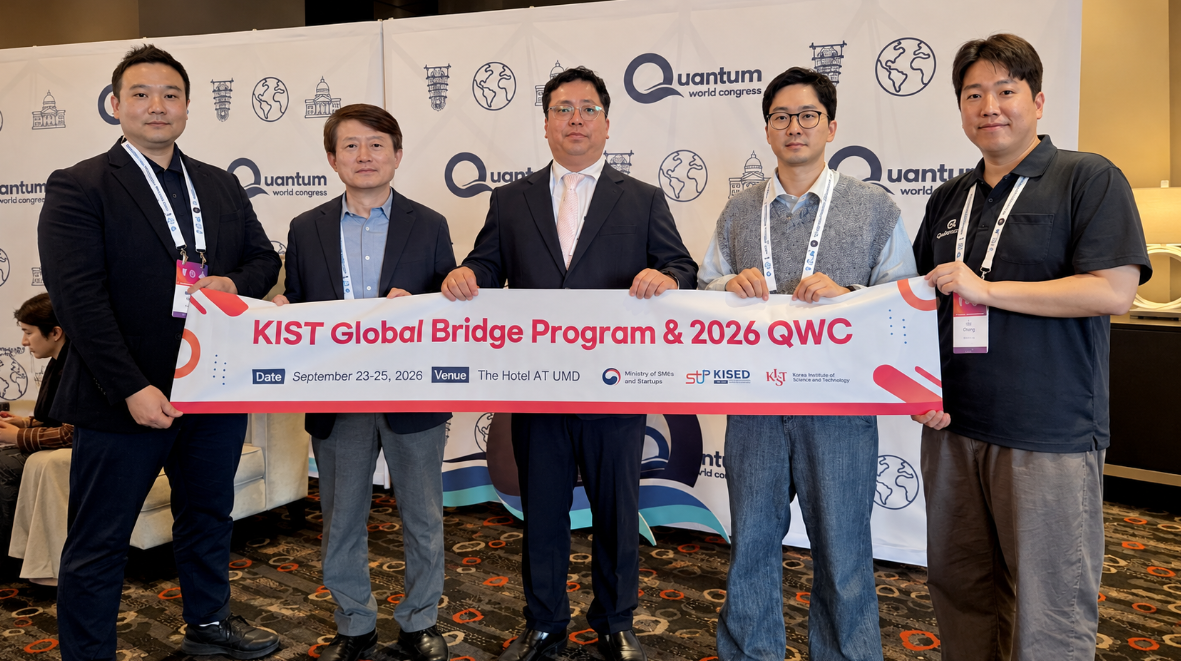
PRESS RELEASE — The Korea Institute of Science and Technology (KIST) has successfully led a delegation of South Korean quantum deep-tech startups at Quantum World Congress (QWC) 2026, establishing key international partnerships and expanding their footprint into the U.S. market.
Serving as the lead organization for the quantum technology sector under South Korea‘s Deeptech Incubator Project for Startups—overseen by the Ministry of SMEs and Startups and administered by the Korea Institute of Startup & Entrepreneurship Development—KIST spearheaded the initiative through its Global Bridge Program. The program connects Korean startups with overseas research institutions, enterprise partners, and investors to drive global commercialization beyond initial technology development.
For this U.S. program, KIST jointly planned and implemented the Global Bridge Program with the U.S. Embassy in Korea, supporting Korean quantum technology startups in connecting with overseas research institutions, enterprise partners, and investors.

During the event, KIST and participating startups initiated strategic discussions to utilize D-Wave‘s quantum computing systems, providing Korean startups direct access to advanced quantum infrastructure for technology development and practical application testing. KIST also met with Japan’s Q-STAR and the National Institute of Advanced Industrial Science and Technology (AIST) to explore opportunities that strengthen bilateral connections between the Korean and Japanese quantum technology ecosystems.
To further expand international corporate connections, KIST facilitated exchanges between Microsoft and startups in the Deeptech Incubator Project to build long-term enterprise collaboration opportunities. These efforts delivered immediate market access outcomes, with participating startup OptiQ-Labs finalizing plans to establish a U.S. East Coast office in November. OptiQ-Labs becomes the first quantum startup supported through the Deeptech Incubator Project to establish a physical regional presence in the eastern United States.
Dr. Kang Sunjoon, Director of KIST’s Technology Commercialization Office and head of the Deeptech Incubator Project, emphasized the importance of turning international connections into sustained partnerships and commercialization opportunities for Korean quantum startups.
“International engagement needs to go beyond individual events and lead to continued collaboration with overseas research institutions, companies and investors,” Kang said. “Building on the connections established through QWC 2026, KIST will continue to support Korean quantum startups in developing technology partnerships, expanding into global markets and creating concrete commercialization opportunities.”
KIST will continue to build on the follow-up partnerships established at QWC 2026, systematically integrating Korean quantum technologies into global research, industrial, and investment networks.
Participating startups at QWC 2026
- OptiQ-Labs: Develops optical hardware for quantum technologies, drawing on over a decade of research in isotope-selective laser spectroscopy, resonance ionization, laser cooling and trapped-ion spectroscopy. Its technologies include ultra-narrow-linewidth laser systems, laser stabilization and ion-trap systems, with the goal of delivering complete ion-trap quantum computer hardware.
- xDots: Develops diamond quantum sensing solutions for industrial energy efficiency. Its xEnergy platform combines room-temperature diamond NV-center sensors with AI and IoT to optimize equipment operation in real time.
- Bright Quantum: Develops on-demand single-photon sources for photonic quantum computing and communication, including commercially available high-end quantum-dot sources and ultra-compact room-temperature systems operating without cryogenics.
- SQK: Develops QMEDIC, a medical imaging platform combining quantum technologies and physics-guided AI to improve low-dose CT image quality while preserving critical anatomical structures.
SOURCE The Korea Institute of Science and Technology (KIST)