

Insider Brief
- Stony Brook University hosted a congressional briefing on September 16 focused on U.S. quantum research, innovation and workforce development.
- The event brought together researchers from Stony Brook, Brookhaven National Laboratory, the Department of Energy, the University of Missouri and Ohio State University for discussions on quantum science and workforce needs.
- The briefing also highlighted Stony Brook’s proposed $4.2 million FY27 federal funding for its Quantum Grid Resilience Initiative and its broader engagement with federal policymakers.
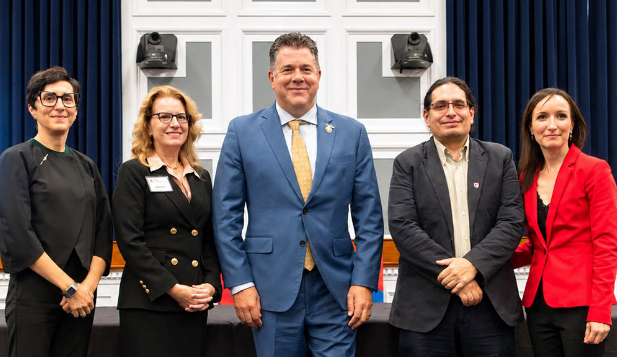
PRESS RELEASE — Stony Brook University brought its leadership in quantum science and education to Capitol Hill on September 16, convening members of Congress, senior federal science officials and researchers from across the country for “Winning the Quantum Race: Workforce, Research and Innovation,” a congressional briefing focused on what it will take to sustain U.S. leadership in quantum science and technology.
In partnership with U.S. Representatives Nick LaLota (NY-01) and Mark Alford (MO-04), the briefing brought together experts from Stony Brook University, Brookhaven National Laboratory (BNL), the U.S. Department of Energy (DOE), the University of Missouri and The Ohio State University, for two panel discussions examining both the scientific promise of quantum technology and the research, infrastructure and workforce needed to turn that promise into American innovation.
“Quantum science and technology have the potential to transform fields ranging from communications and computing to national security, but realizing that potential will require sustained investment and collaboration,” said Mónica Bugallo, interim vice president for research and innovation at Stony Brook University, who opened the briefing. “Stony Brook has an important role to play, not only through the groundbreaking research of our faculty, but by educating the scientists, engineers and skilled professionals who will help build the quantum economy. Bringing together universities, national laboratories, industry, federal leaders and policymakers is exactly the kind of partnership we need to ensure the United States continues to lead in this critical area.”

The program featured remarks from LaLota and Alford, as well as participation from Harriet Kung, deputy director for science programs for the DOE’s Office of Science. Having a senior DOE official participate brought an important federal perspective to the discussion and helped connect the scientific and workforce conversations directly to the federal government’s role in advancing U.S. quantum research and innovation.
From Quantum Science to a Quantum Internet
The first panel, “The Science of Quantum,” explored how quantum information science has developed, why it matters to the American public and what emerging quantum technologies could mean for the country’s economic and national security.
Moderated by Lauren Brookmeyer, associate vice president for federal relations and head of Stony Brook University’s Washington, D.C. office, the panel featured Eden Figueroa, professor of physics and director of the Stony Brook Quantum Institute; Wenchao Ge, associate professor and lead of the Quantum Engineering Research Group at the University of Missouri; Ronald Reano, co-director and professor in the Department of Electrical and Computer Engineering at The Ohio State University; and Gabriella Carini, associate laboratory director of Brookhaven National Laboratory’s Discovery Technologies Directorate.
The conversation examined where quantum information is already beginning to have an impact, why continued federal investment is important, and where the United States leads, and faces growing international competition, in quantum science.
A major focus of this panel was the development of a quantum internet. Figueroa and his fellow panelists discussed the scientific and technological advances still needed to move quantum networking from research testbeds toward a larger interconnected network, as well as the high-stakes problems such a network could help address in the future. The discussion also emphasized the importance of connecting quantum testbeds and expertise across universities, national laboratories and states to build a truly national quantum ecosystem.
That collaborative model is particularly relevant to Stony Brook, where the University’s quantum research enterprise benefits from its longstanding partnership with BNL and from a growing network of academic, government and industry partnerships.

Building the Workforce Behind the Science
The second panel, “Building the Quantum Workforce,” shifted the conversation from scientific discovery to the people who will be needed to build, operate and grow the emerging quantum industry.
Moderated by Marisa Chrysochoou, dean and Ketcham Professor of the College of Engineering at the University of Missouri, the panel featured Angela Kelly, professor of physics and STEM education at Stony Brook; Chi-Ren Shyu, professor and director of the University of Missouri Institute for Data Science and Informatics; Ezekiel “Zeke” Johnston-Halperin, co-director and professor in the Department of Physics at The Ohio State University; and Kung.
Panelists addressed a common misconception surrounding the quantum workforce: that participation in the field is limited to scientists with highly specialized advanced degrees. Instead, the emerging quantum economy will depend on workers with a range of educational backgrounds, skills and training.
Kelly and Johnston-Halperin discussed programs developed at Stony Brook and Ohio State to prepare the next generation of the quantum workforce, while the broader panel examined how universities can keep education and training aligned with evolving employer needs.
The discussion also considered what is required to create sustainable regional quantum ecosystems that attract companies, retain jobs and give graduates opportunities to build long-term careers, as well as federal actions that could help strengthen and expand the quantum workforce nationwide.
Connecting Research with Federal Policymakers
For LaLota, whose congressional district includes Stony Brook University, the briefing built upon his support for the university’s growing quantum research enterprise. The House FY27 appropriations legislation includes $4.2 million in Community Project Funding for Stony Brook’s Quantum Grid Resilience Initiative, following a request submitted by LaLota. If enacted, the funding would support the University’s work at the intersection of quantum technology and grid resilience.
“Stony Brook University is helping put Long Island at the forefront of quantum technology, and I’m working to provide the resources needed to advance that important work. That includes the $4.2 million I secured for Stony Brook’s Quantum Grid Resilience Initiative in the House’s FY27 Commerce, Justice, and Science Appropriations bill. I’ll keep fighting to see that funding through the final process because investments in quantum research strengthen U.S. innovation, bolster our national security, and help us compete globally. Hearing directly from scientists and researchers helps inform the decisions we make and the investments needed to keep the United States leading,” LaLota said.
The proposed funding builds on previous federal support secured by Senator Chuck Schumer, who provided $1M in Congressionally Directed Spending for Stony Brook’s quantum research, underscoring the strong bipartisan support for the University’s work and the growing recognition in Congress of SBU’s important role in advancing U.S. leadership in quantum science and technology.
The briefing also reflected Stony Brook’s broader strategy of bringing the expertise of its researchers directly to Washington and establishing the University and its faculty as resources for policymakers confronting complex scientific and technological issues. The event was developed and executed through a close partnership between Stony Brook’s Office for Research and Innovation and the Office of Federal Relations, bringing together research strategy, scientific expertise and federal engagement to create a substantive forum for congressional engagement.
With significant follow-up opportunities emerging from the briefing, including continued engagement with federal science leaders, the event marked another step in strengthening Stony Brook’s federal engagement and connecting the University’s research strengths with national research and technology priorities.