

Insider Brief
- Microsoft opened a 15,000-square-foot quantum research center at the University of Maryland that will support hardware research, partner integration, workforce training and government collaboration.
- The center will give DARPA on-site access to Microsoft’s latest topological quantum system, including qubits built on its Majorana 2 chip, for independent testing under the agency’s utility-scale quantum program.
- Microsoft is also launching a quantum hardware makerspace, annual measurement-based computing workshops and UMD postdoctoral funding, with partners including AMD, Intel, IQM, Fermilab, Riverlane and Quantum Motion.
Microsoft has opened a quantum research center in Maryland that will house one of its topological quantum systems for independent testing by the Defense Advanced Research Projects Agency, widening the government’s role in evaluating the company’s path toward large-scale quantum computers.
The 15,000-square-foot center, located in the University of Maryland’s Discovery District, combines Microsoft’s proprietary research space with laboratories for partner companies, a DARPA testing area and a hands-on training lab. Microsoft reports in a company blog post that the project was developed with the university, the state-backed Capital of Quantum Initiative and other industry partners.
The center gives DARPA on-site access to Microsoft’s latest topological quantum system, including qubits built on the company’s Majorana 2 chip, which based on an approach that has drawn close attention because it relies on an emerging class of quantum devices designed to be more error resistant.

DARPA will have full access to the system as part of its evaluation work under the Underexplored Systems for Utility-Scale Quantum Computing program, according to the post that was written by Dr. Charles Tahan, Partner, Microsoft Quantum. That program is part of DARPA’s broader Quantum Benchmarking Initiative, which seeks to determine whether competing quantum-computing approaches can produce commercially useful machines by 2033.
Microsoft is among the companies that have advanced to the final stage of the utility-scale program, according to the company. The evaluation effort also includes the Air Force Research Laboratory, Johns Hopkins University Applied Physics Laboratory and national laboratories including Los Alamos, Oak Ridge, Lawrence Berkeley and Lawrence Livermore.
The Maryland center adds physical infrastructure to a partnership that Microsoft announced a year ago. With support from Maryland Gov. Wes Moore’s Capital of Quantum Initiative, the state acquired and renovated the Discovery Center, while Microsoft, UMD and the initiative designed the quantum facility within it.
Microsoft said the center will support research, partner integration, workforce training and government engagement. It will also provide space for future prototypes and for companies seeking to connect quantum hardware or components to Microsoft’s software platform.
A Test for Topological Qubits
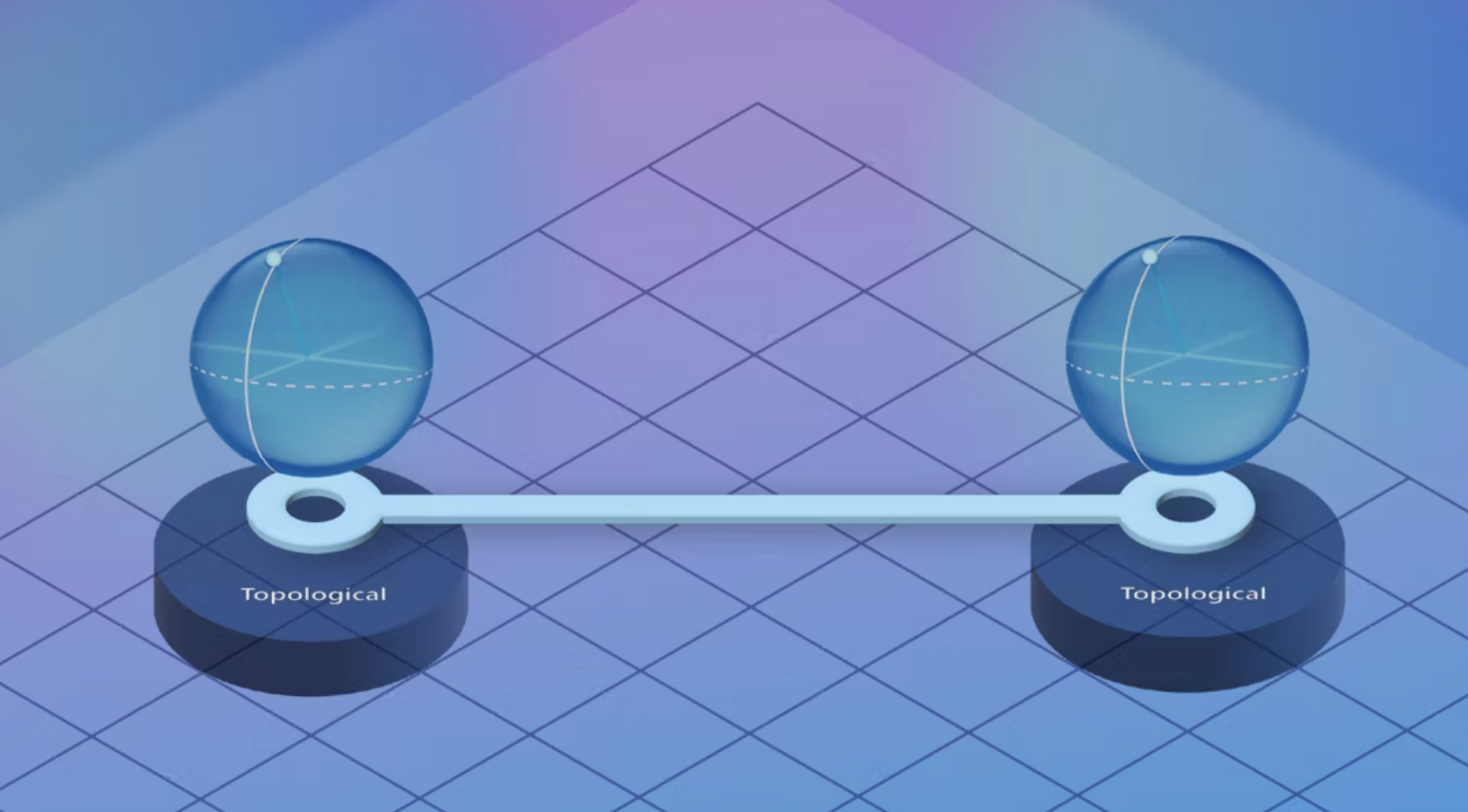
Microsoft’s system uses topological qubits, an approach intended to reduce the burden of quantum error correction. Quantum computers are highly sensitive to environmental noise and operational imperfections, meaning useful systems will need to detect and correct errors repeatedly while calculations are underway.
The company introduced Majorana 2 as its second-generation topological quantum chip. Microsoft said the chip uses a new material stack that replaces aluminum with lead, a change it said improves performance. The system has drawn criticism from some in the scientific community who were skeptical of the claims.
However, the delivery to DARPA may help address those criticisms by opening the company’s hardware to an outside testing team with expertise across hardware, control systems, software and applications. Microsoft said independent access is a necessary step in assessing whether its approach can lead to an economically relevant quantum computer.
The company has described its goal as building systems capable of handling useful workloads beyond the reach of conventional computers. That remains challenging as quantum processors have advanced rapidly in recent years, but the field has yet to demonstrate a broadly useful, fault-tolerant machine that can consistently outperform classical systems on commercially important work.
Microsoft’s Maryland facility will also serve as a location where prospective partners can test how their technologies work with the company’s broader quantum platform. Hardware builders could use the space to integrate machines or components, while developers and end users could explore potential applications, Microsoft said.
The company’s strategy is built around supporting multiple quantum hardware types through a common software and infrastructure layer, rather than tying its platform solely to its own topological-qubit program.
Training With Hardware
A central feature of the new center will be a quantum hardware makerspace intended to give students, researchers, educators and people transitioning from other technical fields a chance to work directly with equipment.
Microsoft said initial partners include AMD, Bluefors, Intel, IQM, Fermi National Accelerator Laboratory, Riverlane and Quantum Motion. Their contributions are expected to provide access to hardware as well as technical expertise.
The company said the program differs from quantum education efforts centered mainly on theory or software. Instead, participants will be expected to work through practical problems across the quantum hardware stack, including selecting designs, deciding what to measure and diagnosing unexpected experimental results.
Microsoft is also working with Fermilab to expand the use of quantum-control technologies across hardware platforms. With UMD, the partners are exploring how Fermilab’s Quantum Instrumentation Control Kit, known as QICK, could be used in education.
The effort reflects a growing industry concern that quantum computing will require a larger workforce able to work across physics, engineering, electronics, controls and software. Many quantum systems depend on specialized equipment, including cryogenic hardware, lasers, control electronics and complex calibration routines.
Microsoft said it hopes the Maryland makerspace will become a model that can be expanded more broadly as lessons and course material emerge from the program.
Measurement-Based Computing Focus
The center will also support research in measurement-based quantum computing, an approach in which measurement results help determine subsequent operations in a quantum calculation.
Microsoft said it plans to launch an annual workshop series focused on improving the speed and accuracy of measurements, developing error-correcting codes and advancing verification and validation methods. The company is also funding its first quantum postdoctoral positions at UMD in research areas of mutual interest to Microsoft and university faculty.
Fast, accurate measurements are particularly important in error-corrected quantum computers because the system must identify errors and decide how to respond quickly enough to prevent them from spreading through a calculation.
Microsoft said its Azure-based quantum platform includes developer tools, a real-time operating system for quantum computers and support for different qubit technologies. It also pointed to its work with Atom Computing, which is applying Microsoft’s error-correction technology to neutral-atom hardware.
The companies are developing a machine called Magne, planned to have 50 logical qubits and scheduled for operation at QuNorth in Denmark by early 2027, Microsoft said. Logical qubits are groups of physical qubits combined through error correction to produce a more stable computational unit.
Microsoft also said its Quantum Development Kit now includes a private-preview analytics library with algorithms and data-science tools intended for advanced analytics and large-scale data analysis.



.png)