
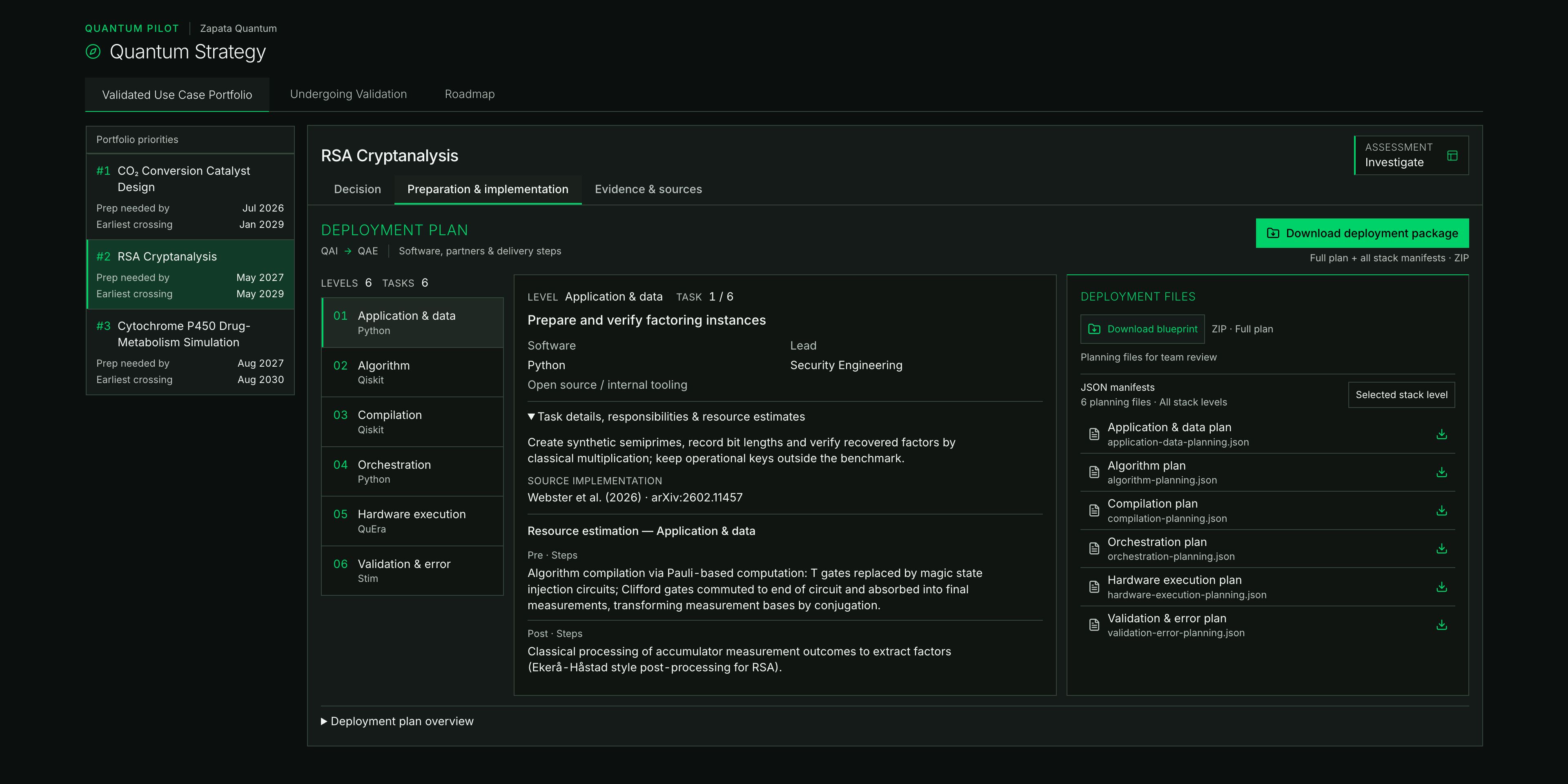


Insider Brief
- Zapata Quantum has launched early access to Quantum Pilot, a cloud-based platform intended to help enterprises identify, assess and prioritize quantum-computing applications without committing to a single hardware provider.
- The platform combines a proprietary knowledge framework, AI-assisted resource estimation, algorithm selection, experiment design, hardware benchmarking and formal verification methods to evaluate technical and commercial readiness.
- Quantum Pilot will initially be offered to select enterprise and government customers, with Zapata positioning it as a way to keep application roadmaps current as quantum hardware, software and research develop.
PRESS RELEASE — Zapata Quantum, Inc. (OTCQB: ZPTA) (“Zapata,” “Zapata Quantum” or the “Company”), a leader in quantum computing algorithm and application development, today announced early access to Quantum Pilot, a hardware-agnostic, cloud-based software platform designed to close a growing gap between rapidly advancing quantum hardware capabilities and enterprises’ ability to determine where and how quantum computing can create business value.
Quantum Pilot builds a dynamic roadmap for enterprises that want to deploy quantum technology but are uncertain which applications are relevant to their business and sector, when those solutions will be practical, and what they could be worth. It gives organizations a systematic way to discover potential applications, weigh their technical and commercial potential, and focus resources on the opportunities with the strongest case for investment. Enterprises can then identify and develop applications without betting on a single quantum modality or provider, and reassess application readiness or change their approach as hardware capabilities and algorithms evolve.
“The critical on-ramp to quantum application development is the efficient and rigorous mapping of use cases to quantum computational solutions,” said Sumit Kapur, CEO of Zapata Quantum. “We built Quantum Pilot to make that on-ramp more accessible to enterprise leaders and ensure that quantum activity becomes a capability that compounds—with each experiment and development effort informing and accelerating the next.”

Delivering Quantum Application Intelligence™
Drawing on Zapata’s experience developing quantum algorithms and applications across industries and hardware architectures, Quantum Pilot combines a proprietary knowledge framework with advanced computational tools, including capabilities developed through its collaboration with NVIDIA to apply agentic AI to quantum resource estimation. The platform also builds on Zapata’s collaboration with the University of Maryland on formal methods for quantum software verification.
Together, these capabilities enable Quantum Pilot to deliver Quantum Application Intelligence (QAI)—helping enterprises identify, evaluate and develop quantum applications with scientific rigor and a clear focus on business value. The platform also continuously tracks and updates the global quantum ecosystem’s research, hardware roadmaps and software developments so that application roadmaps are current as the field advances and users are making application decisions based on the latest data.
“Most conversations about quantum readiness focus on the hardware roadmap. That is not where the real risk sits. It sits one layer up, in the applications and software that decide whether the hardware ever produces business value,” said Mark Hill, Chief Digital Information Officer at CSL Behring, a multibillion-dollar global biotech leader, and Advisor to the Company. “Quantum Pilot matters because it forces the harder question enterprises keep avoiding: which applications are worth building now, not just which processor is fastest,”
Quantum Pilot is powered by three complementary systems:
- Quantum Graph, a proprietary knowledge layer that connects quantum applications, algorithms, research and hardware roadmaps, providing structured context for the platform and its AI agents as the field advances.
- Quantum Engine, a suite of computational tools and agents that supports algorithm selection, resource estimation, experiment design and hardware benchmarking, helping enterprises assess technical feasibility and guide application development.
- Quantum Assurance, a framework that combines formal verification methods with expert review to assess technical results and guide the development process, with Zapata’s scientists helping enterprises interpret evidence and determine next steps.
“Among the things that make Quantum Pilot’s approach to application development distinct is its use of formal verification, rather than after-the-fact validation alone,” said Runzhou Tao, Assistant Professor, University of Maryland, and Fellow, Joint Center for Quantum Information and Computer Science (QuICS). “That’s the same principle we apply in our research with Zapata on verified quantum software, and it addresses a discipline quantum computing has largely developed without.”
Early Access
Quantum Pilot is initially available through an early access program for select enterprise and government customers. Organizations interested in participating can request a demo and learn more at zapataquantum.com/quantumpilot