
Insider Brief
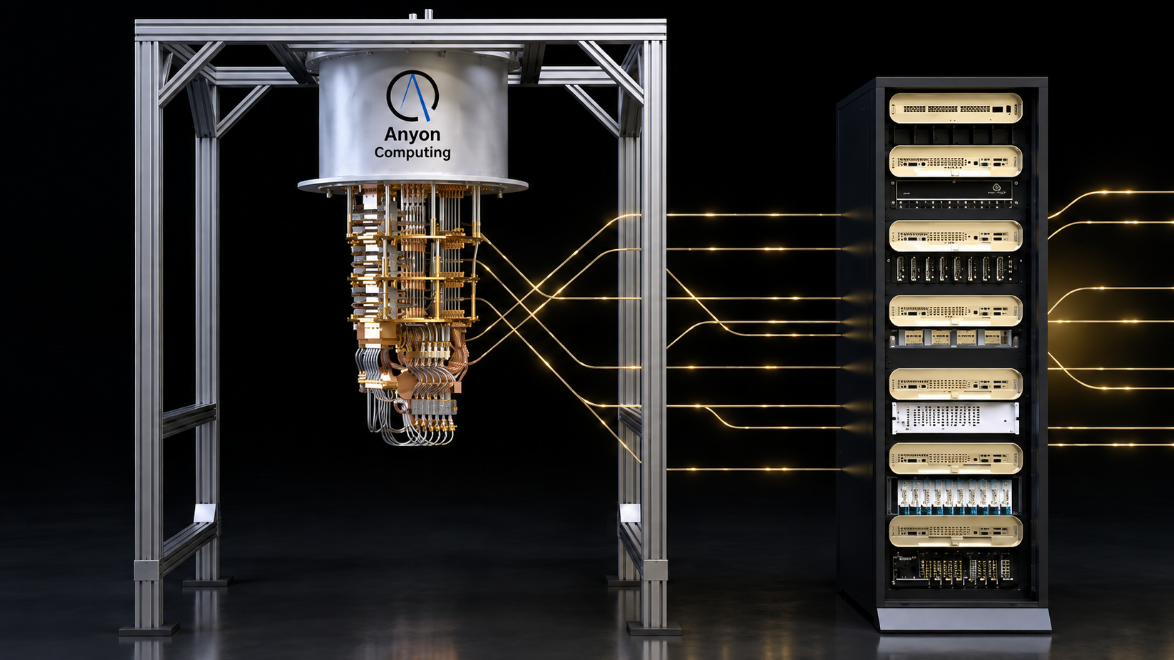
- Anyon Computing has unveiled an open-source real-time quantum control system built on NVIDIA NVQLink that integrates QPU control clusters with GPU and CPU compute nodes as co-processors within a shared supercomputing architecture.
- The system runs CUDA-Q, OpenQASM and QIR and is designed to support microsecond-scale quantum-classical loops for workloads including quantum error correction, calibration, readout classification and hybrid machine learning.
- Anyon says the control system was developed almost entirely by autonomous AI agents and verified through simulation and hardware-in-the-loop testing before production release.
PRESS RELEASE — The control cluster and the quantum processors it drives join GPU and CPU compute nodes as co-processors of a single quantum-GPU supercomputer with quantum-classical loops measured on hardware in microseconds. The system was developed almost entirely by autonomous AI agents.
Anyon Computing, which builds complete quantum supercomputers, today unveiled a new real-time quantum control system built on NVIDIA NVQLink. The system is designed natively so that Anyon’s microwave quantum control cluster, together with the quantum processors (QPUs) it drives, joins GPU and CPU compute nodes as co-processor nodes of a single supercomputing machine. It will be open-sourced and serve as the control plane of large-scale quantum computing inside future data centers.
In Anyon‘s architecture the quantum processor is not a peripheral attached to a classical computer. The QPU nodes’ control cluster, and the GPU and CPU nodes share one RDMA-over-Ethernet fabric and one programming model, so that error decoding, calibration, adaptive control, and hybrid AI-Quantum workflows can run across all of them as one machine. That is the shape large-scale, fault-tolerant quantum computing requires. The loop between measurement and action must close in microseconds, while the qubits are still coherent, and the compute that loop needs will not fit on one chip.

“A quantum supercomputer has to be one machine, not a quantum box bolted onto a classical one. We built this control system using NVIDIA NVQLink so that our control cluster and the quantum processors it drives are co-processor nodes next to the GPUs and CPUs, on the same fabric and in the same program. And we built it the way we intend to build everything from now on, with AI agents doing the engineering against real hardware.”
— Dr. Roger Luo, Co-Founder and CEO, Anyon Computing
Programmed with CUDA-Q Natively for Hybrid Quantum-Classical Tasks
The system runs NVIDIA CUDA-Q programs natively, alongside OpenQASM and QIR. An ordinary CUDA-Q hybrid program runs with its classical code on the real-time host’s CPU/GPU and its quantum calls in the same process, so adaptive quantum-classical loops run at millisecond-to-microsecond cadence without per-call recompilation. With this, the stack has demonstrated the capability to run quantum error correction workloads, adaptive calibration and characterization loops, machine-learning-based readout classification, and hybrid quantum-classical machine learning, including variational and reinforcement-learning training loops. Because the links to host nodes and to peer controllers share commodity RDMA-over-Ethernet, the control plane grows the way a data center does, from one node to many controllers and many GPU and CPU nodes on one switched fabric, with controllers phase-locked on a shared reference.
Engineered by AI agents, Verified on Hardware
The control system is also among the first sophisticated real-time FPGA systems developed almost entirely by autonomous AI agents to reach production release, and the first quantum control system built this way. Anyon‘s agents carried the design from register-transfer-level code through simulation, build, and hardware-in-the-loop verification with autonomous iterative improvements to deliver desired system features in a loop.
The new control system follows Anyon‘s first machine, already running inside a commercial AI data center with NVIDIA GPUs, pioneering NVQLink deployment inside a commercial production data center.
“Building useful quantum-GPU supercomputers is a heterogeneous systems challenge, as the performance of quantum processors depends on tightly coupled access to accelerated computing. Anyon Computing has shown how drawing on NVIDIA NVQLink provides the environment needed for large-scale quantum computing’s most critical workloads, such as calibration, control and error correction.”
— Sam Stanwyck, Director, Quantum Product, NVIDIA
Anyon will be at IEEE Quantum Week (QCE26) in Toronto, Sept. 13–18, 2026. To arrange a meeting, contact info@anyoncomputing.com.
Read NVIDIA‘s IEEE Quantum Week announcement: NVIDIA Expands Open-Source CUDA-Q Platform for Fault-Tolerant Quantum Computing.